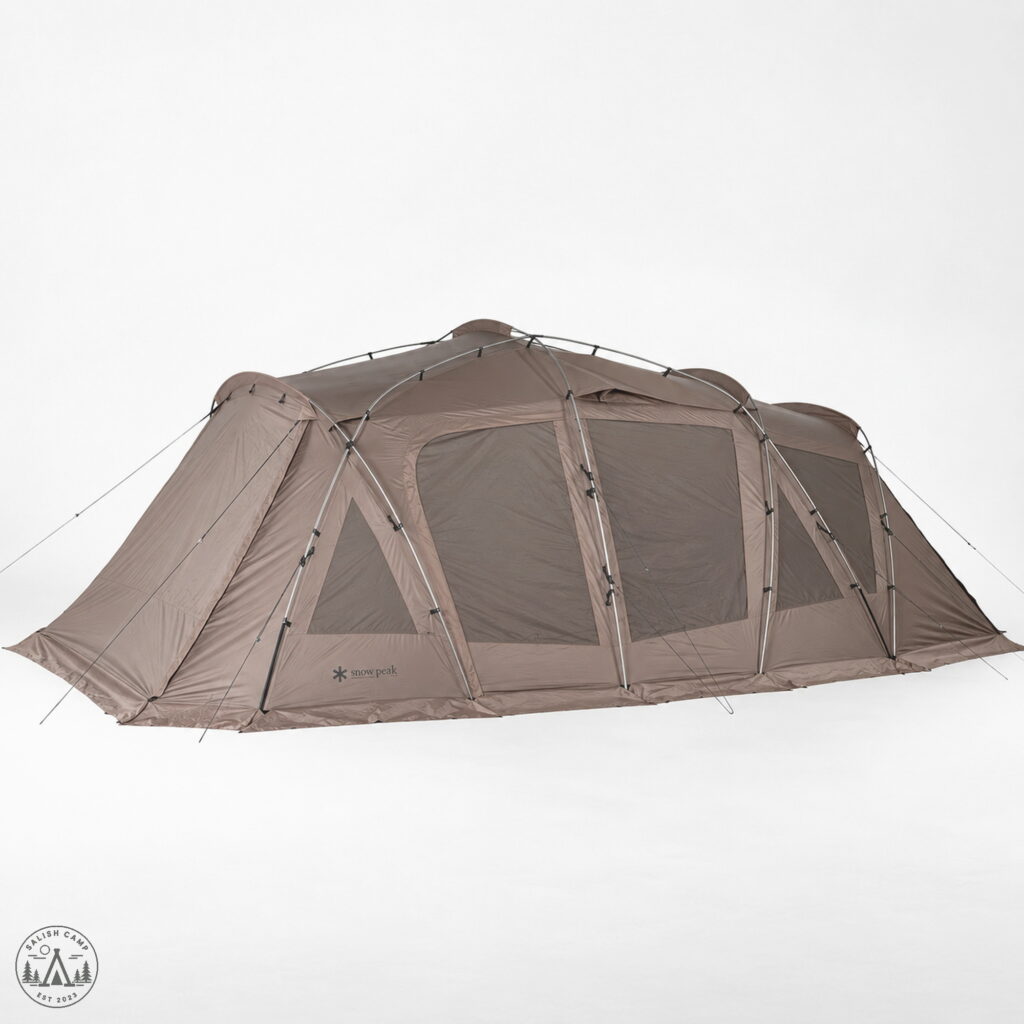
Buy if you already have a smaller tent for backpacking and short trips, but want a genuinely large two-room shelter for wet-weather car camping, family basecamp, or longer Cascade weekends. The Tortue Pro. 2026 Edition gives you a 19 ft × 11.8 ft footprint in use, a 6.9 ft overall height, a separate inner room, a shield roof, and the frame structure Snow Peak describes as having excellent wind resistance. For three or four people who actually intend to spend time inside camp rather than simply sleep there, that combination makes sense.
Skip if you want something light, inexpensive, or casual enough to throw in the car for an overnight. At $1,799.95 and 48.5 lb, FES-770 is a deliberate second-tent purchase. It also arrives as a substantial shelter system with multiple frame types, ropes, bags, an inner room, ground sheet, and shield roof. If your backpacking tent already covers most of your camping and you rarely establish a multi-day drive-in camp, this is far more shelter than you need.
What Stands Out
- This is specifically FES-770, the 2026 Edition. Snow Peak calls it an updated model of the original Tortue Pro and mentions minor improvements allowing easier setup, but does not specify those individual changes.
- The two-room format is the reason to buy it. At 19 ft long × 11.8 ft wide × 6.9 ft high in use, the shelter combines an inner sleeping room with a large covered living structure rather than functioning as a conventional sleeping tent.
- The inner room is still substantial. Its listed interior height is 5.3 ft, while the surrounding shelter reaches 6.9 ft overall.
- The shield roof is a separate included layer. It uses 75D silicone polyester ripstop with Snow Peak's Shield Pigment PU coating and a listed waterproof rating of 1,500 mm minimum.
- The lower materials change where abrasion and ground contact matter. The body skirt uses 210D polyester Oxford, while the included ground sheet uses 210D polyester Oxford with a 1,800 mm minimum waterproof rating.
- The frame package explains part of the 48.5 lb reality. FES-770 includes a ridge pole, two A frames, two C frames, two center frames, one tent frame, and two upright poles, all based around an A6061 frame specification.
- It is slightly more compact than the Land Lock according to Snow Peak. That is the useful extent of the comparison: Snow Peak does not provide Land Lock measurements on this Tortue Pro PDP, so I would not turn that statement into a made-up dimensional comparison.
In The Field
The first thing I would decide before buying the Tortue Pro. 2026 Edition is whether I actually want a basecamp shelter rather than merely a bigger tent. At 48.5 lb, this is not something I mentally put in the same category as the backpacking tent already sitting on my gear shelf. It belongs with the gear I take when I'm driving onto a wet gravel site, unloading deliberately, and expecting camp to stay assembled for the weekend.
That distinction makes the price and weight easier to evaluate. It does not make either disappear. $1,799.95 is serious money, and 48.5 lb is serious packed weight. But FES-770 is also doing considerably more than providing an enclosed place for three or four people to sleep.
The central feature is the two-room architecture. Snow Peak describes a high ceiling and open interior, and the published dimensions explain the scale: 19 ft long, 11.8 ft wide, and 6.9 ft high in use. The inner room itself has a listed 5.3 ft interior height.
For a novice looking at a shelter like this, "two-room" matters more than the marketing language around it. You are essentially buying a camp structure that separates sleeping space from a larger protected living zone. That changes how I would use a rainy PNW site. Instead of treating the tent as the place I crawl into at bedtime, I can establish an actual covered camp and leave the sleeping room as its own defined space.
That is particularly relevant around Seattle and the Cascades, where a weekend forecast can mean long stretches of damp weather rather than one dramatic storm. A high, open shelter gives me somewhere to organize the day when I do not want everyone confined to the sleeping compartment.
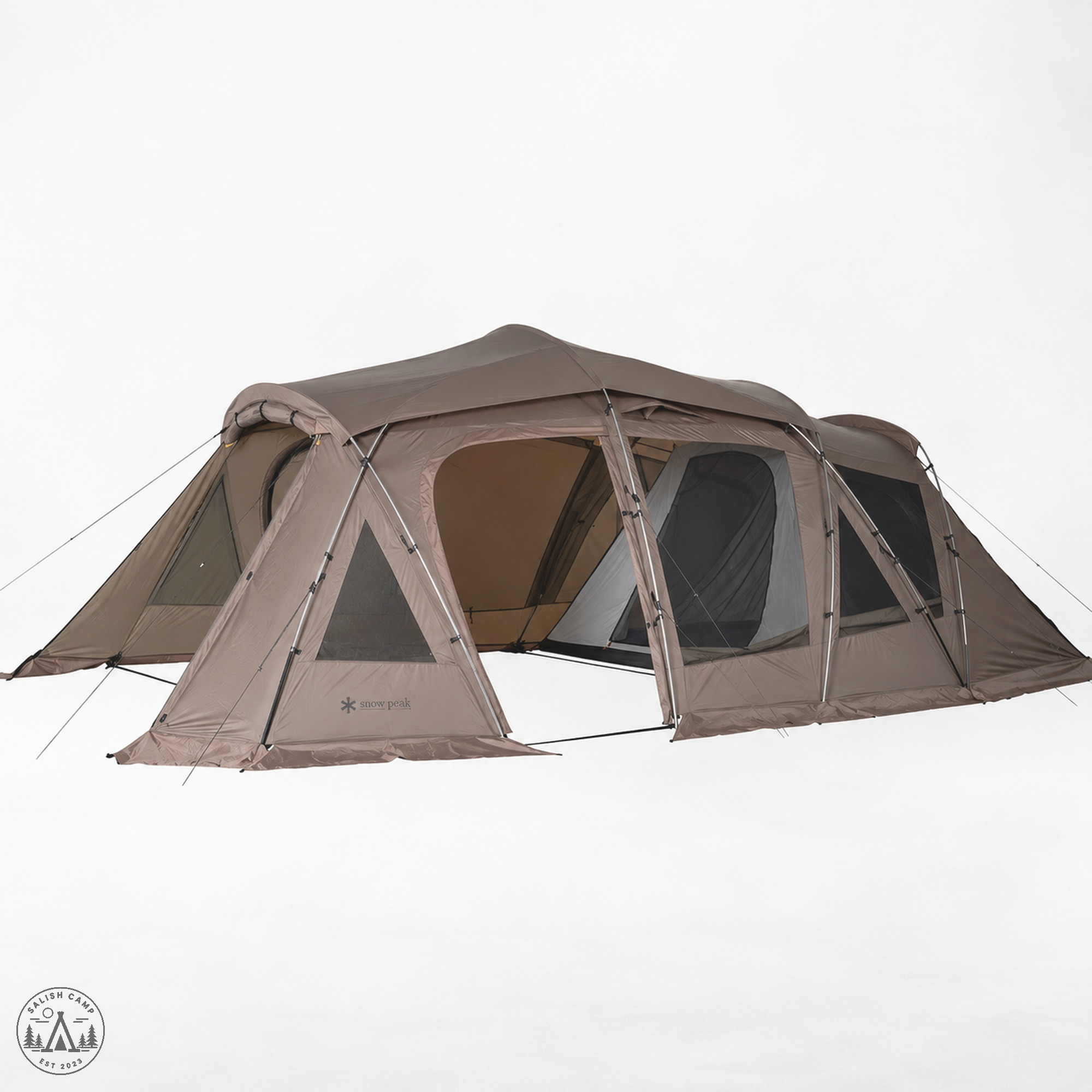
One studio view shows how that long side actually opens. A panel is held out on two poles beside the main doorway. I would not turn that still into a vestibule depth, a second fly, or a named colorway. The product page does not publish a separate vestibule depth, and it does not name a color.
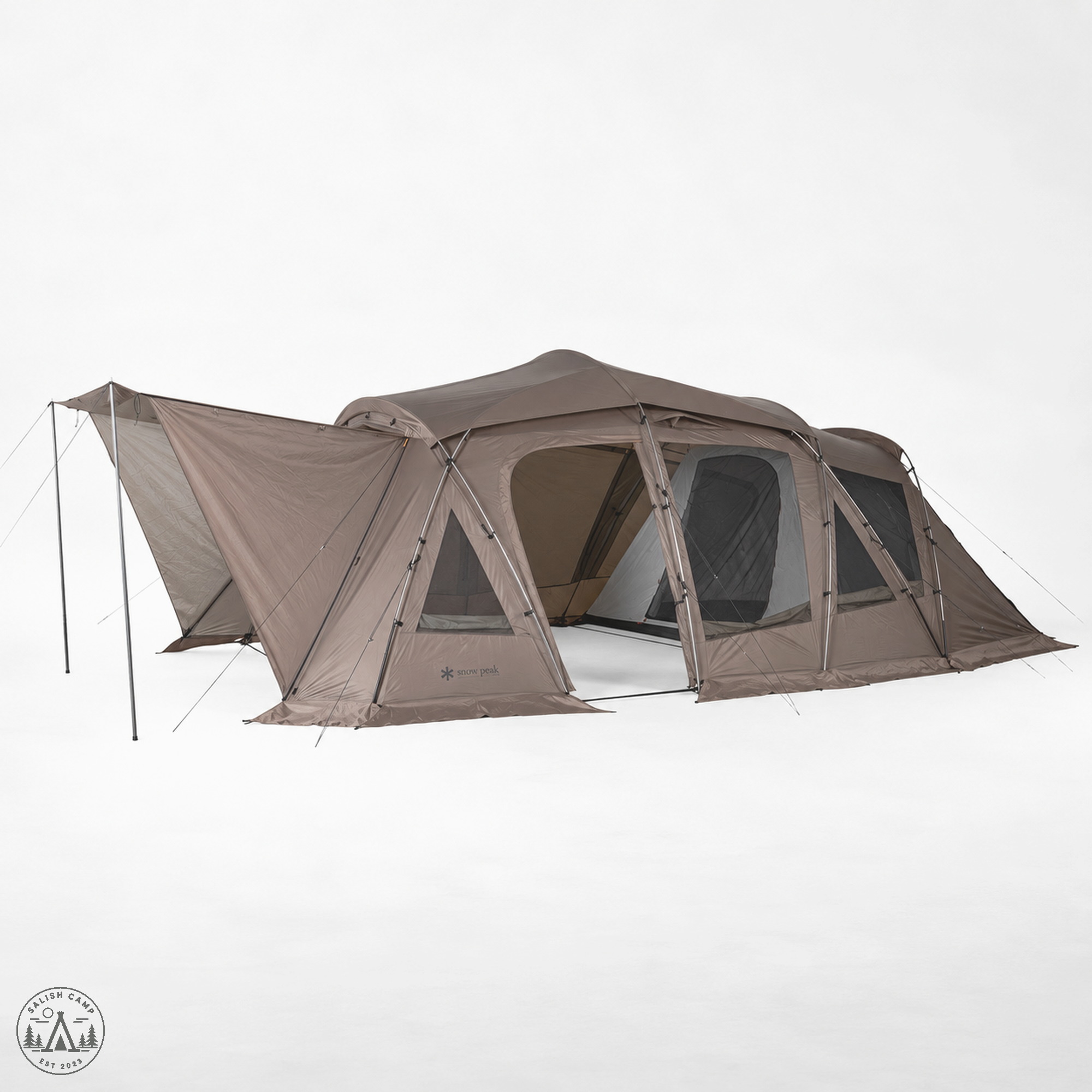
The shield roof is one of the FES-770 details I would pay attention to rather than treating it as another accessory name. It is included and uses 75D silicone polyester ripstop with Shield Pigment PU coating, rated to 1,500 mm minimum. The main body's roof, wall, and window specification uses the same 75D silicone polyester ripstop, Shield Pigment PU coating, and 1,500 mm minimum waterproof rating. I would keep the shield roof as that listed layer rather than pointing at the extended side panel and calling the panel the shield roof.
Lower down, Snow Peak changes materials. The body skirt is 210D polyester Oxford with PU coating and a listed 450 mm minimum waterproof rating. I would keep those specifications distinct rather than casually describing every piece of the shelter as having the same waterproof construction.
The inner room also has its own material stack. Its roof and walls are 20D polyester taffeta ripstop; Snow Peak does not list a waterproof rating for those panels. The inner bottom is 40D nylon taffeta ripstop with PU coating and a 1,800 mm minimum rating. Beneath that, the included ground sheet is 210D polyester Oxford with PU coating and another 1,800 mm minimum rating.
That included inner room is important because it tells me this is not just a giant shell requiring another tent to make the system usable for sleeping. Snow Peak includes the inner room and its ground sheet with FES-770. Capacity is officially 3–4 people, so that is the number I would plan around rather than trying to infer a larger capacity from the overall shelter dimensions.
The 5.3 ft inner height also deserves a little clarification. The complete shelter reaches 6.9 ft, but the sleeping room is lower. I would therefore think of the tall main structure as the living environment and the inner as the dedicated sleeping enclosure, rather than expecting the entire interior to have the same standing height.
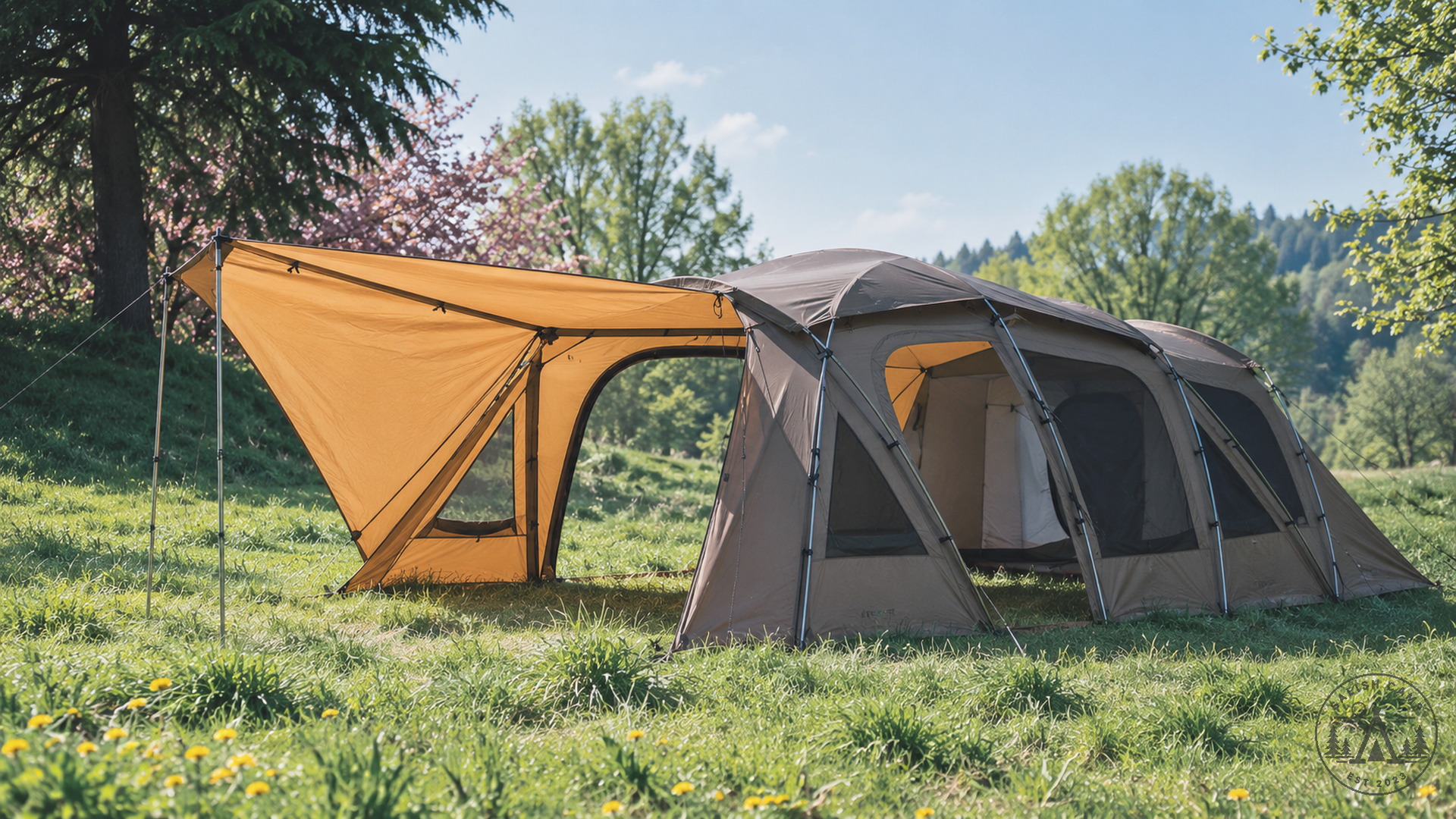
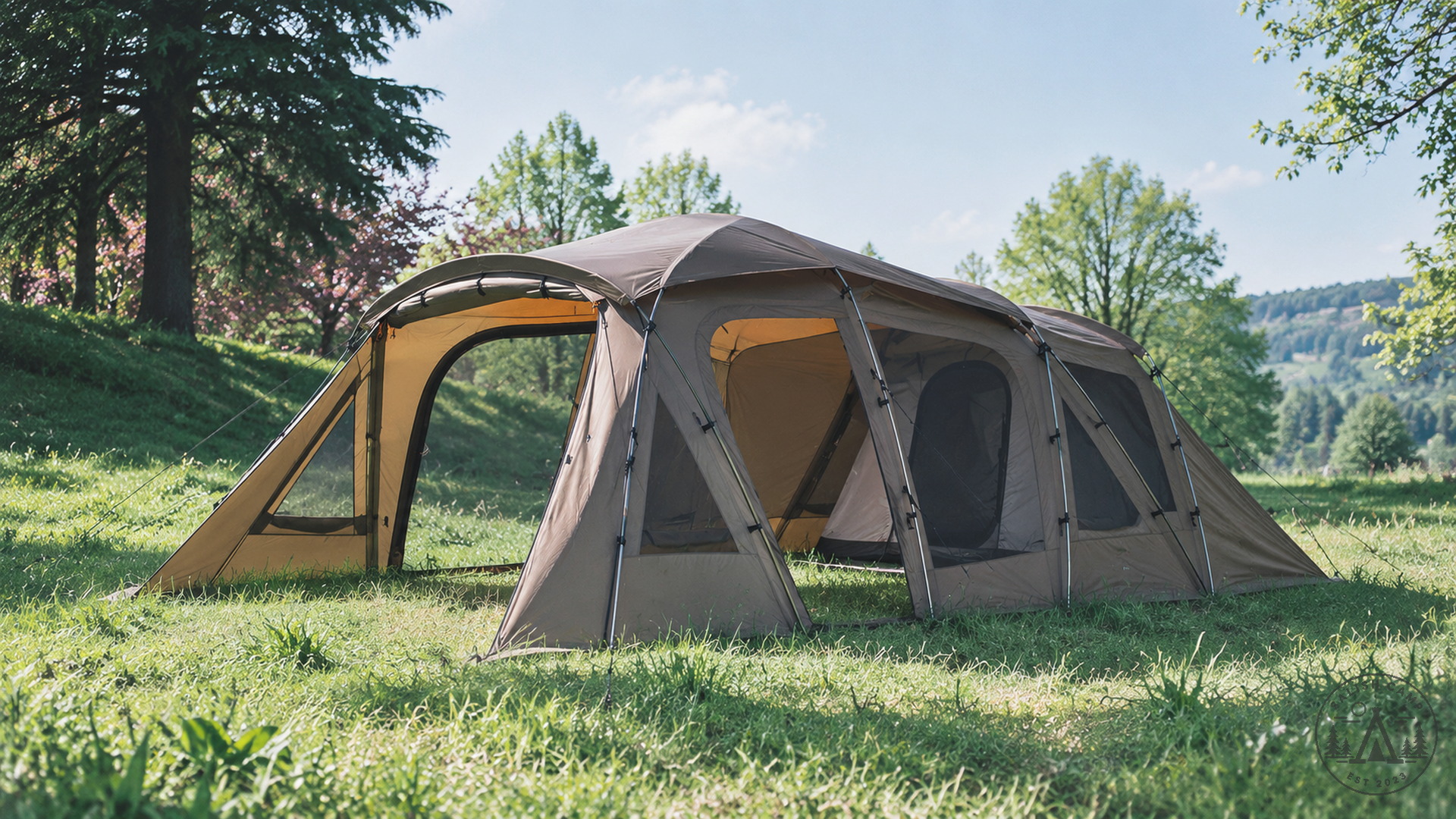
Outdoors, that extended cover reads as living space beside the body rather than as more sleeping room. The field still shows the canopy held out on poles next to the open shelter. I would not treat it as a second product, and I would not assign it a depth the page never prints.
Then there is the frame system. This is where someone coming from a backpacking tent needs to recalibrate expectations.
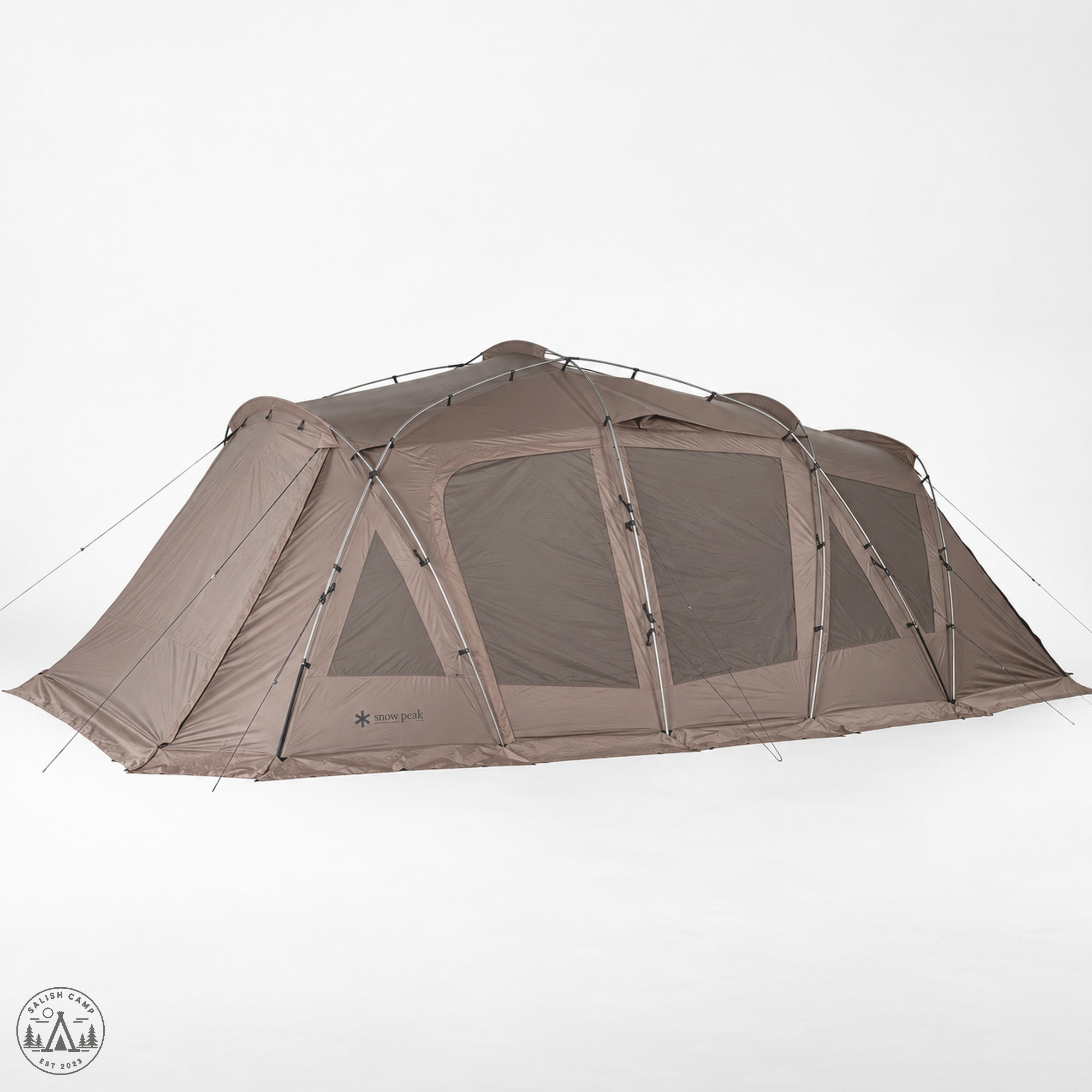
Snow Peak includes one ridge pole, two A frames, two C frames, two center frames, one tent frame, and two upright poles. The listed frame material is A6061. The product page describes the shelter as having excellent wind resistance. The pitched shelter shows an external frame and guy lines over the body. I would not name individual frame types from those wide views, because the pictures do not isolate the ridge pole, A frames, C frames, or upright poles.
I would not convert that wind-resistance claim into an invented wind-speed rating, and Snow Peak does not give a setup time on this PDP. Likewise, although the page says the 2026 Edition has minor improvements allowing easier setup, it does not identify exactly what those changes are. There is no factual basis here for claiming a particular redesigned joint, pole sequence, clip, or other mechanism.
What I can say is that the component list makes this clearly different from pitching a small backpacking shelter. There are multiple structural frame types and a substantial rope package to manage. Snow Peak supplies six 11.5 ft ropes with tensioners, eight 8.2 ft ropes with tensioners, and two 4.9 ft ropes with tensioners. The included list names a peg case. It does not itemize the pegs themselves, so I would not describe a stake kit.
For my kind of PNW use, that means site selection starts before I pull everything out of the vehicle. The published in-use dimensions are 19 × 11.8 ft, so I want a site where the shelter itself has appropriate room and where I can deal sensibly with the included ropes and tensioners.
I would not invent a separate floor-area figure from those dimensions because Snow Peak does not list one. The overall dimensions describe the shelter in use; they are not an invitation to manufacture a square-foot specification.
The same restraint applies to several other common tent questions. The PDP gives four seasons as the official season specification, but it does not provide a wind-speed rating. It does not call the shelter freestanding or non-freestanding. It does not list a stove jack. It does not specify a separate vestibule depth. Those omissions matter when comparing expensive shelters because it is very easy for assumptions to become "specifications" once they get repeated online.
What Snow Peak does explicitly say is that the Tortue Pro. 2026 Edition has a slightly more compact floor area than the Land Lock. I find that useful as positioning, especially if I am trying to understand where the Tortue sits within Snow Peak's large-shelter world. But without Land Lock dimensions on this product page, I would leave the comparison there.
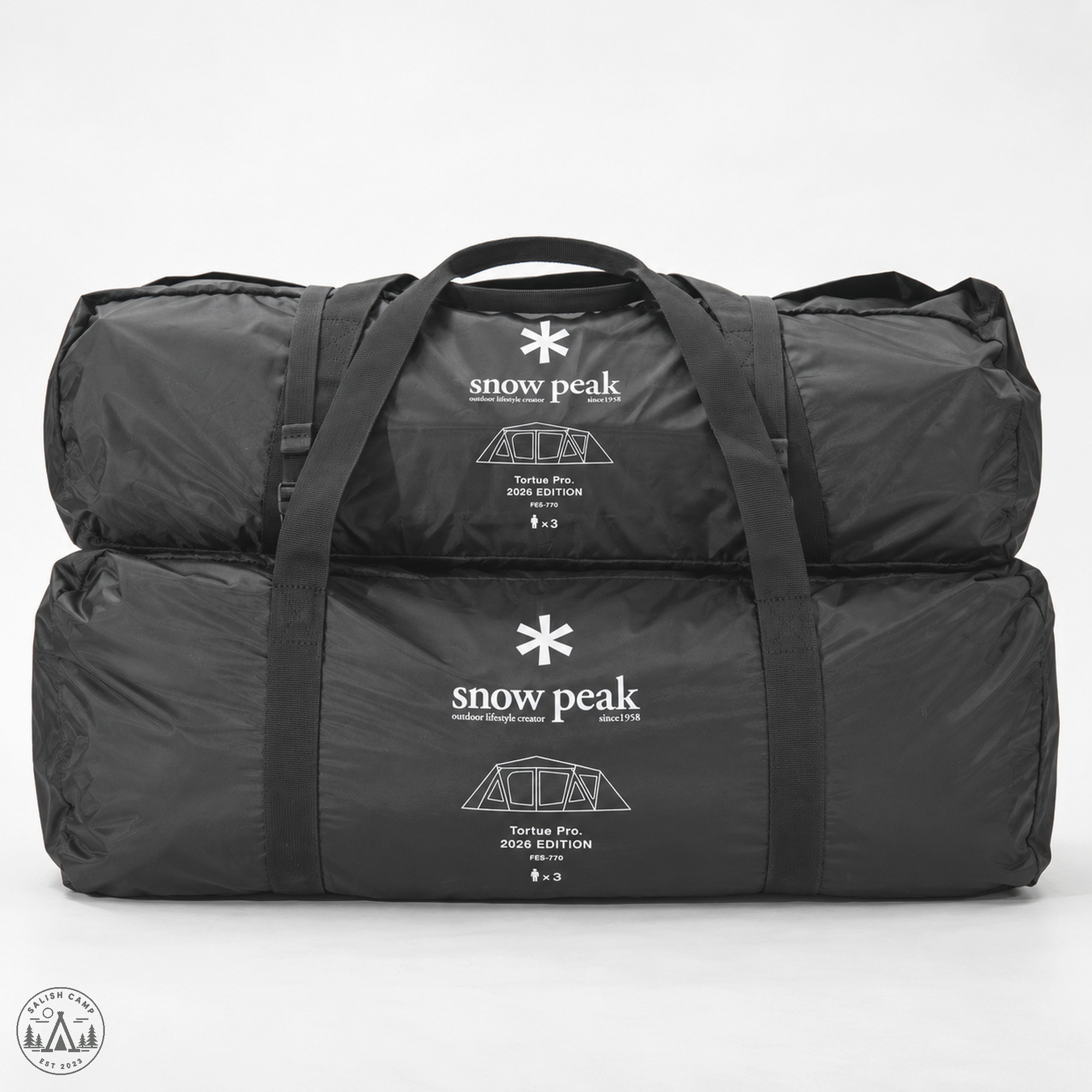
Packing is another place where this shelter makes its priorities obvious. The main carry bag measures 29.9 × 12.6 × 12.6 inches high, while the separate frame carry bag is 28.4 × 7.1 × 9.1 inches high. The still shows two black bags with the same Tortue Pro. 2026 Edition, FES-770, and ×3 print. It does not label one of them as the frame carry bag, so I would not assign those inch figures to a specific bag in the photo. The ×3 mark on the bags is also narrower than the PDP capacity of 3–4 people, which is the number I would plan around.
That split makes sense when I look at what comes with the shelter. Beyond the main body, shield roof, inner room, and ground sheet, there is that large collection of structural frames, two upright poles, ropes with tensioners, a carry bag, frame carry bag, ground-sheet case, and peg case.
In other words, the 48.5 lb specification should not be read like the packed weight of a conventional tent. This is a multi-piece camp shelter system, and I would plan vehicle space and unloading around that fact.
The final question for me is whether the Tortue Pro. actually earns its place next to a backpacking tent rather than replacing it. I think that is the cleanest way to understand FES-770.
My smaller shelter handles trips where packed size and weight dominate the decision. The Tortue Pro. is for almost the opposite scenario: I am driving in, establishing camp, and placing a high value on protected living space once I arrive. Its 3–4 person capacity, two-room design, 6.9 ft overall height, inner room, shield roof, ground sheet, extensive frame structure, and four-season specification all point toward that use.
It also creates a natural base for the kind of low camp furniture and equipment Snow Peak sells. If I'm already building that style of camp, the Snow Peak Entry IGT is relevant because the table system serves the same drive-in, stay-awhile approach.
But I would not buy the Tortue Pro. merely because I want "a nicer tent." The price, weight, packed components, and physical size are too significant for that. I would buy it because I specifically want the two-room format and expect to use that covered living space often enough to justify hauling a 48.5 lb shelter to camp.
That is a narrower argument, but it is a much stronger one.
Pros
- Genuine two-room shelter: the inner room and large surrounding structure give FES-770 a fundamentally different role from a conventional sleeping tent.
- Substantial included system: main body, shield roof, inner room, ground sheet, complete frame package, upright poles, tensioned ropes, and multiple storage cases are included.
- Tall main shelter: the 6.9 ft overall height supports the high-ceiling, open-interior design Snow Peak describes.
- Purposeful fabric specifications: the body, shield roof, skirt, inner floor, and ground sheet each have clearly differentiated materials and published waterproof ratings where Snow Peak provides them.
Cons
- 48.5 lb is a major commitment: this is firmly a drive-in basecamp shelter, especially for someone accustomed to carrying a backpacking tent.
- $1,799.95 is expensive: you need to value the two-room format and substantial shelter system for the purchase to make sense.
- Large system means more components to manage: multiple frame types, two packed bags, the inner room, shield roof, ground sheet, and numerous tensioned ropes make this inherently more involved than a simple sleeping tent.
Technical Specifications
| Product | Tortue Pro. 2026 Edition |
|---|---|
| SKU | FES-770 |
| Price | $1,799.95 (snowpeak.com, 2026-10-04) |
| Weight | 48.5 lb |
| Capacity | 3–4 people |
| Seasons | 4 |
| In use | 19 ft L × 11.8 ft W × 6.9 ft H |
| Interior height | 5.3 ft (inner tent) |
| Carry bag | 29.9 × 12.6 × 12.6 in (h) |
| Frame carry bag | 28.4 × 7.1 × 9.1 in (h) |
| Body fabric | 75D silicone polyester ripstop, 1,500 mm min (skirt 210D Oxford, 450 mm min) |
| Shield roof | 75D silicone polyester ripstop, 1,500 mm min |
| Inner room | Roof/wall 20D polyester taffeta ripstop; floor 40D nylon taffeta, 1,800 mm min |
| Ground sheet | 210D polyester Oxford, 1,800 mm min |
| Frame | A6061 |
| Not on PDP | Setup time, floor area, color name, stove jack |
Final Thoughts
The Snow Peak Tortue Pro. 2026 Edition makes the most sense when I stop asking whether it is a good tent and ask whether I need this much camp.
For a quick overnight, the answer for me is no. Forty-eight and a half pounds, multiple frame pieces, two primary carry bags, and a $1,799.95 price are difficult to justify when all I need is somewhere to sleep.
For a drive-in Cascade weekend where the shelter goes up and stays up, the equation changes. The 19 ft × 11.8 ft × 6.9 ft structure gives three or four people a two-room camp with a dedicated inner sleeping space and a high main shelter. The shield roof, ground sheet, inner room, extensive A6061 frame package, ropes, tensioners, and storage cases are already part of FES-770 rather than pieces I have to infer or add to the specification.
Snow Peak also describes the 2026 model as an updated Tortue Pro with a slightly more compact floor area than the Land Lock, excellent wind resistance, and minor improvements allowing easier setup. I would take those statements exactly as far as Snow Peak does. The PDP does not explain the individual improvements, quantify wind resistance, or give a setup time. It also does not give Land Lock dimensions, so "slightly more compact" stays a positioning line rather than a measurement.
That leaves a fairly straightforward buying decision. I would choose FES-770 if I wanted my second tent to do something my backpacking shelter fundamentally cannot: establish a large, protected two-room basecamp for several people. I would pass if I were merely looking for more sleeping space.