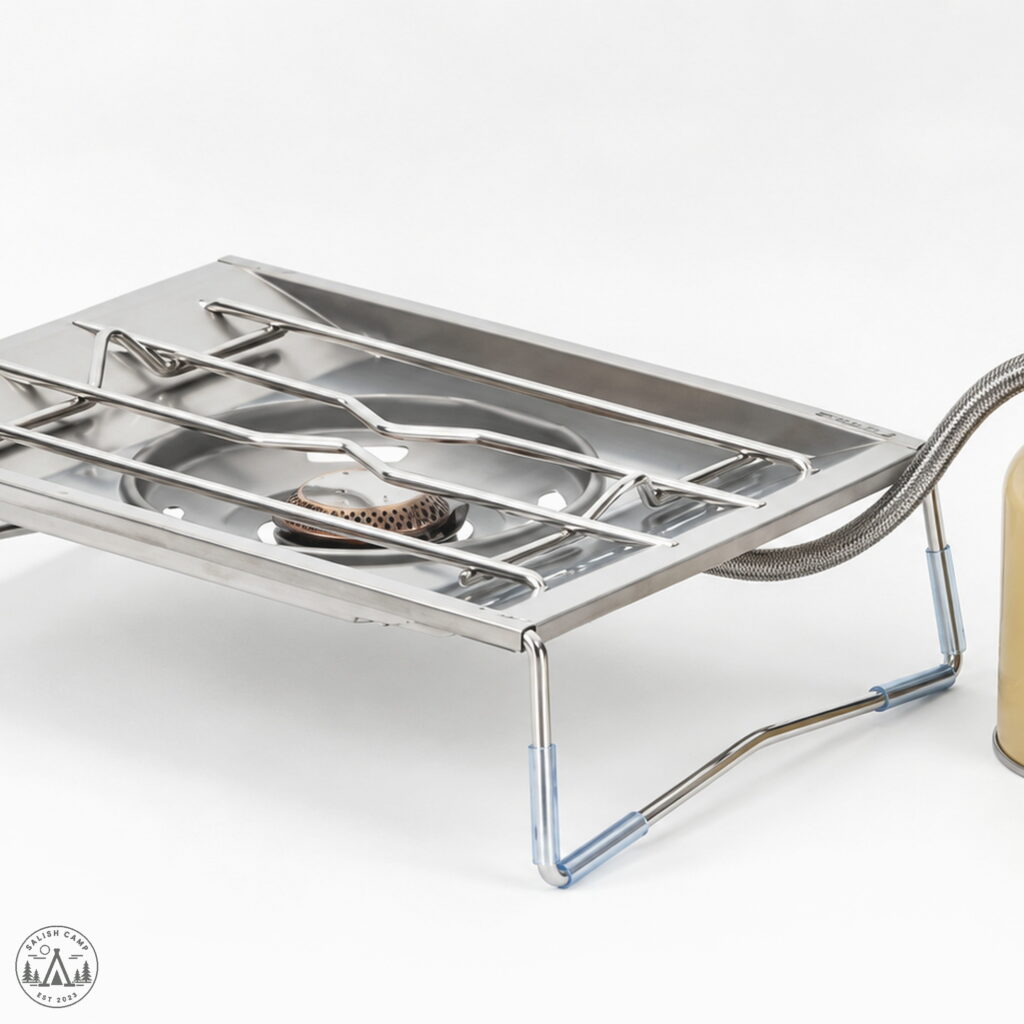
Buy if you already own an IGT frame—or are building a Snow Peak low-table cooking setup—and want a dedicated one-unit burner that sits nearly flush with the work surface. The Flat Burner GS-450R-US gives you an 11,897 BTU burner, removable standalone legs, a broad grill, drip tray, remote canister adapter with auto-igniter, and a storage bag in one purpose-built package. At $129.95, it makes the most sense as base-camp kitchen hardware rather than as a stove you choose primarily for low weight. The US Snow Peak listing showed it sold out on October 4, 2026, with no restock date stated.
Skip if you count ounces, primarily boil water on the trail, or do not see yourself using the IGT format. At 4.2 lb / 1.9 kg, this is fundamentally different from an upright canister stove such as the Snow Peak GigaPower Manual Renewed or an integrated boil-focused system such as a Jetboil. The Flat Burner earns its weight by giving you a larger, low cooking platform for a deliberate base-camp kitchen; if that is not the job you need done, much of its appeal disappears.
What Stands Out
- It occupies exactly one IGT unit. That is the defining feature for me: the burner becomes part of the table rather than another stove sitting on top of it.
- The same burner can work outside an IGT frame. Snow Peak includes two removable legs and the tray, so I can set it up as a standalone burner instead of treating the frame as mandatory.
- The US burner is rated at 11,897 BTU. Snow Peak's separate Japan GS-450R listing specifies output as 3,000 kcal/h; I keep those manufacturer figures separate rather than converting one and presenting the result as another official specification.
- The fuel connection and ignition are remote from the burner. The included canister adapter incorporates the auto-igniter, while the GigaPower fuel canister itself is sold separately.
- Snow Peak supplies the working hardware, not just the burner head. The US package includes the burner, tray, two legs, grill, canister adapter with auto-igniter, storage strap, and storage bag.
- It is built around a broad, stable cooking surface. Snow Peak's US page specifically describes it as providing a stable base for larger pots. The US PDP does not publish a maximum pot diameter; the separate Japan GS-450R listing specifies Φ23 cm or smaller and prohibits Dutch ovens.
- Cleaning is part of the design rather than an afterthought. The grill lifts away from the burner and tray, which matters after several damp PNW camp meals involving oil, sauce, and food that inevitably finds its way below the pot.
In The Field
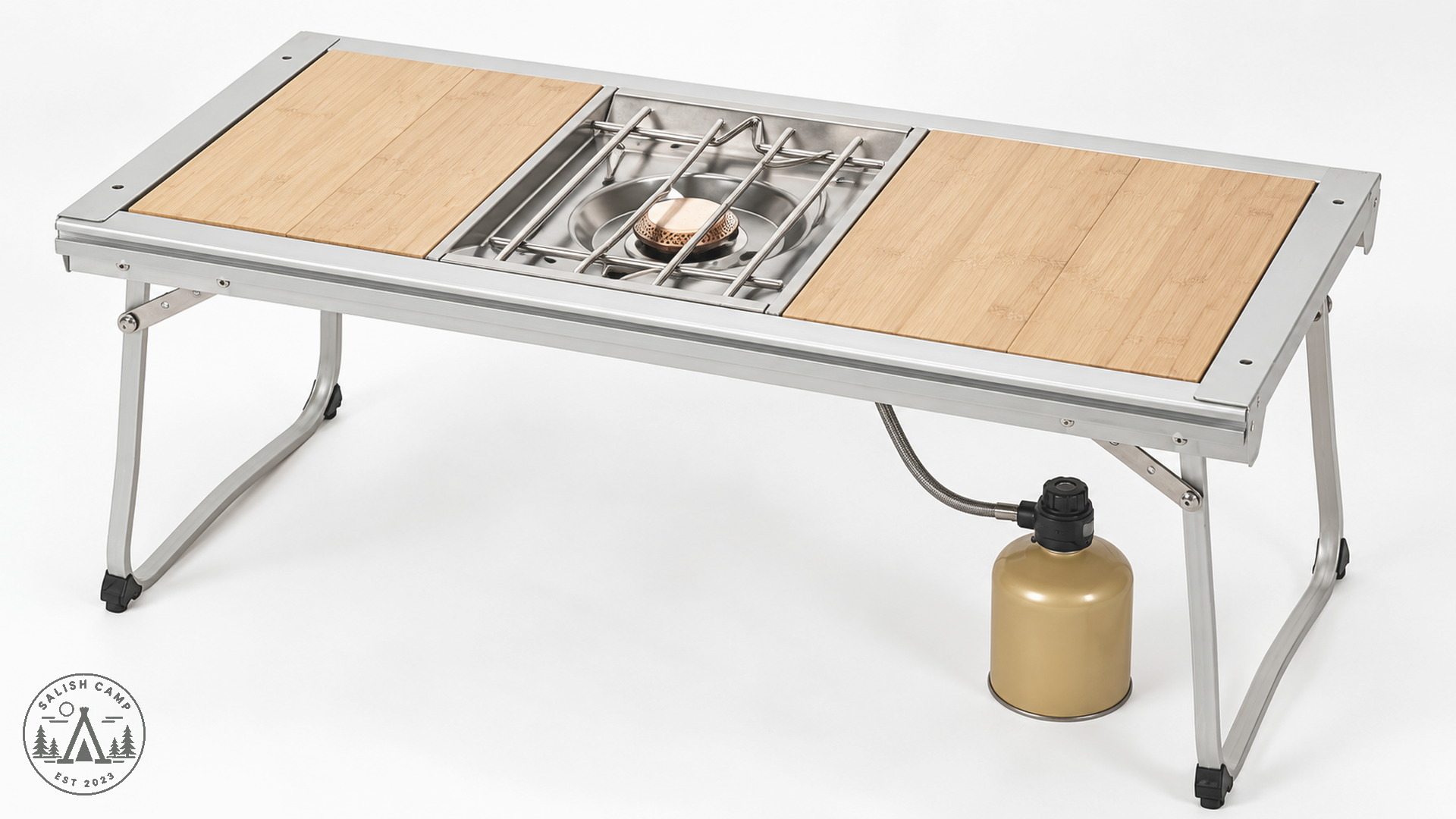
The reason I like the Flat Burner becomes obvious when I drop it into an IGT frame. It does not feel like a portable stove that Snow Peak found a way to suspend inside a table. It feels like the table and burner were conceived as parts of the same kitchen.
That distinction matters at a Cascade car camp. On a damp forest-service pad, I am usually not trying to achieve the fastest possible boil with the smallest possible object. I have a cooler, food prep, cookware, coffee gear, and enough time at camp to actually cook. I want a stable working height and a predictable place for the hot pan. A burner that occupies one IGT unit gives the kitchen a much cleaner layout than placing another stove on top of the table.
If you are new to Snow Peak's system, "one unit" is worth understanding before buying. IGT tables divide their central workspace into standardized openings. The Flat Burner fills one of those openings. If you are considering the Snow Peak Entry IGT, that modular relationship is a major reason to look at this stove in the first place.
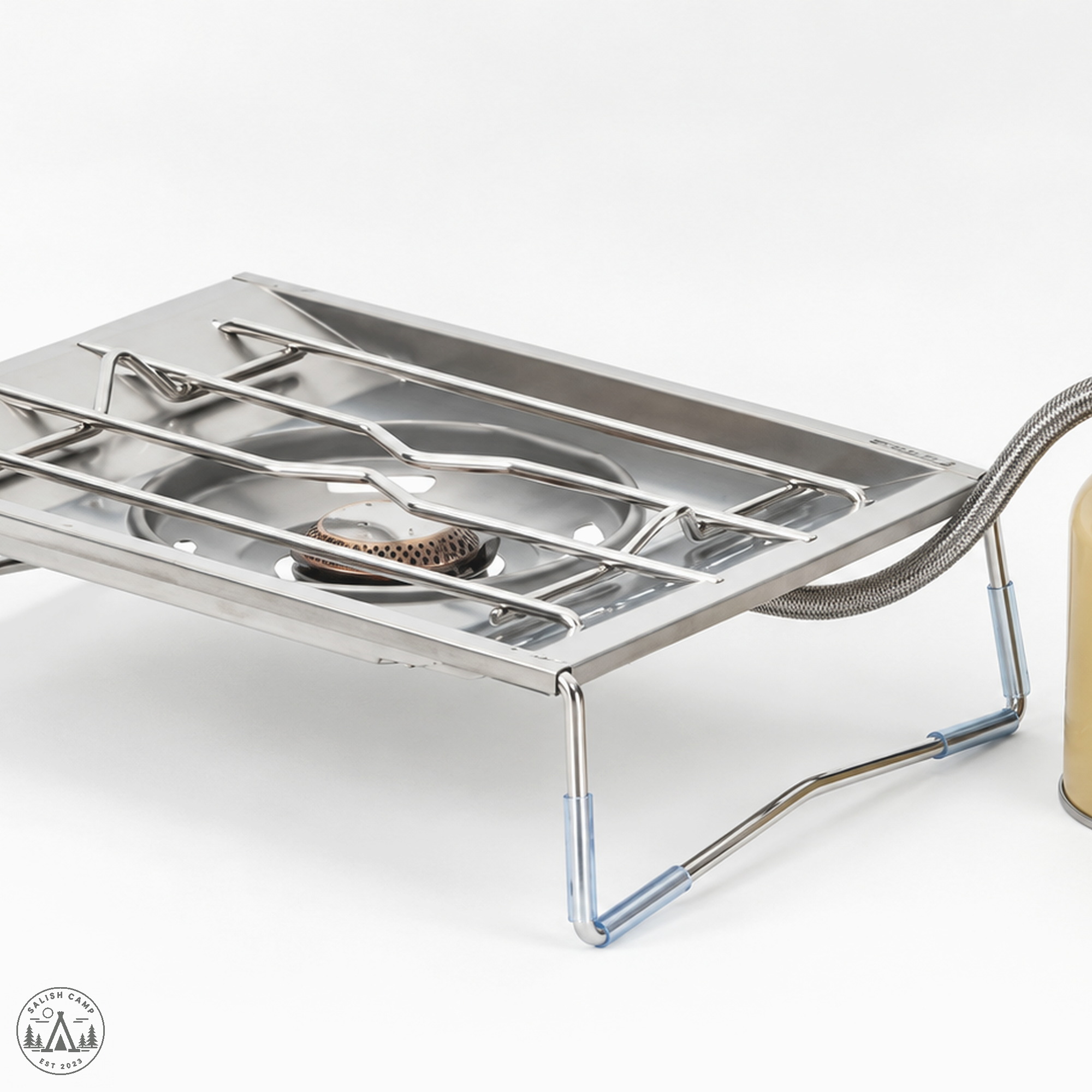
It is not locked to an IGT frame, though. Snow Peak includes two legs, and that standalone configuration is more useful than it might sound. There are trips where I want the burner away from the main table, or I simply do not bring the full IGT setup. The legs let the Flat Burner become its own low cooking station.
When I install it into a compatible IGT frame, those legs come off. That produces the configuration I associate most strongly with this burner: the grill and cooking surface sit low within the table rather than perching several inches above it.
There is an important compatibility detail here that I would not generalize. Snow Peak Japan says the included valve holder can be used to hang the gas cartridge from the IGT rail and specifically names CK-150, CK-149, CK-180, and CK-090. I would not assume that rail-hanging method applies to the Entry IGT CK-080R, because Snow Peak does not include CK-080R in that list. Standalone use does not require that holder.
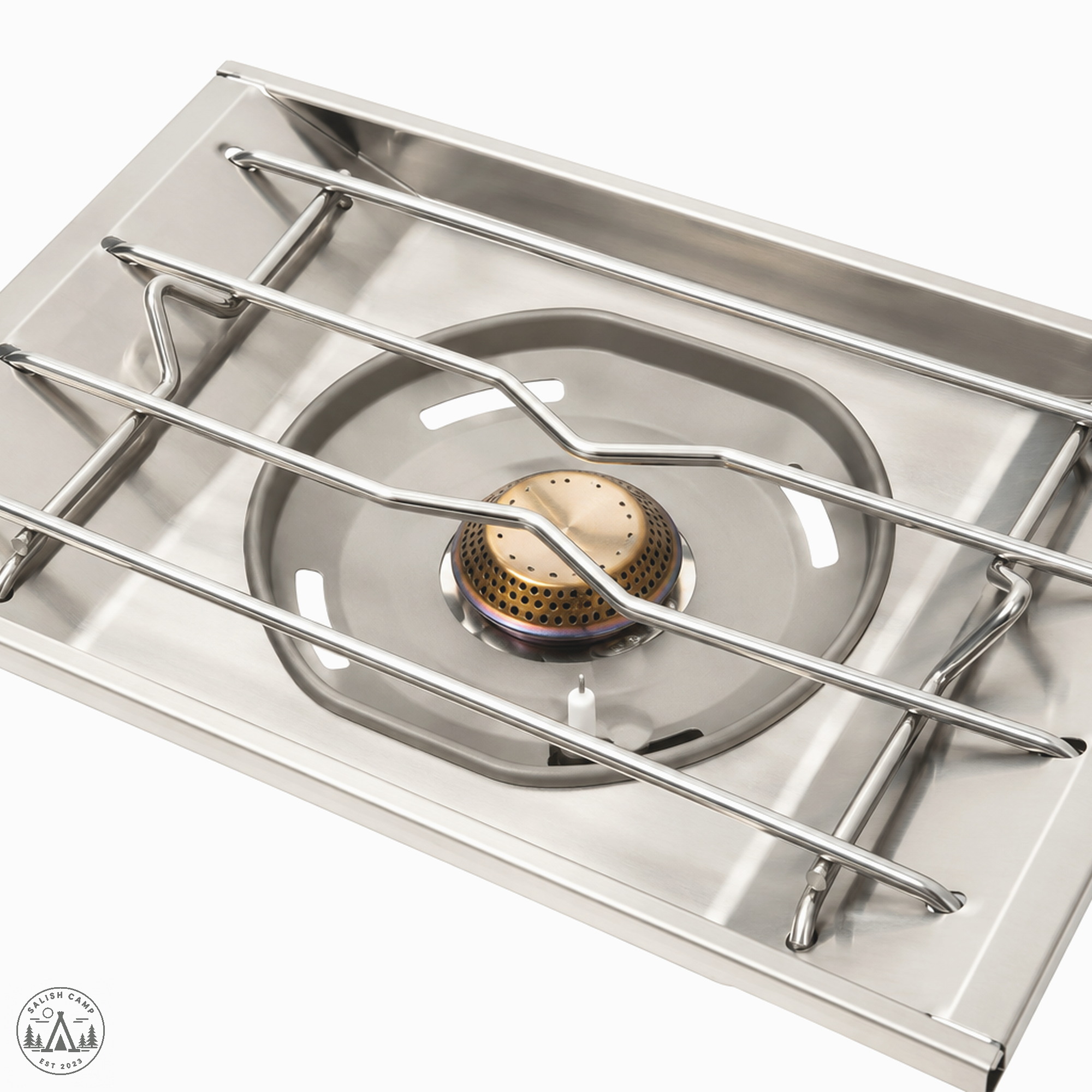
The grill is another reason this stove feels different from an upright backpacking burner. Instead of balancing cookware over compact folding supports, I get a broad fixed surface above the burner. Snow Peak describes the US version as providing a stable base for larger pots, and that tracks with the Flat Burner's entire base-camp orientation.
I would not turn "larger pots" into an invented US specification, however. Snow Peak's US GS-450R-US page does not state a maximum pot diameter. The Japanese GS-450R listing does: Φ23 cm or smaller, with Dutch ovens not permitted. That is useful information, but it belongs specifically to the Japan listing rather than being silently inserted into the US spec sheet.
In practical use, I treat that as a reminder of what the Flat Burner actually is. A wide grill does not mean unlimited cookware. This remains a portable gas burner with manufacturer-defined boundaries.
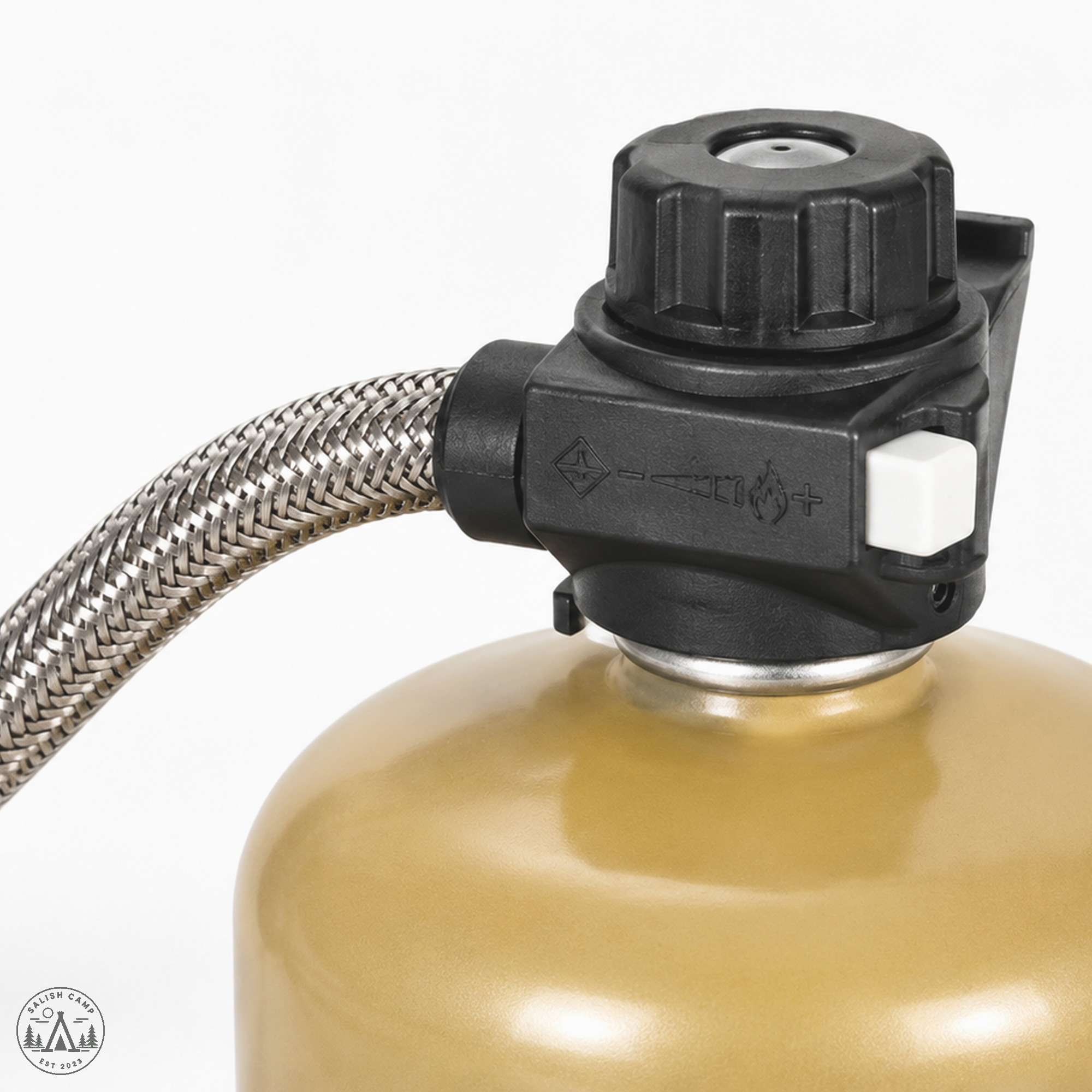
Fuel setup is straightforward. The Flat Burner uses a GigaPower fuel canister, which is sold separately. There is no fuel canister hiding in the included-parts list.
The canister connects through the supplied adapter, and that adapter carries the auto-igniter. Once the fuel connection is properly set up, ignition is by clicking the auto-igniter rather than bringing a separate lighter to the burner for normal operation.
That remote fuel arrangement is especially appropriate in an IGT kitchen because the canister does not need to occupy the same cooking opening as the burner. It also visually separates this product from Snow Peak's small upright GigaPower stove. Both burn canister fuel, but their intended jobs are very different.
The GigaPower Manual Renewed is the kind of stove I consider when packability and a compact upright format matter. The Flat Burner is what I consider when the stove is part of the camp furniture.
And 4.2 lb / 1.9 kg makes that distinction impossible to ignore.
That is Snow Peak's current US published weight. The Japanese GS-450R listing also states 1.9 kg but explicitly says that figure excludes the storage case. Snow Peak's US page does not clarify whether its 4.2-pound figure includes the bag, so I would not manufacture a second "packed" weight from incomplete information.
Either way, this is not a gram-counting stove.
I would happily put it in the back of a vehicle for a weekend around the Cascades. I would not look at that weight and try to rationalize it into a backpacking kit. Even the included storage strap and bag tell you something about its role: this is a piece of modular camp-kitchen equipment that gets packed, transported, assembled, cooked on, cleaned, and put away.
Cleaning is one of the less glamorous reasons I prefer this format for real meals. Snow Peak specifically calls the Flat Burner easy to clean. The grill and burner arrangement gives access to the tray underneath rather than forcing me to clean a permanently integrated tabletop appliance.
That matters when breakfast involves more than boiling water. Grease spits. Sauce escapes. Rice sticks where I did not intend it to. On a wet morning, pine needles and general campsite debris somehow find every horizontal surface. Being able to break the cooking area down into its component pieces makes the Flat Burner more realistic for repeated base-camp use.
There is also a detail worth watching if you have seen older Flat Burner imagery. Snow Peak Japan says the drip tray—described as a wind guard in the manual—was changed to stainless steel on the GS-450R. I would use the current GS-450R construction as the reference rather than assuming an older GS-450 part is identical.
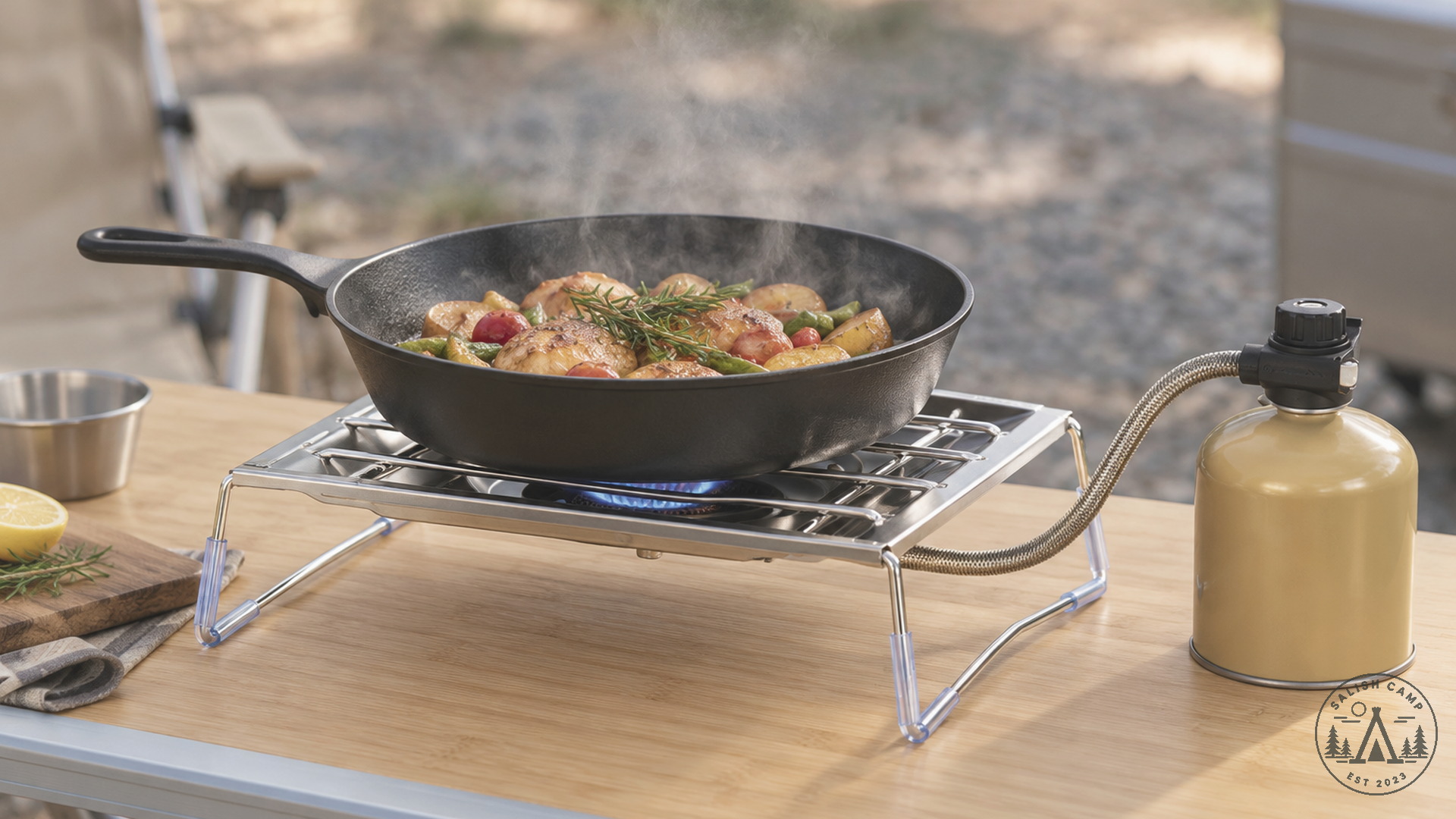
Output is substantial enough for the kind of cooking I expect from it. Snow Peak's US specification is 11,897 BTU. The Japan GS-450R page separately publishes 3,000 kcal/h. Those are the manufacturer's respective regional specifications; there is no need to convert one and imply Snow Peak published the resulting number.
The Japanese listing also publishes burn-time figures for specific canisters: 210 minutes with GP-500GR and 110 minutes with GP-250GR. It does not state equivalent times for the SR canisters it lists, and Snow Peak's US PDP does not publish a burn-time specification. I treat those Japan figures as regional reference data, not a universal promise of exactly how long every US camp setup will run.
Actual fuel planning still depends on what I am doing. Simmering, repeated heating, and running the burner hard are different uses. For a weekend camp, I plan fuel around the meals rather than interpreting a laboratory-style duration as my personal countdown clock.
The most useful way I have found to evaluate the Flat Burner is to ignore the fact that it technically uses the same broad fuel category as much smaller camp stoves. That comparison obscures the point.
An integrated boil system is built around efficiently performing the boiling job. An upright stove such as the GigaPower Manual Renewed emphasizes a much smaller stove package. The Flat Burner instead spends weight and space on a low grill, tray, standalone legs, remote fuel connection, and IGT integration.
Those are not free advantages. They are the reason it weighs 4.2 pounds.
For me, the Flat Burner makes the strongest case when it remains installed for more than a single boil. At a two-night Cascade base camp, I can cook dinner, leave the kitchen arrangement intact, come back in the morning, put the coffee water on, and then make breakfast without reconstructing the cooking station.
That is where the IGT concept earns its space in the vehicle. The stove has a defined location, the surrounding table remains useful for prep, and cookware sits down at the working surface instead of being elevated on a little burner perched above it.
I also like pairing that kind of setup with appropriately sized cookware rather than treating the Flat Burner as justification for bringing the biggest pot I own. Something like the Snow Peak Trek 900 illustrates the other end of Snow Peak's cooking ecosystem: compact cookware can still make sense even when the burner itself is part of a more substantial base-camp kitchen.
The catch in October 2026 is availability. Snow Peak listed the GS-450R-US at $129.95, but the US page showed it sold out on October 4, 2026, with pickup unavailable at Snow Peak Brooklyn. There was no restock date stated, so I would not plan a camp-kitchen build around an assumed return date.
Pros
- True one-unit IGT integration: the burner drops into a single IGT opening instead of consuming tabletop space as a stove placed on top.
- Useful standalone configuration: the included pair of removable legs lets the same burner work outside an IGT frame.
- Complete burner hardware package: grill, tray, canister adapter with auto-igniter, storage strap, and storage bag are included with the burner and legs.
- Base-camp-oriented cooking surface: the low grill and Snow Peak's stated support for larger pots make it better suited to actual camp cooking than a tiny upright stove.
Cons
- 4.2 lb / 1.9 kg is substantial: there is little reason to choose this for a gram-conscious backpacking kitchen.
- Fuel is extra: a GigaPower canister is required and is not included.
- Currently unavailable direct from Snow Peak US: the $129.95 GS-450R-US listing showed sold out on October 4, 2026, without a stated restock date.
Technical Specifications
| Product | Snow Peak Flat Burner |
|---|---|
| SKU | GS-450R-US (Japan listing GS-450R) |
| Price | $129.95 (snowpeak.com, 2026-10-04; sold out that day) |
| Weight | 4.2 lb / 1.9 kg (US). Japan: 1.9 kg excluding the storage case |
| Dimensions | L 10.6 × W 16.1 × H 4.3 in (US). Japan: 270 × 410 × 110 mm excluding hose and valve |
| Output | 11,897 BTU (US). Japan lists 3,000 kcal/h — do not convert |
| IGT | 1 unit |
| Ignition | Auto-igniter on the canister adapter |
| Fuel | GigaPower canister, sold separately |
| Included | Burner, tray, legs ×2, grill, canister adapter with auto-igniter, storage strap, storage bag |
| Materials | Stainless steel, brass, aluminum, steel, resin |
| Pot limit | Not on the US PDP. Japan GS-450R: Φ23 cm or smaller; Dutch ovens not allowed |
Final Thoughts
The Flat Burner is easy to misjudge if I evaluate it like a conventional portable stove. At 4.2 lb / 1.9 kg, it loses that comparison before I even start cooking. A small upright canister stove is dramatically more appropriate when the objective is to carry the least possible kitchen, and an integrated boil system targets another job again.
What the GS-450R-US offers instead is integration. One IGT unit becomes the cooking station. The grill sits low. The tray catches the mess underneath. The remote adapter gives me auto-ignition. The two supplied legs preserve standalone use. When camp is a place where I intend to cook rather than simply stop long enough to boil water, those details add up.
The tradeoff is equally clear. I have to transport four-plus pounds of burner hardware, buy the fuel separately, and accept that much of the product's appeal depends on wanting the IGT-style kitchen in the first place. At the time of this review, there is also the more immediate problem that Snow Peak's US listing was sold out.
For my Seattle and Cascade car-camp use, I think it is a particularly coherent piece of Snow Peak equipment when it lives inside an IGT setup. Outside that context, I become much more critical of the weight. It is a specialized base-camp burner, and it is better for being judged that way rather than stretched into jobs it was never built to do.