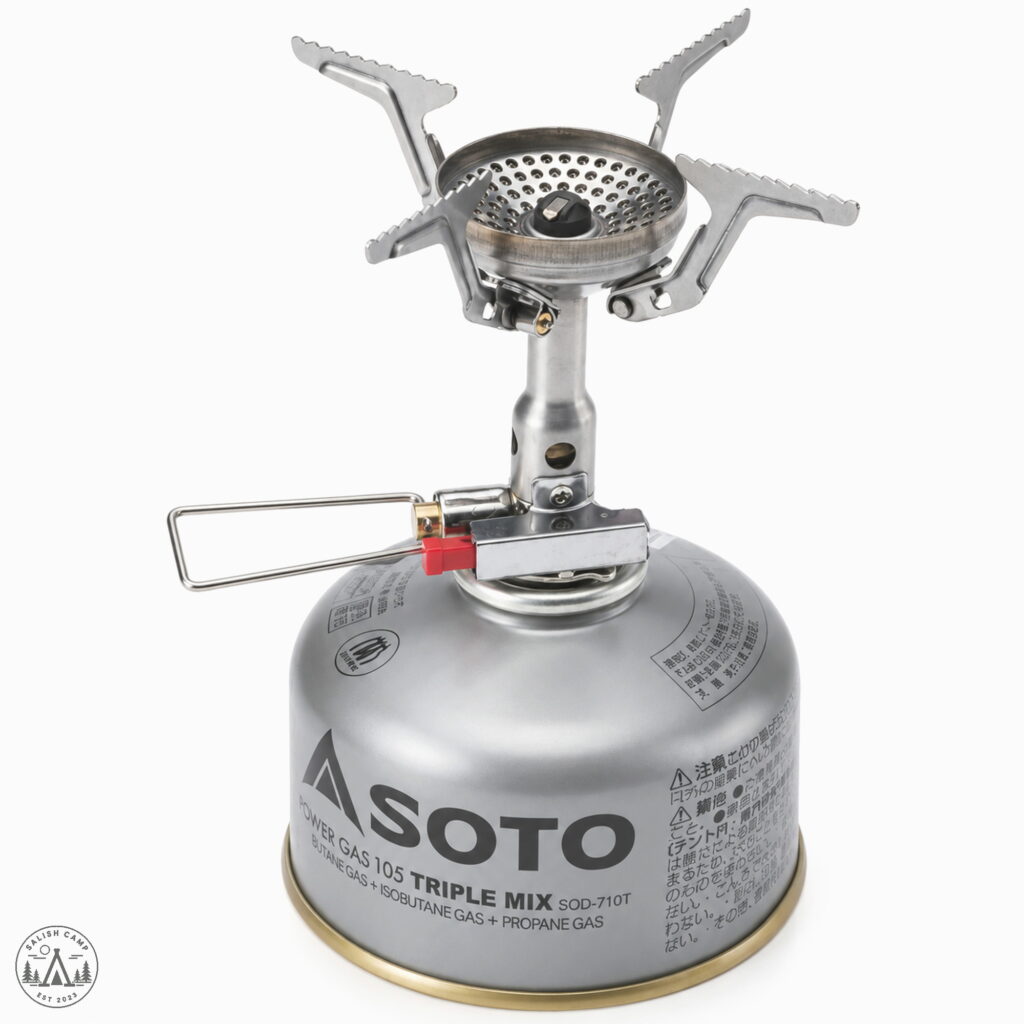
Buy if you want a lightweight canister stove that stays reasonably affordable without stripping away the features I actually appreciate on wet, windy Pacific Northwest trips. At 2.9 oz (81 g) and $49.95, the Amicus Stove with Igniter gives me integrated ignition, a compact folding shape, spring-loaded pot supports, and a burner specifically shaped around wind resistance. For Cascades overnighters and Olympic Peninsula camps where I already have a pot and standard isobutane-propane canisters, that is a practical combination.
Skip if your priority is maximum burner output, an included pot system, or simply owning the lightest and most minimal burner possible. The Amicus is a standalone stove rather than a complete cooking system, and its primary specification is 10210 BTU. It occupies a useful middle ground: light enough for backpacking, inexpensive enough to be approachable, and better featured than the most stripped-down burners, but without pretending to be SOTO’s flagship option.
What Stands Out
- 2.9 oz (81 g) stove weight: Light enough that I don’t have to justify carrying the integrated ignition system on short PNW backpacking trips.
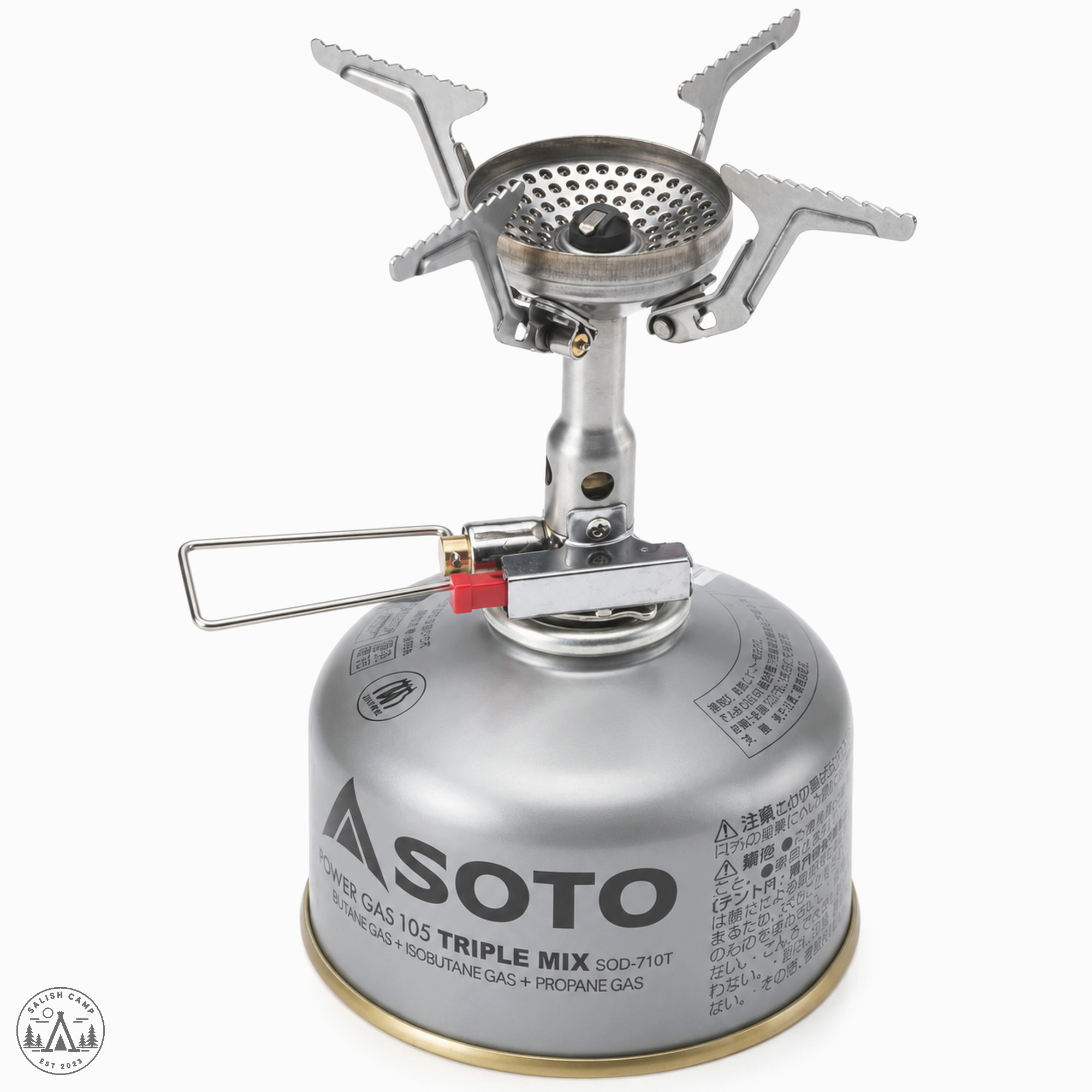
- Wind-oriented burner geometry: A raised ledge around the burner crown and concave burner surface are specifically intended to improve performance when wind moves across the burner.
- Built-in igniter: OD-1NVE includes integrated ignition with the electric line hidden inside the stove structure, reducing my dependence on a separate lighter for routine starts.
- Spring-loaded pot supports: The four supports deploy quickly and give the stove a more substantial pot platform than its tiny stowed dimensions suggest.
- Triple O-ring valve system: SOTO uses its Triple O-ring valve system here, with the product description also calling out a Triple O-ring Seal and Metal Seal.
- Compact packed shape: At 1.7 × 1.6 × 3.0 inches stowed, it disappears easily into the small spaces left inside an existing cook kit.
- $49.95 positioning: The Amicus brings several convenience and wind-oriented features into a price bracket that makes sense for someone building a backpacking kitchen without paying flagship-stove money.

In The Field
A canister stove can look almost comically simple on a gear table. Screw it onto a canister, unfold the supports, put a pot on top, and make dinner. Once I get into the Cascades or Olympics, though, the differences between these little burners become easier to appreciate. Cold fingers, damp gear and moving air have a way of turning seemingly minor design details into the things I notice most.
The Amicus hits a particularly useful point for the kind of overnight backpacking I do. I already own a pot. I already use standard threaded isobutane-propane canisters. I don’t need another integrated cookset or a proprietary kitchen ecosystem. What I want is a compact burner that doesn’t add much weight, gives me decent control, and doesn’t immediately feel out of its element when an alpine lunch stop gets breezy.
At 2.9 oz (81 g), the Amicus is easy to pack for that job. That is the stove weight that matters here. The 8 oz figure and 9 × 6 × 6 inch dimensions appearing in the site’s additional information/JSON-LD refer to the shipping package, not the stove itself. On my backpacking checklist, this is a 2.9 oz burner.
Its stowed dimensions are similarly useful. Folded down, it measures 1.7 × 1.6 × 3.0 inches. I can tuck something that small into an existing cook kit without reorganizing everything around the stove. That matters more to me than achieving a theoretically perfect nesting arrangement. On a one- or two-night trip, I want to open my food bag, pull out a compact kitchen and get water heating without scattering components around camp.

The spring-loaded pot supports help with that simplicity. They open into a four-point platform rather than leaving me fiddling with loose components. With a pot sitting on top, four supports also give me a clear visual sense of where the load is being carried.
There is an important distinction for someone new to backpacking stoves: pot stability and stove stability aren’t exactly the same thing. The Amicus can provide a solid support platform at the burner, but the entire setup still depends on the fuel canister underneath it. I still choose a flat spot and pay attention to the pot. A compact upright canister stove is not something I treat like a kitchen range just because the supports look secure.
The feature I would specifically choose this OD-1NVE configuration for is the built-in igniter. In damp shoulder-season conditions, I like being able to turn on the gas and ignite the stove without immediately digging for another item. SOTO hides the electric line for the ignition system within the stove structure, which makes the integration feel deliberate rather than like an exposed component hanging off the burner.

I still carry an independent fire source in the backcountry. An integrated igniter is a convenience feature, not something I use as an excuse to eliminate basic redundancy. But convenience counts. When I’ve stopped in mist, my hands are cold and I’m trying to get something hot going quickly, pressing an igniter is preferable to searching through another pocket.
SOTO also offers the Amicus line in a no-igniter version, but this review is specifically about OD-1NVE with the built-in igniter. For the configuration here, the igniter is part of the appeal rather than an accessory I would add later.
Wind is the more interesting part of the Amicus design. Instead of simply making a generic exposed burner and calling it wind resistant, SOTO shapes the burner with a raised ledge around the crown and a concave burner surface. The idea is to reduce how easily moving air disrupts combustion across the burner face.
That is exactly the sort of design choice I want to see for Pacific Northwest backpacking. I’m not talking about cooking in a gale or pretending any tiny upright stove is immune to weather. I’m thinking about the ordinary moving air I encounter beside an alpine lake, on an exposed ridge during lunch, or at a campsite where there isn’t a conveniently protected cooking spot.

A novice might reasonably ask whether that means a wind-resistant burner eliminates the need to think about shelter. It doesn’t. I still use terrain and good campsite positioning to get out of direct wind when possible. I also don’t enclose an upright canister in a way that can trap excessive heat around it. Burner design is one layer of performance; sensible placement remains another.
Output is also worth putting in perspective. The primary specification for the Amicus is 10210 BTU, or 2800 kcal/h and 3260 W. SOTO’s feature/wind block also prints 11000 BTU, creating a discrepancy on the product page; I’m using the formal Specifications figure of 10210 BTU as the primary number.
I don’t see that output as a weakness for the intended use. Backpacking stove performance isn’t just a contest to print the largest BTU figure. For my typical overnight cooking, I’m heating water and making relatively simple meals. Burner control and how effectively the flame behaves in real conditions matter alongside peak output.
The listed duration is approximately 1.5 hours with an 8 oz (250 g) canister. I treat that as a reference figure rather than a promise about exactly how many meals I’ll get from a canister. Actual fuel consumption on a trip depends heavily on how I cook, flame setting and conditions. Someone simmering food and someone repeatedly running a stove hard to boil water aren’t using fuel in the same way.

Flame control is useful here because I don’t always want full output. Once water is hot or I’m using a pot for actual cooking rather than just boiling, being able to turn the flame down makes the stove more versatile. It also helps separate the Amicus from the mindset that a backpacking stove exists solely to blast maximum flame at a titanium mug.
Fuel compatibility is refreshingly conventional. The Amicus uses standard isobutane-propane canisters with a Lindal valve connection. SOTO specifically names Primus, Snow Peak, MSR and Jetboil canisters on the page. For me, that means the stove fits into the fuel setup I already use instead of forcing another format into my gear storage.
The Triple O-ring valve system is another feature that isn’t particularly glamorous but belongs on the list of reasons this feels like more than a bargain-basement burner. SOTO also describes a Triple O-ring Seal and Metal Seal. I don’t need to interact with any of that during ordinary use; it is part of the valve architecture doing its job in the background.

There is no pot included here, and that is worth emphasizing because the Amicus makes the most sense to me for someone who already owns the rest of the kitchen. At $49.95, I’m buying the stove, not a complete cook system. If I were starting from absolutely nothing and wanted every cooking component in one purchase, I would need to budget separately for the pot and fuel canister.
For the backpacker who already has those pieces, however, that simplicity is a strength. I don’t want to replace a pot I like just to get a new burner.
That’s ultimately where the Amicus lands for me. It isn’t trying to solve backpacking cooking with a large integrated system. It gives me a 2.9 oz burner with an igniter, conventional canister compatibility, compact dimensions, controllable flame and actual thought put into how the burner deals with moving air.
For Cascades and Olympics overnighters, that is a sensible feature set. The PNW doesn’t require an exotic stove. It rewards a small one that packs easily, lights without fuss and has been designed with wind in mind.

Pros
- Built-in igniter on OD-1NVE adds real convenience without pushing stove weight beyond 2.9 oz (81 g).
- Raised burner ledge and concave burner surface give the Amicus a genuinely wind-oriented design rather than relying solely on marketing language.
- Spring-loaded four-point pot supports combine quick deployment with a useful platform for an existing backpacking pot.
- $49.95 price, tiny stowed dimensions and standard Lindal-valve canister compatibility make it easy to integrate into an existing kit.
Cons
- No pot is included, so anyone building a complete cook system from scratch still needs separate cookware.
- Primary output of 10210 BTU is solid mid-tier territory rather than a reason to choose the stove purely for maximum burner power.
- The built-in igniter is convenient, but I would still carry a separate ignition source as backcountry redundancy.
Technical Specifications
| Specification | Details |
|---|---|
| Product | SOTO Amicus Stove with Igniter |
| Config in photos / primary | OD-1NVE with built-in igniter |
| Product # | OD-1NVE |
| JSON-LD sku / barcode | 4953571093093 |
| Price | $49.95 USD (sotooutdoors.com, 2026-10-06, in stock) |
| Weight (stove) | 2.9 oz / 81 g |
| Shipping / package weight (context) | 8 oz; package 9 × 6 × 6 in — not stove weight |
| Output (primary) | 10210 BTU · 2800 kcal/h · 3260 W |
| Duration | Approx. 1.5 hours with 8 oz (250 g) canister |
| Dimensions in use | 3.0 × 4.0 × 3.4 in (7.6 × 10.0 × 8.6 cm) |
| Dimensions stowed | 1.7 × 1.6 × 3.0 in (4.3 × 4.0 × 7.5 cm) |
| Igniter | Built-in (this SKU) |
| Valve / seal | Triple O-ring valve system; Triple O-ring Seal and Metal Seal |
| Burner notes | Raised ledge at burner crown; concave burner surface; wind-oriented design |
| Pot supports | Spring-loaded |
| Fuel | Standard isobutane-propane canisters; Lindal valve compatible (Primus, Snow Peak, MSR, Jetboil named on page) |
| Marketing BTU line (once only if used) | Feature/wind block also prints 11000 BTU — primary is Specifications 10210 BTU |
Final Thoughts
The SOTO Amicus Stove with Igniter is the kind of budget backpacking gear I find easy to recommend because the lower price doesn’t come from deleting every useful feature. At 2.9 oz (81 g), it remains legitimately lightweight, yet OD-1NVE still gives me integrated ignition, spring-loaded pot supports, a compact folded profile and burner geometry intentionally designed around wind.
That combination is particularly convincing in the Pacific Northwest. I don’t expect the Amicus to make exposed alpine weather irrelevant, but the raised burner crown and concave burner surface address a real condition I routinely encounter. Add conventional Lindal-valve canister compatibility and the stove slots neatly into a cook kit I already own.
The limitations are equally straightforward. This isn’t a complete cooking system, there’s no pot included, and its 10210 BTU primary output doesn’t turn it into a flagship powerhouse. Those tradeoffs make sense at $49.95.
For an overnight backpacker who already owns a pot and canisters, I’d rather put my money into a compact burner with an igniter and meaningful wind-oriented engineering than pay for pieces I don’t need.