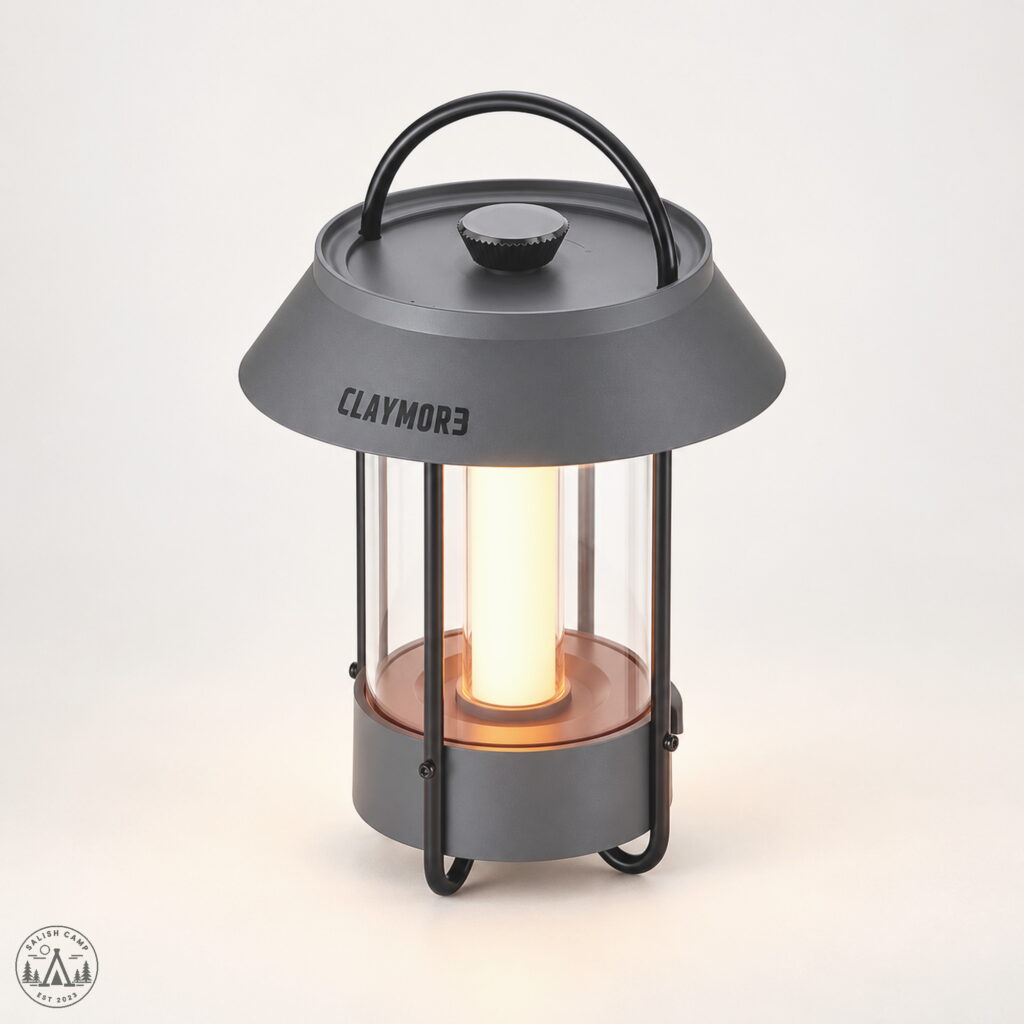
Buy if you want a rechargeable table lantern that makes a campsite feel comfortable after dark rather than simply flooding it with light. The Claymore Selene is especially appealing for car camping, covered outdoor dining, and indoor use where its warm colour temperatures, diffused output, and long runtime matter more than maximum brightness. The included hardshell case is a welcome part of the package.
Skip if you need a lightweight backpacking lantern, a powerful work light, or the most illumination possible for your money. At 660 g with a maximum output of 660 lumens, the Selene prioritizes atmosphere and comfortable close-range lighting. It is a premium ambient lantern, not a replacement for a headlamp or a high-output campsite floodlight.
What Stands Out
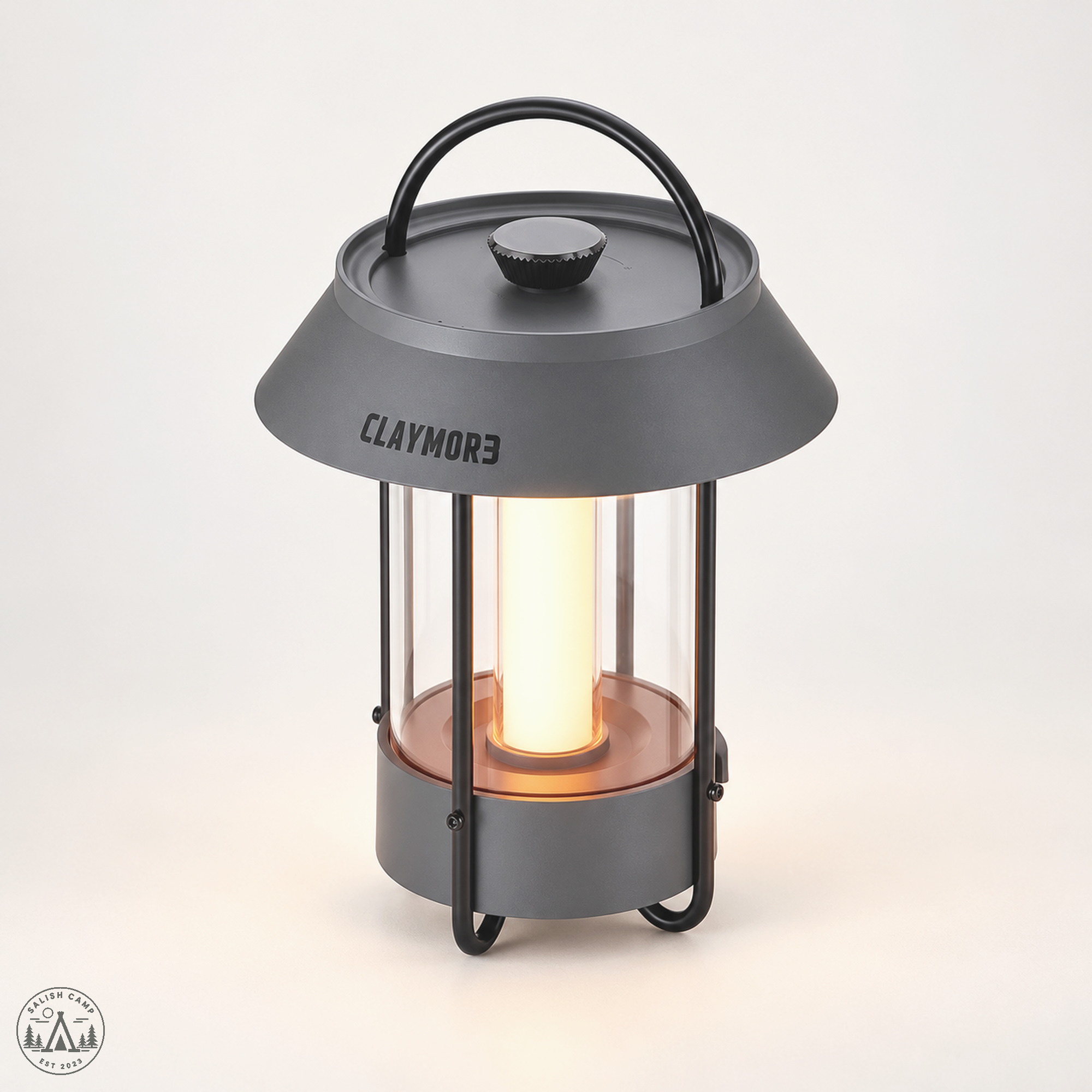
- Four distinct lighting modes: Warm White at 3,000K, Orange at 1,500K, Deep Orange at 1,300K, and Breeze at 1,500–3,000K give the Selene a wider range of ambient lighting options than a basic single-colour lantern.
- Glare-free diffusion: Claymore says the Selene diffuses its light rather than exposing a harsh source, using a diffused lighting design that feels better suited to a dining table, tent interior, or relaxed campsite seating area.
- Old-fashioned lantern styling: Its rounded body, removable shade, and carrying handle give it the visual character of a traditional table lantern without requiring fuel, glass mantles, or an open flame.
- Long rechargeable runtime: The 24.12 Wh battery supports a stated operating range of 6–55 hours, making lower-output use particularly attractive for extended evenings and multi-night camping trips.
- Breeze lighting mode: The fourth mode adds an ambient lighting option within the warm 1,500–3,000K range, giving the Selene a different character from its fixed-colour settings.
- Built-in power bank capability: A USB-A output allows the internal battery to supply power to another compatible device when needed, although doing so reduces the energy available for lighting.
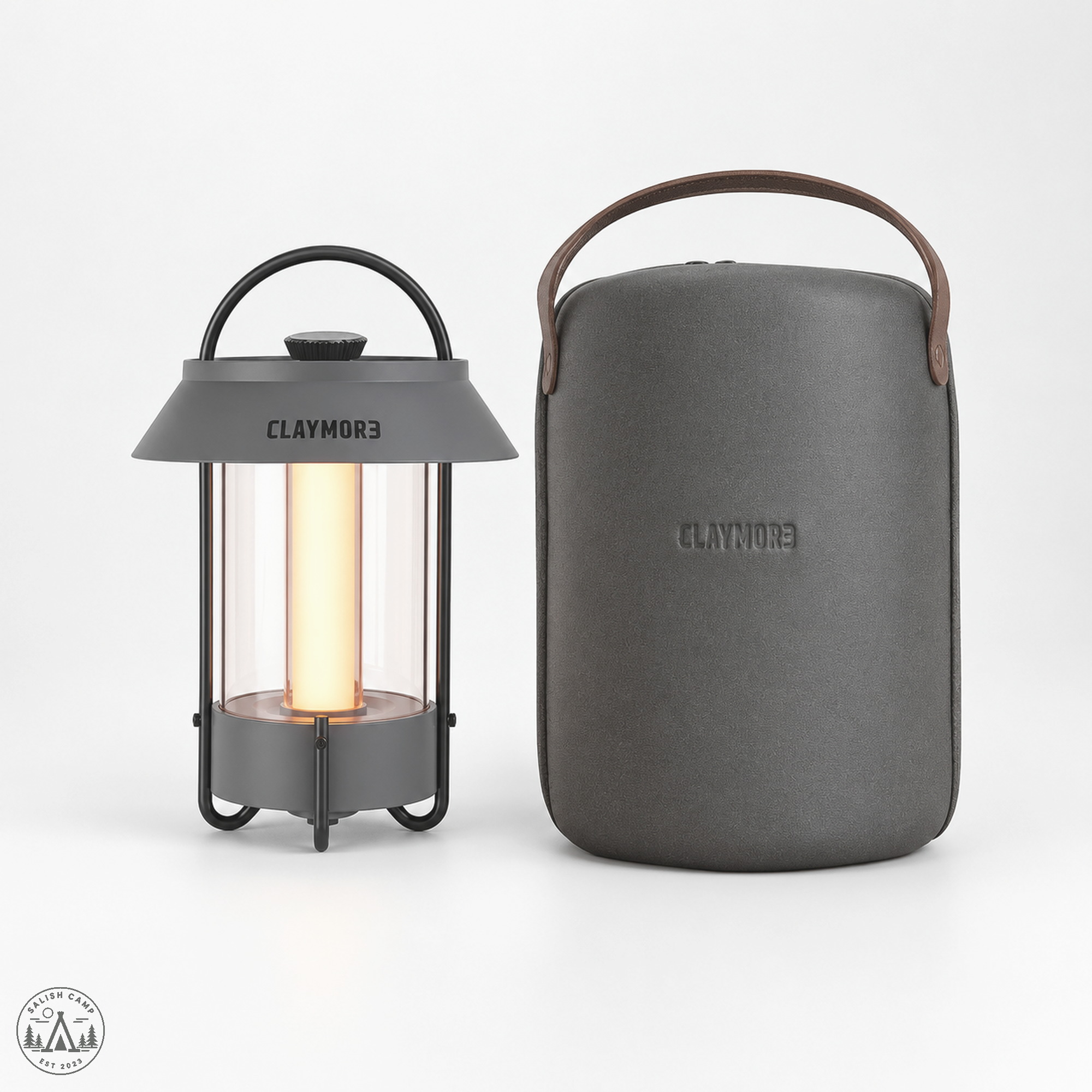
- Flexible placement and protected storage: A flat base, top handle, 1/4-inch mounting socket, and included hardshell case make the Selene practical for table use, compatible mounting setups, and organized transport.
In The Field
There’s a point on an October camping trip when I stop caring how brightly I can light the whole campsite. Dinner is done, the stove is cooling, and everyone has settled around the table under a tarp. At that point I want light that’s comfortable to sit around, not something that feels like a miniature construction lamp. That’s where the Claymore Selene makes sense.
It’s built around having light nearby. You set it on the table, pick a colour, adjust the brightness and let it become part of the space. That matters because plenty of lanterns are bright enough for dinner but unpleasant to look at: a concentrated LED in your line of sight creates glare, and around a low camp table where everyone sits close, that glare is more noticeable than the brightness. Claymore designs the Selene for glare-free diffusion, and that’s its strongest decision. I still carry a headlamp for walking around camp or checking guylines, but those aren’t jobs I’d buy this lantern for.
The four colour settings are the main reason I’d pick it over a simpler rechargeable lantern. Warm White at 3,000K is the practical starting point, warmer than typical utility white but still useful for prepping food, sorting small items or reading at the table. That’s my default while cooking under a tarp on the Olympic Peninsula. Orange at 1,500K leans into atmosphere, the setting I’d switch to once the cooking is done and I’m just sitting with coffee. Deep Orange at 1,300K goes further still; it’s not the colour for checking whether food is cooked, but it’s lovely as quiet background light. Breeze mode, spanning 1,500–3,000K, adds one more ambient option rather than a fixed colour. I treat it as a relaxing mode, not a task light. If you only ever want plain white light, you may never care about these modes. If you enjoy a carefully arranged camp, you probably will.
Brightness runs from 30 to 660 lumens. For close-range table light, the top end gives useful headroom, especially when the Selene is your main light. I wouldn’t buy it to light a big group site from one spot, though. A lantern in the middle of a dining table has a different job from one hung over a kitchen. At a Cascades car-camp, I use a brighter utility light while unloading and setting up after dark, then switch to the Selene for the table. That pairing makes more sense to me than asking one lantern to do everything.
The battery is rated at 24.12 Wh, with a published run time of 6–55 hours. That spread needs reading correctly: 55 hours isn’t a promise of several nights at full brightness. Run time depends on mode and output, and lower settings are the sensible choice when you want to stretch it. On a weekend trip I charge it at home before leaving and drop the brightness once dinner is over, where the warm orange modes shine anyway. Charging is USB-C at 5V 2A, with a listed 5.5 hours, so I plan to charge it during the day rather than top it up right before dinner.
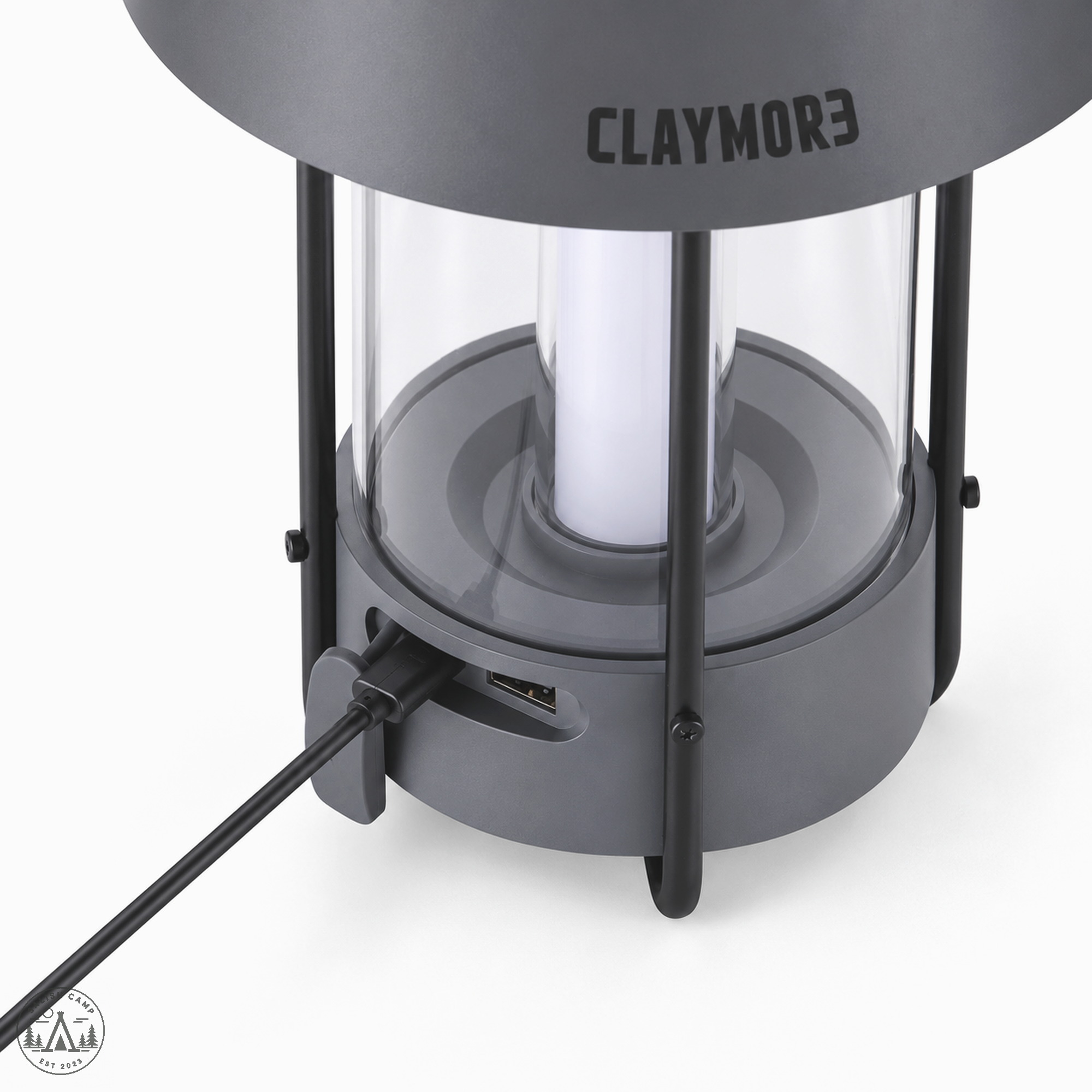
The USB-A power bank output is a handy extra if a phone needs a boost, but I wouldn’t treat the Selene as my main backup battery. Every bit of energy sent to another device is energy the lantern can’t use, and on a multi-night trip without charging, I save it for light.
The Selene has an old-fashioned silhouette with modern guts. The removable shade sets it apart from an ordinary cylinder lantern. With the shade on, it reads like a traditional table lamp, and taking it off gives you another look without a second light. A single button runs everything, which I appreciate when it’s cold or raining and I don’t want to navigate an interface just to find a comfortable mode.
The top handle lets you carry or hang it, and there’s a 1/4-in socket for compatible mounts, though I mostly keep it on a stable table where its shape and diffusion work best. On a gravel bar beside the Skagit, I watch where it sits, because a flat, steady spot matters on a crowded camp table. At 660 g, it’s no burden in a car-camp setup, but it’s real weight for anyone counting items in a backpack.
The Selene is rated IP54. That covers ordinary outdoor conditions and incidental splashes, but it isn’t waterproof or submersible, and I wouldn’t leave it out in sustained heavy rain. In the Pacific Northwest, its place is on a table under a tarp. On a late-season coastal site with damp air, wind-driven mist and the odd sideways shower, I keep it back from the exposed edge of the shelter and protect the charging ports from moisture.
The same gentle light gives it a life indoors, too: a cabin table, a bedside during a power outage or a covered porch. Because it’s rechargeable and burns nothing, there are none of the fumes or ventilation worries that come with fuel lanterns, a real advantage if you move it between camp and home.
At $167.95, this configuration includes a hardshell case, which is one of its most practical details. Lanterns with removable parts can be awkward to pack, and the case keeps the lantern, shade and cable together instead of rattling loose in a camp bin. During a wet pack-up on the Olympic Peninsula, when I’m busy keeping muddy gear away from everything else, that matters.
That’s the Selene’s appeal in the end. It isn’t trying to replace every other light in the kit. It’s the lantern I bring out once camp is set and I want the table to feel like a good place to spend the evening.
Pros
- Excellent ambient lighting options: Four modes spanning warm white through deep orange provide useful flexibility for dining, relaxing, and indoor atmosphere.
- Comfortable diffused output: The glare-free design is particularly well suited to close-range table lighting.
- Rechargeable with practical versatility: Long maximum runtime, USB-C charging, USB-A power output, and multiple placement options support regular camp use.
- Protective case included: The hardshell case makes the lantern and removable shade easier to organize and transport.
Cons
- Premium price for an ambient lantern: Much of the value comes from lighting character, design, and convenience rather than maximum output.
- Not particularly lightweight: At 660 g, it makes more sense for car camping and stationary use than lightweight backpacking.
- Limited as a primary area light: The 660-lumen ceiling and diffusion-focused design make it less suitable for illuminating large working spaces.
Technical Specifications
| Specification | Details |
|---|---|
| Product | Claymore Selene |
| Config | Dark Gray (CLL-GL-650DG), with hardshell case |
| Price | $167.95 USD (claymoreoutdoor.com, 2026-10-10) |
| Brightness | 30–660 lm |
| Colour | Warm White 3,000K, Orange 1,500K, Deep Orange 1,300K, Breeze 1,500–3,000K |
| Battery | 24.12 Wh (6,700 mAh @3.6V) |
| Run time | 6–55 h |
| Charging | USB-C 5V 2A, 5.5 h |
| Power bank | USB-A out 5V 2A |
| Water resistance | IP54 |
| Size | 165 x 165 x 250 mm |
| Weight | 660 g |
| Mounting | Top handle, 1/4-in socket, flat surface |
| In the box | Lantern, hardshell case, shade, USB-C cable |
Final Thoughts
The Claymore Selene is a good example of why brightness alone doesn’t determine whether a camping lantern is worth owning.
Its real strength is the quality and character of the lighting experience it offers. The warm colour temperatures, diffused output, traditional lantern shape, and Breeze mode make it appealing for evenings when comfort matters more than raw illumination.
For Pacific Northwest car camping, that’s a useful distinction. There’s plenty of equipment designed to help establish camp, prepare meals, and work after dark. Fewer pieces are designed specifically to make the time after those tasks more enjoyable.
I like the Selene most as a dedicated table lantern under a tarp, especially during cooler autumn trips when dinner extends into a long evening. Its battery capacity, rechargeable design, and included hardshell case make that role practical rather than purely decorative.
Still, it isn’t a universal lighting solution. I’d carry a headlamp for personal tasks and a separate high-output light when I need to illuminate a broader area. The Selene’s weight and premium positioning are difficult to justify if basic illumination is the only priority.
But for someone who cares about the feel of a campsite, prefers warm light over harsh white LEDs, and wants a rechargeable lantern that works just as comfortably indoors, the Selene offers a distinctive and well-considered combination.