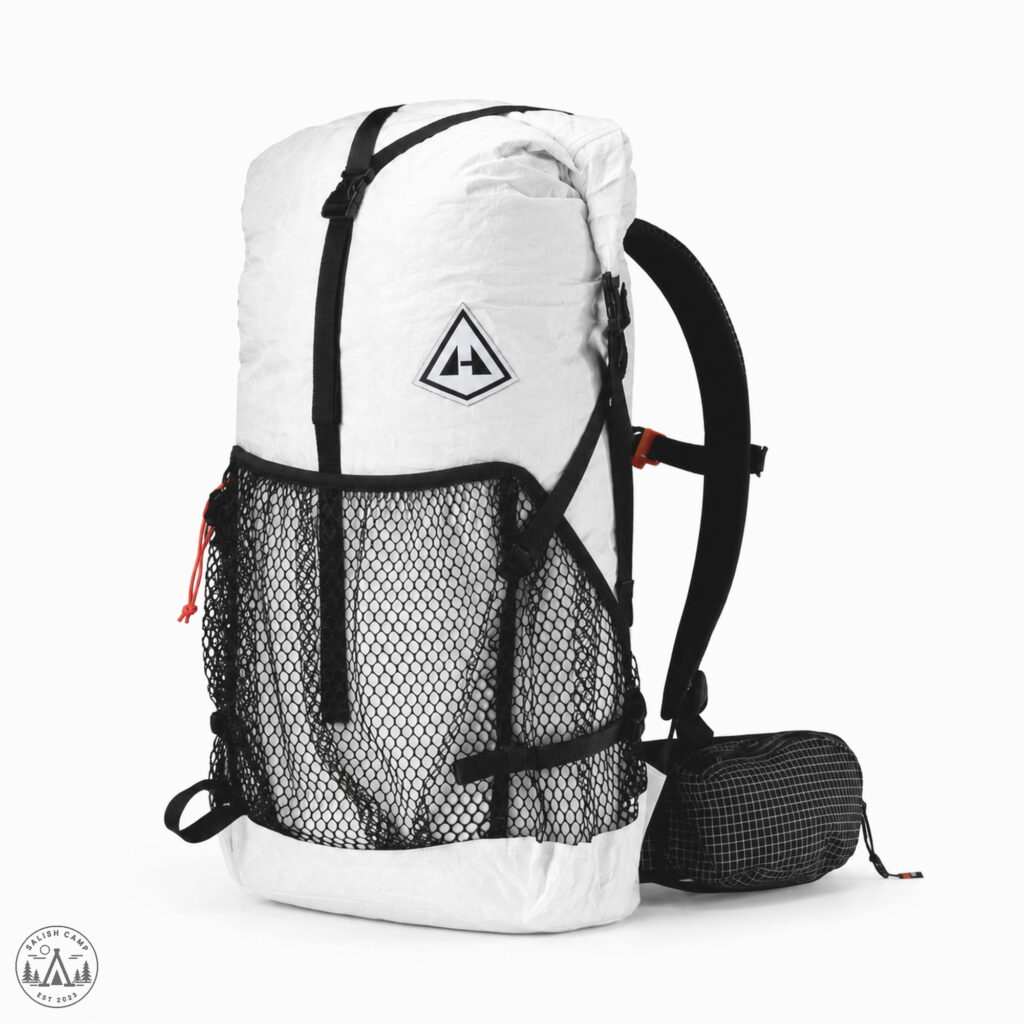
Buy if you want a classic Dyneema ultralight pack that stays under two pounds without giving up a hip belt, aluminum stays, an integrated foam back panel, or genuinely useful external storage. The locked 40L / Small / White Windrider weighs 27.9 oz (≈ 27.87 oz / 790 g), and its three external mesh pockets are exactly what I want for wet layers, bottles, and trail gear I don't want buried inside the pack. For Cascades and Olympics overnights with a reasonably compact kit, the combination of low weight, roll-top simplicity, and accessible storage is compelling.
Skip if $395 is beyond what you want to spend on an ultralight pack, your gear consistently needs more than 40L of internal space, or you don't like relying on exposed mesh for a large portion of your quick-access storage. I'd also skip this particular configuration if Small isn't your measured torso size. The captured Small / White variant was estimated to ship in two weeks, and I'd rather wait for the correct fit than spend this much and compromise on torso sizing.
What Stands Out
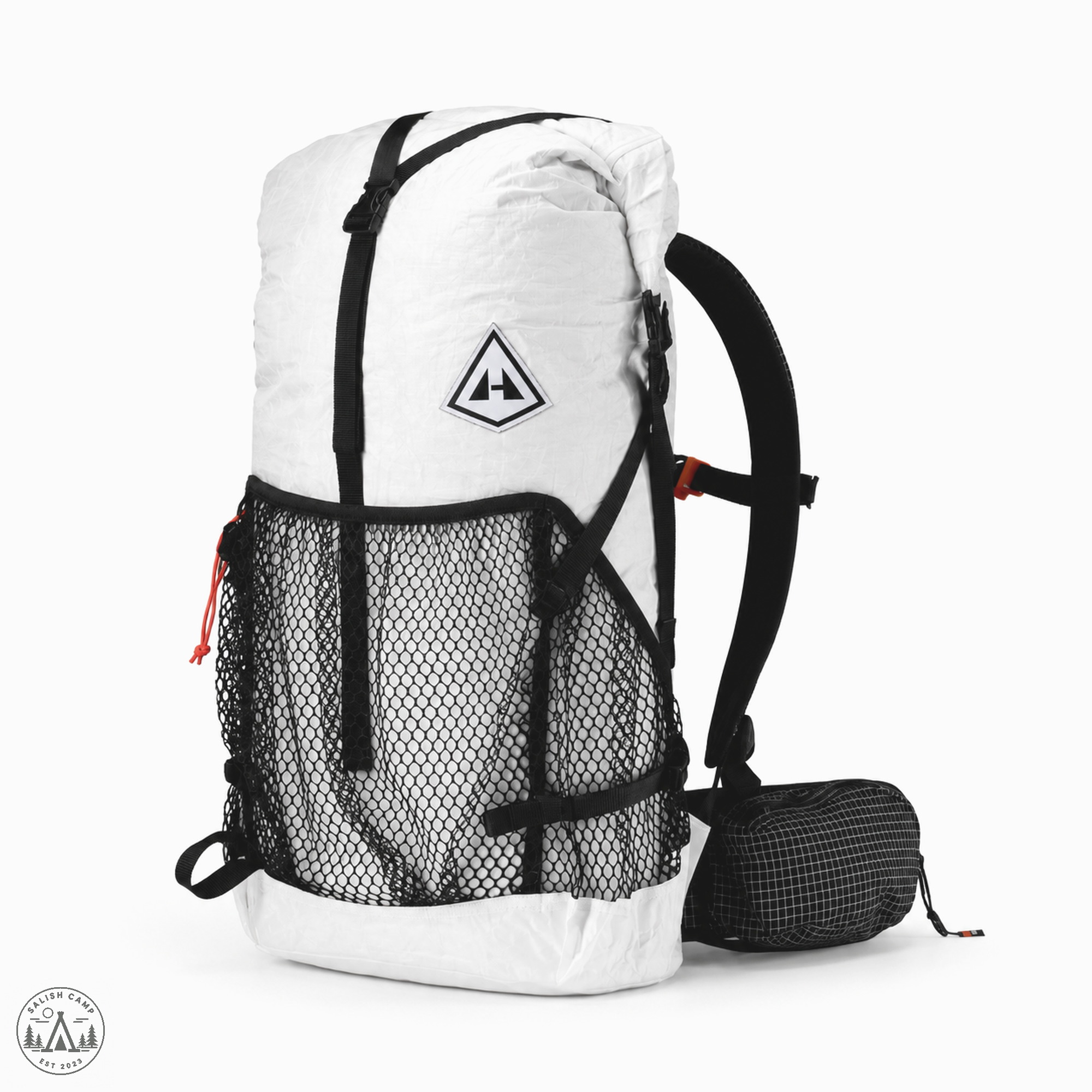
- 27.9 oz for the locked 40L / Small / White. That's the number that matters for this review, and it puts the Windrider comfortably below two pounds while retaining meaningful load-support components.
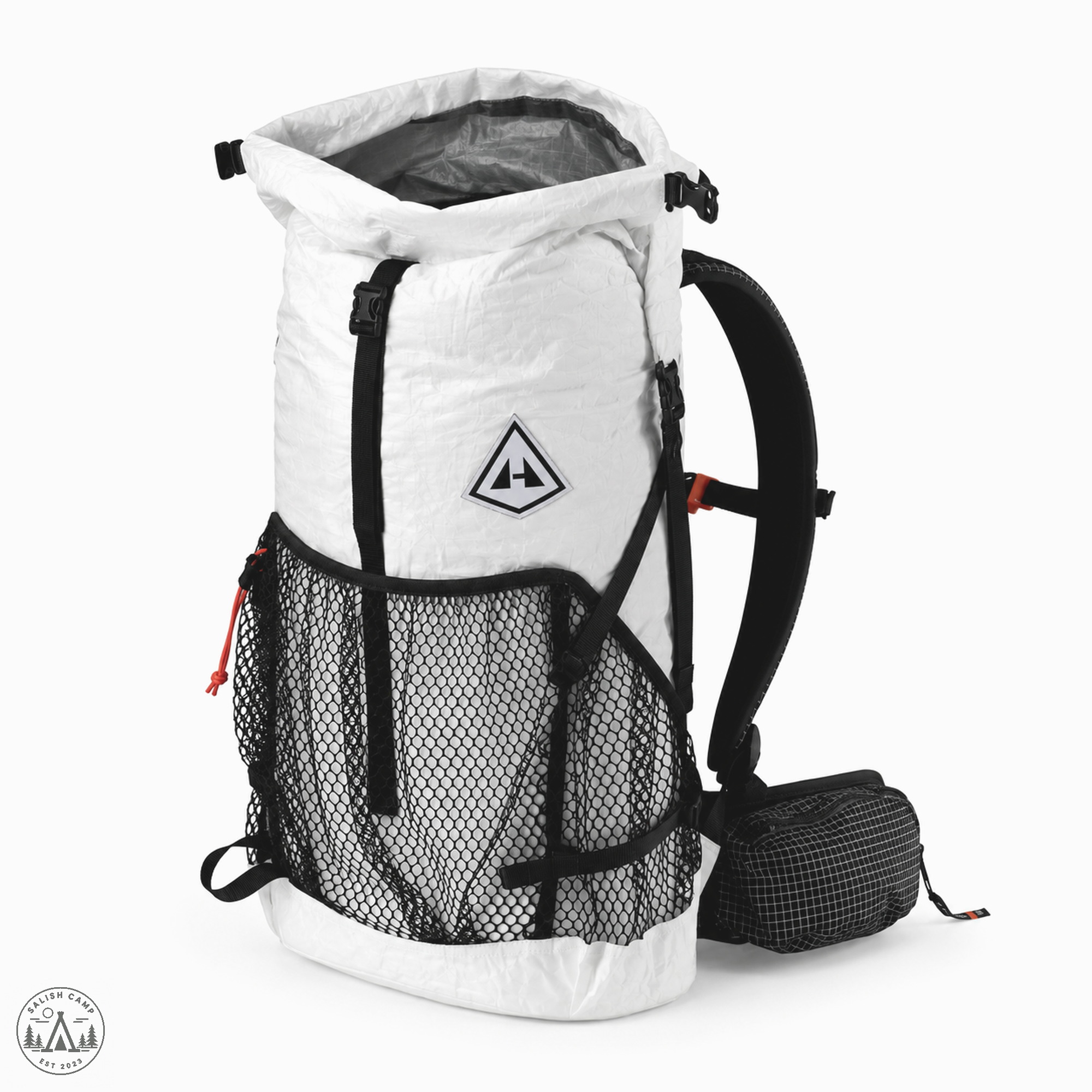
- Three external mesh pockets are central to the design. They're not token pockets: the 40L has 11.5 L of stated external volume, giving wet and frequently used equipment substantial space outside the main compartment.
- Dyneema® Woven Composite 3.9 is the main body material. Hyperlite pairs it with Large Hole Mesh for the Windrider's characteristic external storage.
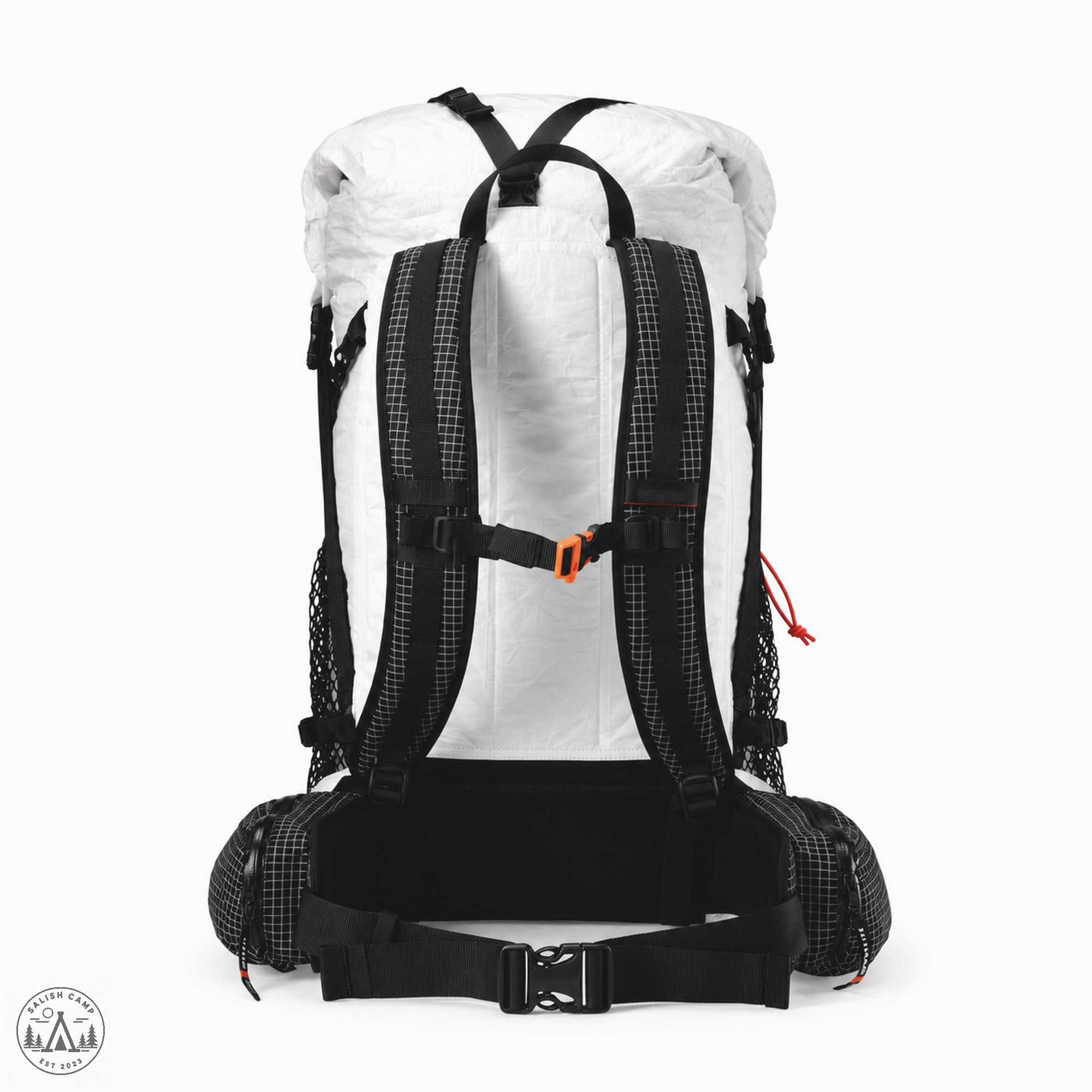
- The suspension has real structure. Two removable contoured aluminum stays work with an integrated 1/4-inch foam back panel and a sewn-through back-panel design.
- The roll-top is deliberately uncomplicated. Vertical compression straps close the top, while a Top Y-Strap adds another way to control the load.
- The redesigned outside pockets improve bottle access. Lower back edges are intended to make bottles easier to reach while wearing the pack, while the pockets themselves are deeper for better gear security.
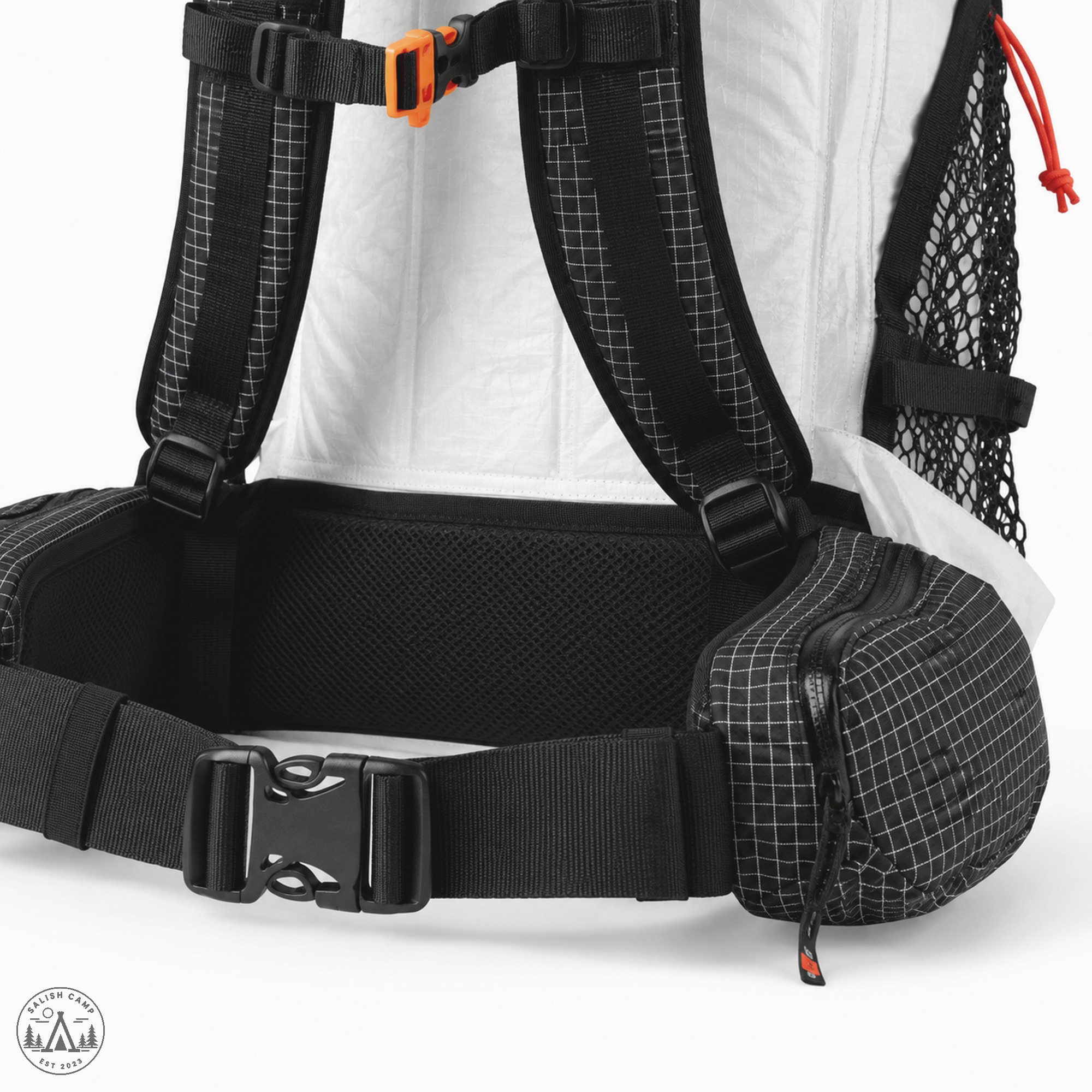
- The hip belt isn't stripped down to save ounces. It uses dual-density foam and spacer mesh and includes Hardline Dyneema® zippered pockets with #5 YKK zippers.
In The Field
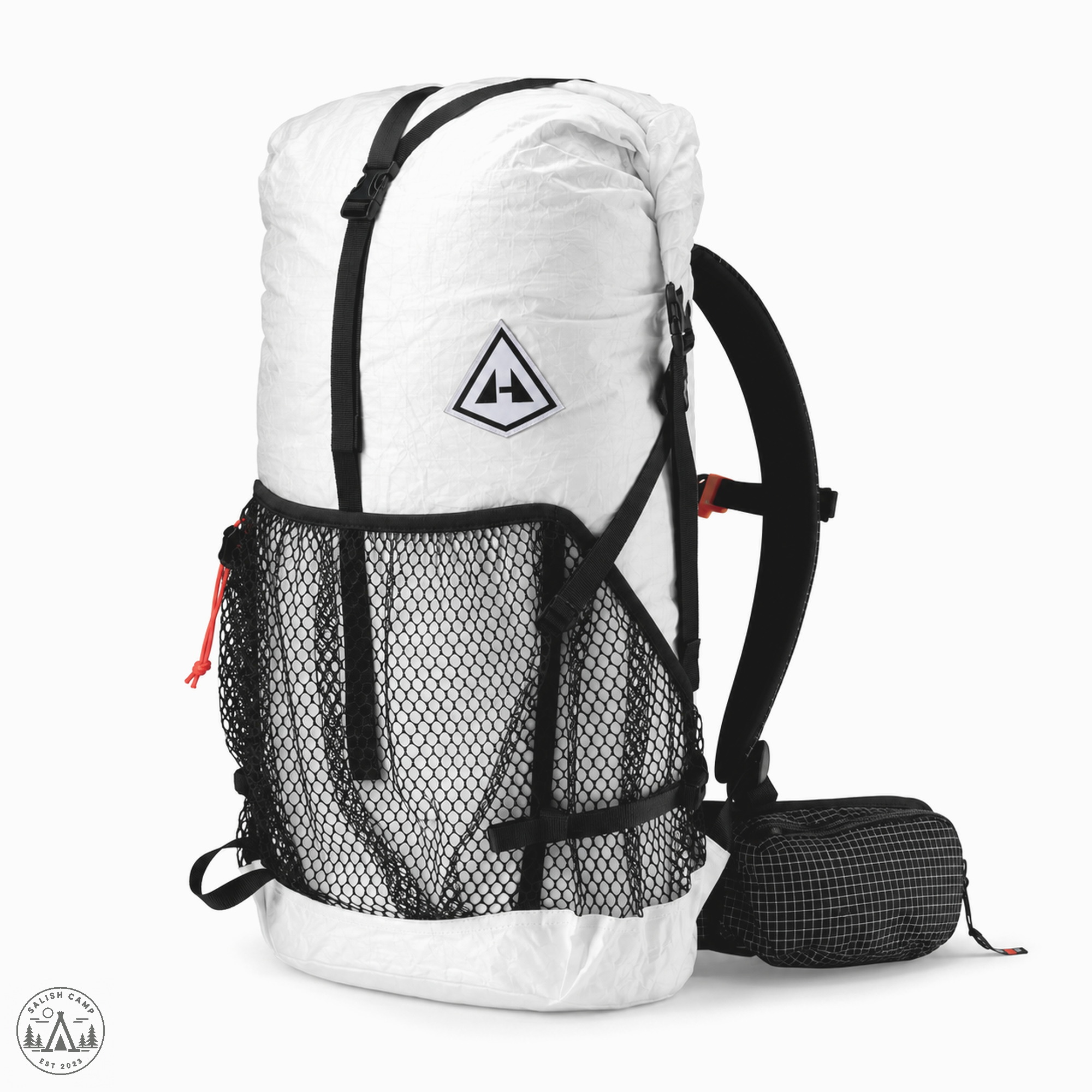
The Windrider is the kind of pack I appreciate more after a wet morning than while studying it indoors. Its layout is almost aggressively simple: one main roll-top compartment, three big mesh pockets, a hip belt, shoulder straps, compression, and enough internal structure to manage an actual backpacking load.
That simplicity works well for the way I pack for the Cascades and Olympics.
I want my insulation, sleep system, and dry camp clothing protected inside. I want things that become wet, dirty, or repeatedly needed during the day somewhere else. The Windrider's mesh pockets create that separation without requiring me to open another zippered compartment every time the weather changes.
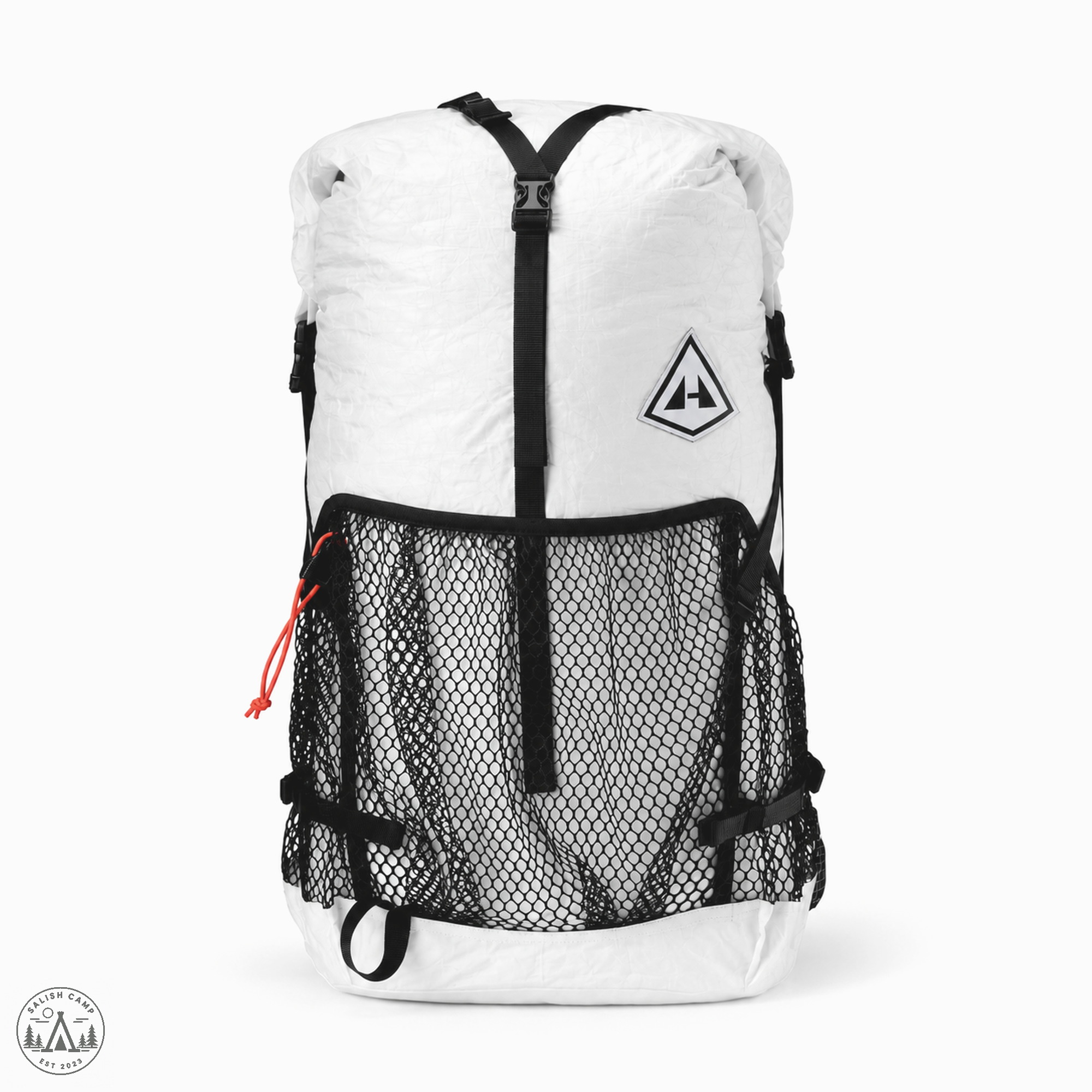
A rain shell is an obvious example. On a damp shoulder-season day, I may put it on and take it off repeatedly as showers move through or the trail changes elevation. I don't want to unroll the main compartment every time. A wet shelter component or groundsheet is another candidate for external storage when conditions make that practical. Water treatment and other frequently accessed trail items can stay outside as well.
That's where the Windrider's 11.5 L of external volume becomes important. A novice looking only at "40L" could assume this is an extremely restrictive pack, but that number describes the internal volume. The external storage adds considerable working capacity.
I still wouldn't buy the 40L version without first looking hard at the rest of my kit. Forty liters works best when the shelter, insulation, sleep system, clothing, and cook kit are already reasonably compact. A bulky synthetic sleeping bag or large shelter can consume space quickly. If my normal load simply doesn't fit, I'd rather acknowledge that than hang equipment everywhere outside the pack and pretend I've made 40L work.
Hyperlite offers the Windrider in 55L and 70L versions as well, at $420 and $450. Those are useful context, but 40L is the pack I'm interested in here: a size for overnight and lightweight multi-day travel where I've already done enough gear refinement that I don't need a huge main compartment.
The roll-top reinforces that approach. I load the main body, bring the sides together, roll it down, and secure it with the vertical compression straps. The Top Y-Strap gives me another way to compress the load. There isn't a floating lid or separate top compartment to manage.
The more interesting part is that Hyperlite hasn't achieved the low pack weight by turning the Windrider into a frameless fabric tube.
The 40L uses an integrated 1/4-inch foam back panel and two removable contoured aluminum stays. The back panel is sewn through, and the redesigned shoulder straps use a revised shape with additional bartacks for sternum-strap adjustment. The hip belt uses dual-density foam and spacer mesh.
That structure matters because the 40L has a stated load capacity of up to 40 lbs.
I treat that as a ceiling, not an invitation. If I'm buying a 27.9-ounce pack, my goal isn't to carry 40 pounds every weekend. But water, food, shoulder-season equipment, or a longer resupply can push a normally light load upward. Having stays and a hip belt gives me more load-management capability when that happens.
For someone coming from a conventional backpack, that also makes the Windrider a relatively understandable transition into ultralight gear. I don't have to abandon the idea of transferring load through a hip belt or immediately learn how to make a frameless pack comfortable. I can reduce pack weight substantially while retaining familiar suspension components.
The catch is that none of those features can rescue bad sizing.
This review is specifically about the Small torso, which covers 15–17 inches. I would measure my torso rather than infer the size from my height, clothing size, or whatever backpack I happened to own previously.
With a structured pack, I want the hip belt sitting where it can do its job and the shoulder straps interacting naturally with my torso. If the pack is too long or too short, endlessly adjusting the sternum strap and load isn't going to change the underlying geometry.
For clarity, the locked 40L / Small / White pack here is 27.9 oz, while Hyperlite's 29.6 oz / 840.1 g White spec-table figure is the 40L average for size Medium.
Once the fit is right, the side-pocket design becomes another practical advantage. Hyperlite redesigned the outside pockets with more depth and lower back edges to improve water-bottle access. That's a small change on paper and a meaningful one after hours on trail.
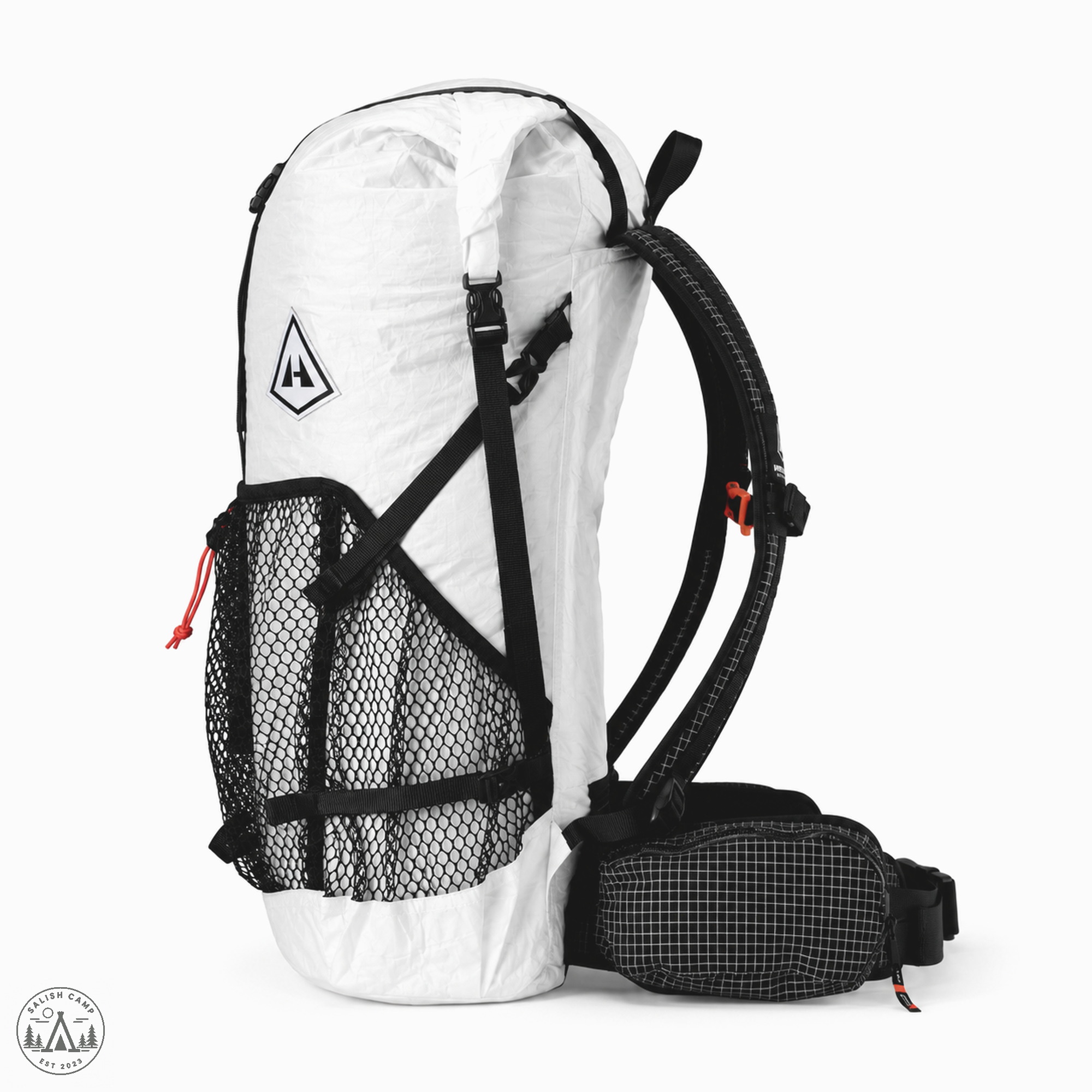
I strongly prefer being able to reach a bottle without removing my pack. If I can't, the bottle pocket becomes storage rather than genuine on-trail access. Lowering the rear edge makes the pocket easier to reach while the additional depth helps keep equipment secure.
The removable side compression straps give me another way to control the load, and the pack also provides daisy chains for external carry. There's a bladder hang loop and hydroport if I prefer a reservoir rather than bottles.
Then there's the White Dyneema® Woven Composite 3.9.
White is the classic visual treatment for this kind of pack, but I wouldn't choose it with any expectation that it will remain visually untouched. Pacific Northwest backpacking means wet brush, mud, gritty camps, tree debris, and plenty of opportunities to make a white pack look like it has been backpacking.
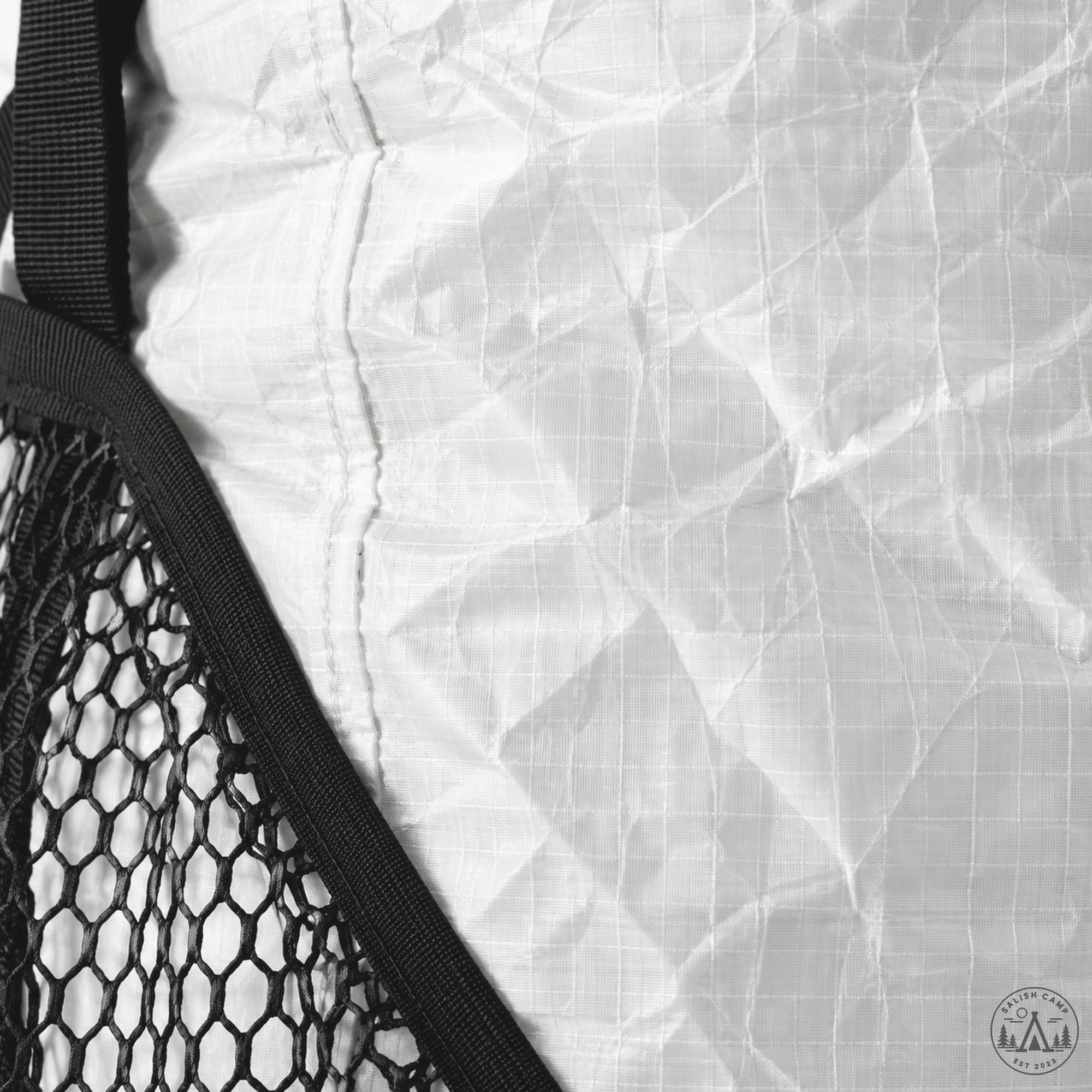
Hyperlite says Dyneema® Woven Composite 3.9 combines the light weight of its Dyneema® Composite Hybrid 3.8 with durability and abrasion resistance surpassing the heavier Dyneema® Composite Hybrid 5.9. That's an interesting material claim, but what matters to me in this particular pack is the resulting balance: a light body material paired with a backpack that still includes stays, foam, a substantial hip belt, and useful external pockets.
I approach weather protection with similarly practical expectations. The Windrider has seam tape on all vertical side seams and behind sewn-on pack features, and Hyperlite describes the materials as waterproof while also suggesting pairing the pack with Stuff Sacks.
For PNW use, that's enough information for me to keep protecting critical insulation and sleep gear rather than treating the pack as an excuse to stop thinking about water management. Sustained rain has a way of finding weaknesses in any packing system. My sleeping insulation is too important to use as the experiment.
The mesh makes the wet/dry strategy easier because soaked equipment doesn't automatically have to go back inside.
The last issue is price and timing.
At $395, this isn't a pack I'd buy because I vaguely want to "go ultralight." I'd buy it after getting the rest of my gear reasonably compact, confirming that 40L is appropriate, measuring my torso, and deciding that the Windrider's external mesh layout suits the way I hike.
The captured Small / White configuration also carried an estimated two-week shipping window. That means I wouldn't order one immediately before a planned trip. More importantly, I wouldn't change torso sizes just to get a pack faster.
When all of those decisions line up, though, the Windrider's appeal is straightforward. It gets my base pack weight down without forcing me into an aggressively minimal suspension, gives wet equipment an obvious place to live, and keeps the daily act of opening, closing, and organizing my backpack uncomplicated.
For wet PNW overnight miles, that's a combination I can use.
Pros
- Low weight with useful structure: The locked 40L / Small / White configuration is 27.9 oz while retaining aluminum stays, an integrated foam back panel, and a real hip belt.
- Excellent external working storage: Three mesh pockets and 11.5 L of external volume give wet and frequently accessed gear somewhere practical to live.
- Simple roll-top organization: Vertical compression straps and the Top Y-Strap keep the closure and load-management system straightforward.
- Thoughtful trail access: Deeper external pockets with lower rear edges make water-bottle access more practical while wearing the pack.
Cons
- Premium price: $395 is a substantial investment for a 40L ultralight backpack.
- Mesh isn't ideal for everything: Gear needing more protection belongs inside rather than in the exposed external pockets.
- Availability requires planning: The captured 40L / Small / White configuration was estimated to ship in two weeks.
Technical Specifications
| Specification | Details |
|---|---|
| Product | Hyperlite Mountain Gear Windrider |
| Config in photos / primary | 40L / Small / White, SKU 3-40140-1 |
| Price (primary) | $395.00 USD (hyperlitemountaingear.com, 2026-10-06) |
| Weight (primary) | 27.9 oz (≈ 27.87 oz / 790 g) for locked 40L Small White |
| Availability (capture) | Estimated to ship in 2 weeks |
| Other volumes / prices | 55L $420.00; 70L $450.00 |
| Spec-table 40L White average (medium) | 29.6 oz / 840.1 g* (average, size medium) |
| Spec-table 40L Black average (medium) | 29.8 oz / 844.1 g* (average, size medium) |
| Volume / external volume (40L) | 40L internal; 11.5 L external |
| Load capacity (40L) | Up to 40 lbs |
| Material | Dyneema® Woven Composite 3.9, Large Hole Mesh |
| Back width (40L) | 11 in / 27.9 cm |
| Height fully unrolled (40L) | 31.5 in / 80.0 cm |
| Top / bottom circumference (40L) | 37.5" / 33.5" (95.3 / 85.1 cm) |
| Torso (primary) | Small 15"–17" |
| Colors | White (primary); Black also offered |
| Closure / compression | Roll-top with vertical compression straps; Top Y-Strap |
| Back panel (40L) | Integrated 1/4" foam; sewn-through; two removable contoured aluminum stays |
| Hip belt | Dual density foam + spacer mesh; Hardline Dyneema® zippered pockets (#5 YKK) |
| External pockets | Three external mesh pockets |
| Country | Mexico |
Final Thoughts
The Windrider 40L appeals to me because its ultralight credentials don't come at the expense of the backpack features I still value on PNW trips. At 27.9 oz for this 40L / Small / White configuration, it gives me aluminum stays, an integrated foam back panel, a supportive hip belt, hip-belt pockets, practical compression, and three large external mesh pockets.
Those mesh pockets are the defining feature. They suit the rhythm of hiking in the Cascades and Olympics, where rain shells, wet gear, water, and frequently used equipment need to move in and out of storage throughout the day. The roll-top main compartment can stay focused on the equipment I want protected.
I'd still approach the purchase methodically. Make sure 40L fits the actual kit. Measure torso length instead of guessing. Accept that White will show trail use. Order early enough that the estimated shipping window isn't a problem. And decide whether the Windrider's combination of material, weight, structure, and pocket layout is worth $395.
If those pieces line up, this is exactly what I want from a classic Dyneema ultralight backpack: low weight without making the carrying system unnecessarily austere, big external storage without complicated organization, and a roll-top design that stays simple from trailhead to a wet evening camp.