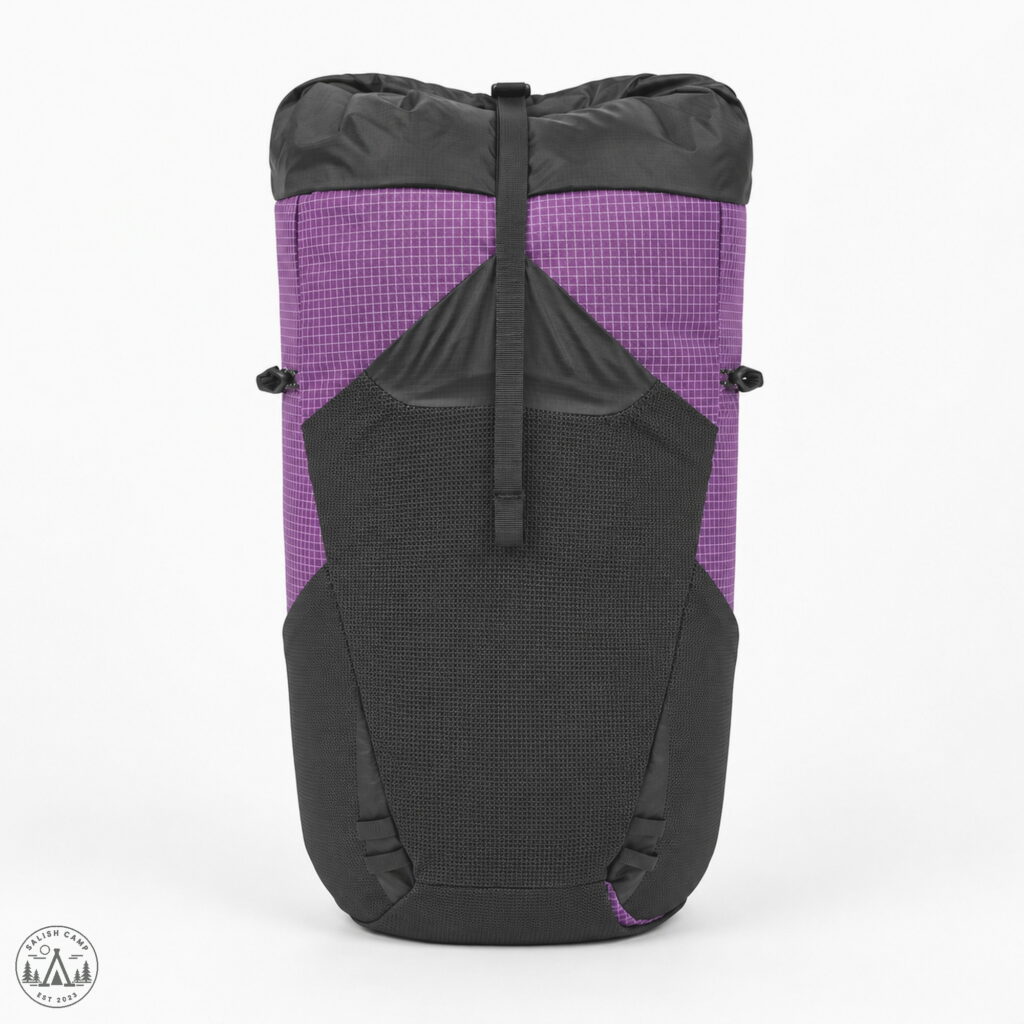
Buy if your overnight kit is already compact, you move quickly over technical trails, and you want a 14.1 oz frameless pack that carries more like a running vest than a traditional backpack. At $240, the purple gridstop Joey combines a flexible 3D-mesh harness, reachable bottle pockets, and an on-the-move bottom pocket in a genuinely minimalist 24 L package.
Skip if your trips require bulky insulation, a large food load, substantial wet-weather gear, or the load transfer of a framed backpack. The Joey rewards careful packing and disciplined gear choices. It is not the pack I would choose for a leisurely three-night trip in the Olympics with unpredictable weather and extra clothing.
What Stands Out
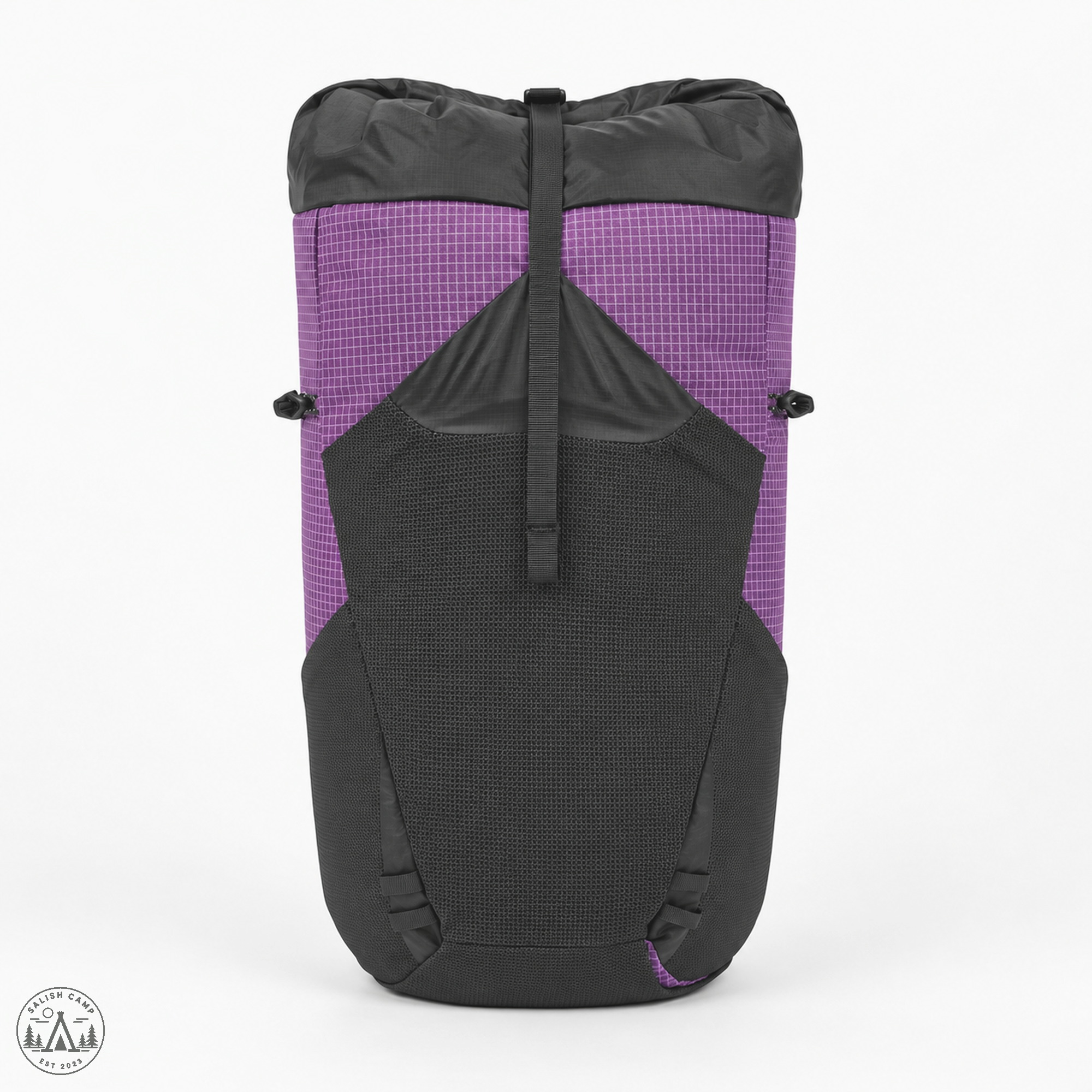
- 14.1 oz for a complete overnight vest pack. The standard-strap purple gridstop Joey keeps weight exceptionally low while providing a 24 L main compartment, a reachable bottom pocket, chest and side bottle pockets, and a close-fitting vest harness.
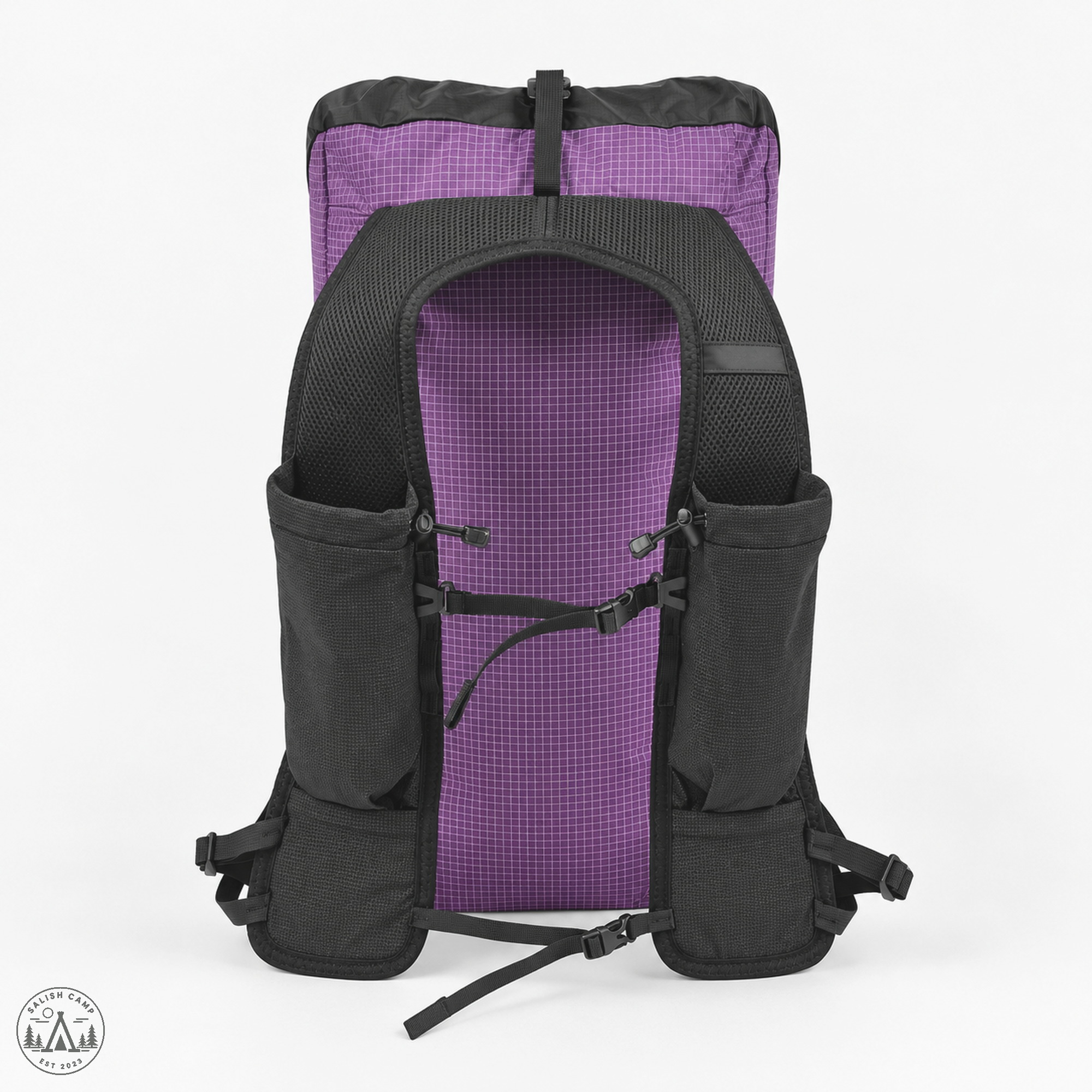
- A harness designed around movement. Two layers of stretchy 3D mesh wrap around the shoulders, distributing weight across a broader contact area than conventional narrow backpack straps. Upper and lower sternum straps help stabilize the carry.
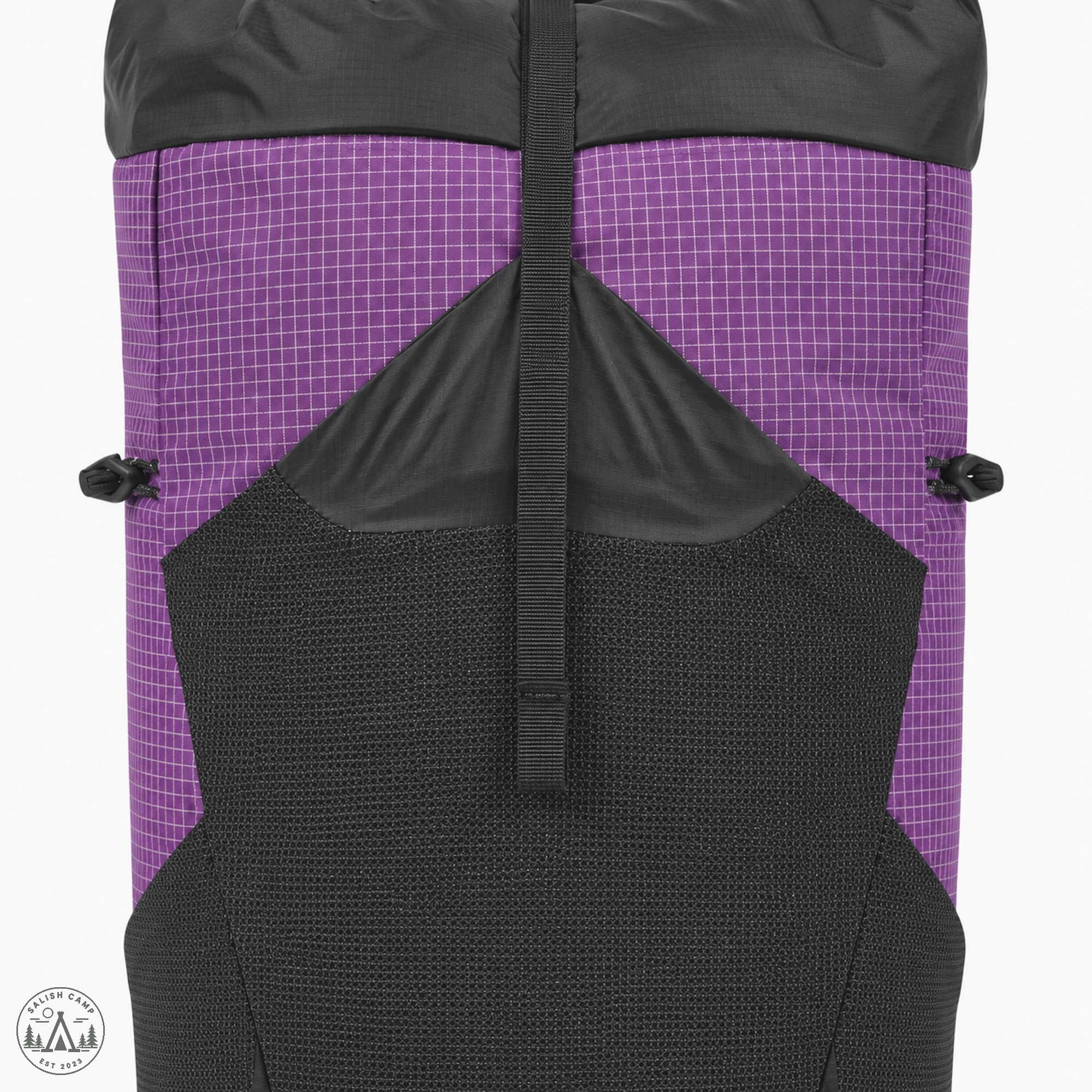
- A bottom pocket you can actually reach. The UHMWPE grid mesh pocket underneath the pack lets you retrieve snacks or small essentials without removing it. A separate small trash portal sits opposite the main opening.
- Water access without stopping. Two chest pockets accommodate short, wide 500 ml soft bottles, while two side pockets can hold 1-liter bottles. The layout supports drinking and retrieving small items while walking.
- A simple cinch-and-G-hook closure. The main compartment closes with a cinch cord and an exterior G-hook strap, avoiding complicated lid assemblies and keeping the pack straightforward to operate.
- Useful exterior attachment details. Tension-lock shock cords above the side pockets help stabilize tall items, while 10 mm webbing attachment points provide additional options for carrying an ice axe or other gear.
- A meaningful fabric choice. The purple 210D UHMWPE gridstop version costs $240, while the black Ultraweave 200x version costs $300 and includes a reinforced Ultra 200TX back panel. Both preserve the Joey’s compact, frameless design.
In The Field
The Joey makes the most sense when I think about how my packing has changed for fast Cascades trips. On a normal backpacking weekend I can justify a roomier shelter, extra cook gear, or another layer that might never leave the pack. When the plan is a long day that runs into an overnight and another early start, every item has to earn its place. That is the environment the Joey is built for. It is not a traditional backpack with vest straps added afterward. Its 24 L capacity, flexible harness, and accessible pockets push a different way of traveling through the mountains.
Whether 24 L is enough for a real Pacific Northwest overnight depends on the kit, not optimism. For a fast Goat Rocks overnight I would start with a compact shelter, a small quilt or sleeping bag, an inflatable pad, and minimal sleep clothing — those pieces have to compress well, because they consume much of the space before food or insulation enter the equation. What I refuse to cut is a dependable rain shell, an insulating puffy, a compact first-aid kit, navigation essentials, and enough food for the route. Even in summer an exposed Cascade ridge can turn cold and wet quickly. Cutting pack weight should never mean pretending a rain jacket and warm insulation are optional. The difference between a workable Joey load and an overloaded one is usually volume more than ounces: a bulky synthetic bag or large freestanding tent can swallow the room a more compact system leaves for clothing and food.
I pack sleeping insulation low, with soft clothing against the back-facing wall so the contact surface stays forgiving — the Joey has no rigid frame or padded back panel. Denser items belong close to my back rather than hanging away from my center of gravity. Food, shelter components, and other firm objects need deliberate placement; a poorly positioned cook pot or canister becomes a pressure point after several hours. On an Olympic coast overnight the food-storage requirement adds another wrinkle. Pa’lante confirms a BV425 fits sideways inside the Joey, and it can also ride on top under the G-hook when the pack is not completely full (Pa’lante suggests carrying it empty or with trash for balance). That flexibility helps, but it does not magically grow the internal capacity.
What interests me most is the harness. Instead of narrow backpack straps, Pa’lante uses two layers of stretchy 3D mesh that wrap around the shoulders to spread pressure and mold to the upper body. On a fast hike, when I move from a steady climb into a rocky descent, I want the pack to move with my torso rather than swing independently. The upper sternum strap adjusts along a daisy chain; the lower stays fixed. Together they give two points of chest stabilization. I start with the upper strap in a comfortable position, then tighten both enough to control bounce without restricting hard breathing on sustained climbs. Cranking everything down is rarely the answer. The aluminum suspension rings on the side adjustment straps finish the fit system. Still, a frameless vest can improve stability without replacing a frame or transferring substantial weight onto the hips. If the load starts to feel wrong, the fix is to reduce gear or change packs — not to force the Joey to behave like a framed backpack.
Choosing the right harness matters because both strap configurations share the same 18 in pack body. Standard straps suit roughly small-to-medium builds; long straps suit larger and XL builds and add about 2 in above the strap pockets. Pa’lante’s own fit notes are useful: testers at 5’4", 5’7", and 6’1" wear standard straps, while a 6’4" tester wears long straps. I would not decide on height alone. Shoulder width, chest shape, and where the pockets sit when the pack is loaded all matter — the chest pockets should stay reachable without forcing the sternum straps into an awkward position. Anyone between sizes should check Pa’lante’s sizing page before ordering rather than assuming longer straps are more comfortable.
One of the strongest arguments for the Joey is how much stays accessible while moving. On a long Enchantments traverse I prefer a steady rhythm instead of stopping for every snack. The bottom pocket puts UHMWPE grid mesh underneath the pack so contents stay within reach; I keep frequently needed food there and keep smaller items organized so they do not bury themselves. The small trash portal on the opposite side is especially practical — empty wrappers go back into the pack without mixing with clean snacks or opening the main compartment. The chest pockets are shown holding short, wide 500 ml soft bottles, a format that suits the vest layout; I would not assume a taller, narrower running flask fits equally well. The side pockets are shown with 1-liter bottles and a tenkara rod, giving another way to carry water or small gear without breaking stride. For a fast Wonderland Trail section I would lock the water arrangement before starting so weight stays balanced and the bottles I actually use stay in reach.
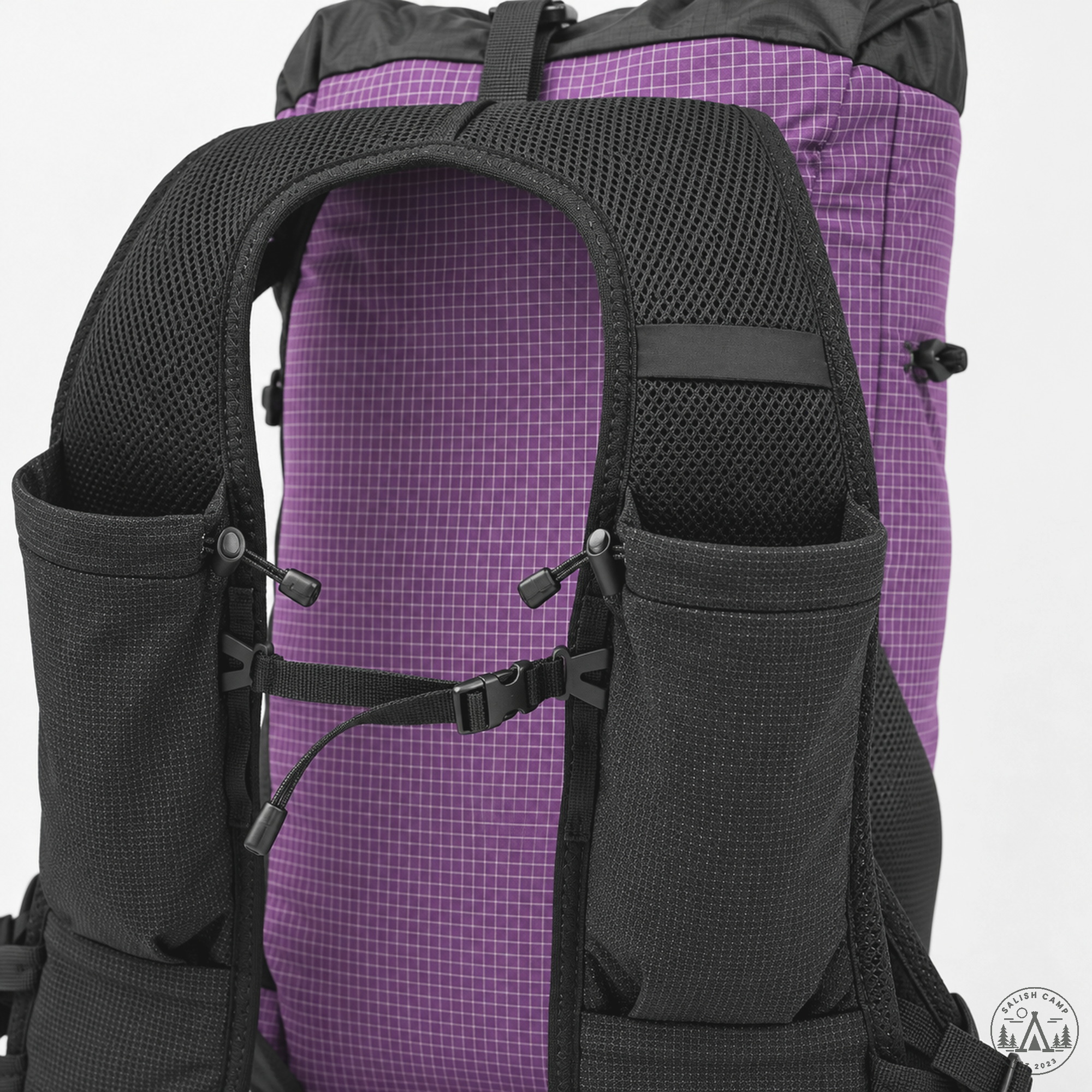
The purple gridstop Joey is the version I find most appealing for this role. Pa’lante prints the gridstop weight as 14.1/14.6 oz without labeling which figure is which; by the page’s size order I use 14.1 oz for the standard-strap pack. At 14.1 oz and $240 it delivers the full 24 L design without the Ultraweave upcharge. The black Ultraweave 200x version costs $300 and weighs 14.7 oz with standard straps, and it adds a reinforced Ultra 200TX back panel. That fabric difference may matter to someone who specifically wants the Ultraweave system, but it does not change the carrying architecture — both versions remain compact, frameless vest packs. For my fast-and-light PNW use I would put the $60 toward another piece of kit before upgrading the pack fabric. I would also use a waterproof pack liner either way. The Joey is not advertised as waterproof, and prolonged Olympic Peninsula rain is a poor place to trust an unverified fabric-and-seam system. A liner protects the sleeping insulation and dry clothing I need at camp; the rain shell stays accessible outside the liner so I can put it on without unpacking.
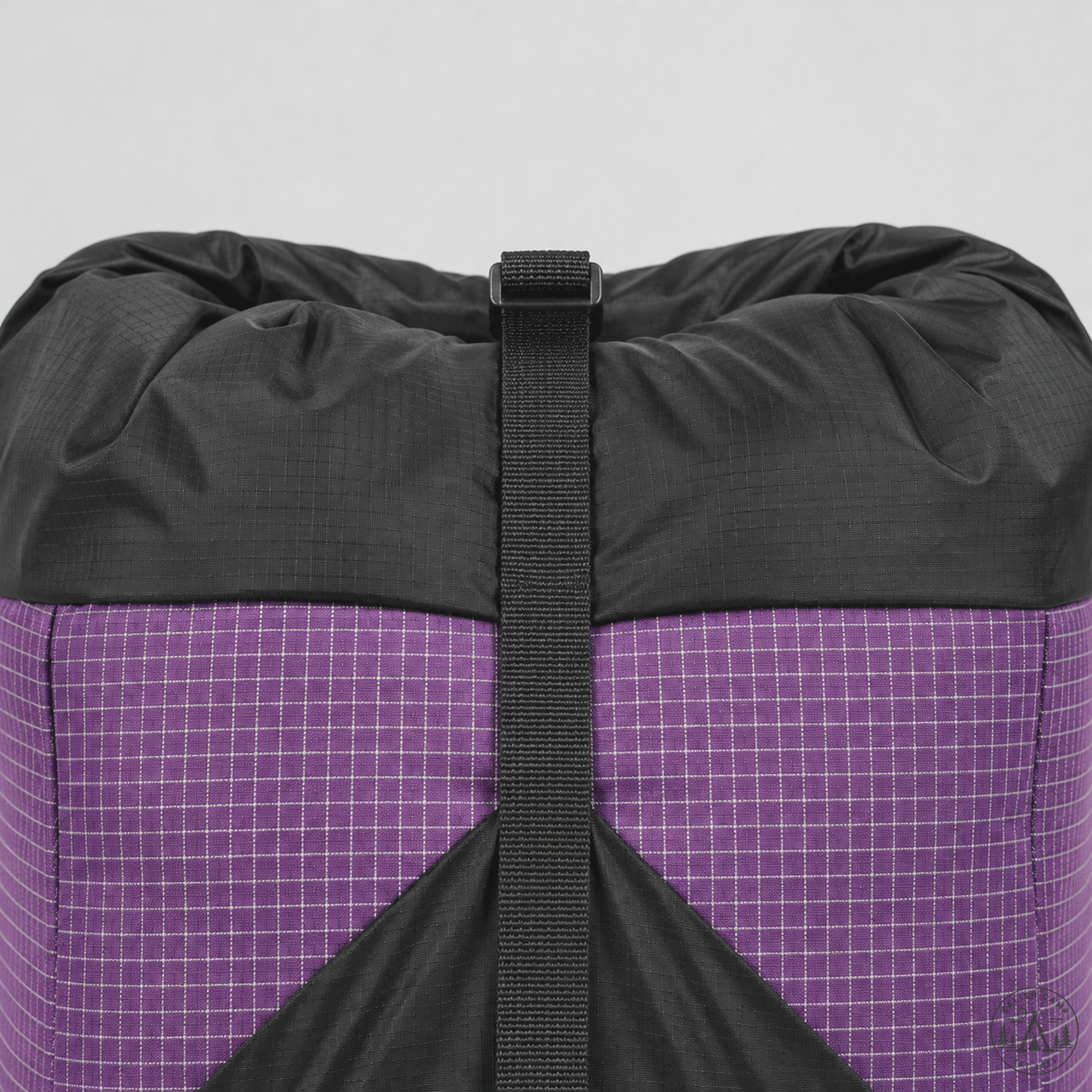
The Joey is attractive because it makes a narrow set of compromises well. For a one-push Enchantments traverse with emergency overnight capability, or a short fastpacking route with compact equipment, the low weight and body-hugging harness earn their keep. A longer North Cascades trip with extra food, cold-weather insulation, and substantial rain protection changes the equation. If I am strapping multiple bulky items outside simply to close the pack, I have chosen the wrong capacity. The same applies when I want a heavier camera kit, a more comfortable sleep system, or several days of food between resupplies. Then a larger frameless pack gives more usable volume, and a framed backpack is the better call when load support matters more than running-vest stability. The Joey is not a replacement for every backpack I own. It is the pack I reach for when the kit is already lean and the objective is to move efficiently over long distances.
Pros
- Exceptionally light overnight platform. At 14.1 oz, the standard-strap gridstop Joey provides 24 L of capacity without unnecessary structure.
- Movement-focused vest harness. Stretchy two-layer 3D mesh, dual sternum straps, and side adjustments support a close-fitting carry.
- Excellent on-the-move organization. Reachable bottom, chest, and side pockets reduce the need to stop and unpack.
- Simple, functional construction. The cinch-and-G-hook closure, exterior shock cords, and attachment points provide useful flexibility without excessive hardware.
Cons
- Limited internal volume. The 24 L compartment requires compact shelter, sleep, clothing, and food systems, particularly in wet or cold conditions.
- Minimal structural support. Frameless construction and no hipbelt make careful packing essential and limit its appeal for heavier loads.
- Harness fit requires attention. Standard and long straps change the vest’s positioning, and the fixed lower sternum strap offers less adjustment flexibility.
Technical Specifications
| Specification | Details |
|---|---|
| Product | Pa’lante Packs Joey |
| Config in photos / primary | Purple 210D UHMWPE gridstop / black UHMWPE grid mesh, standard straps, SKU joey-purple-gridstop |
| Price (primary) | $240 USD (palantepacks.com, 2026-10-09, in stock) |
| Type | Frameless vest-style pack |
| Volume | 24 L (internal capacity) |
| Weight | 14.1 oz |
| Size | 18 in; standard straps (long straps about 2 in longer) |
| Fabrics | 210D UHMWPE gridstop, 70D nylon ripstop, 70D 3×3 UHMWPE grid mesh |
| Closure | Cinch cord and G-hook |
| Pockets | Bottom pocket, 2 chest pockets, 2 side pockets |
| Other options | Long straps 14.6 oz, $240; Ultraweave 200x 14.7 oz (standard) / 15.1 oz (long), $300 |
| Manufactured | Vietnam |
Final Thoughts
The Pa’lante Joey is a specialized pack, and that is exactly why I like its design.
It takes the features I appreciate in a running vest — close-fitting shoulder straps, accessible food storage, convenient hydration, and reduced bounce — and applies them to a compact overnight backpack.
For the kind of Pacific Northwest trip where I am covering substantial mileage, moving quickly over uneven terrain, and carrying only the equipment needed for a safe night outside, that combination makes sense.
The purple gridstop version is especially compelling. Its 14.1 oz weight and $240 price make it the lighter, less expensive choice compared with the Ultraweave configuration, while retaining the same core carrying concept.
I would not choose it for every Cascades backpacking trip. A long stretch of rain, colder temperatures, or a more substantial food load can quickly expose the limitations of a 24 L frameless pack. And without a hipbelt, there is little reason to force a heavier kit into it simply to save pack weight.
But when my equipment is compact, the weather preparation is deliberate, and the route rewards moving efficiently, the Joey offers something different from a conventional ultralight backpack.
It is a vest that can carry a carefully selected overnight kit, rather than an overnight backpack pretending to be a running vest.