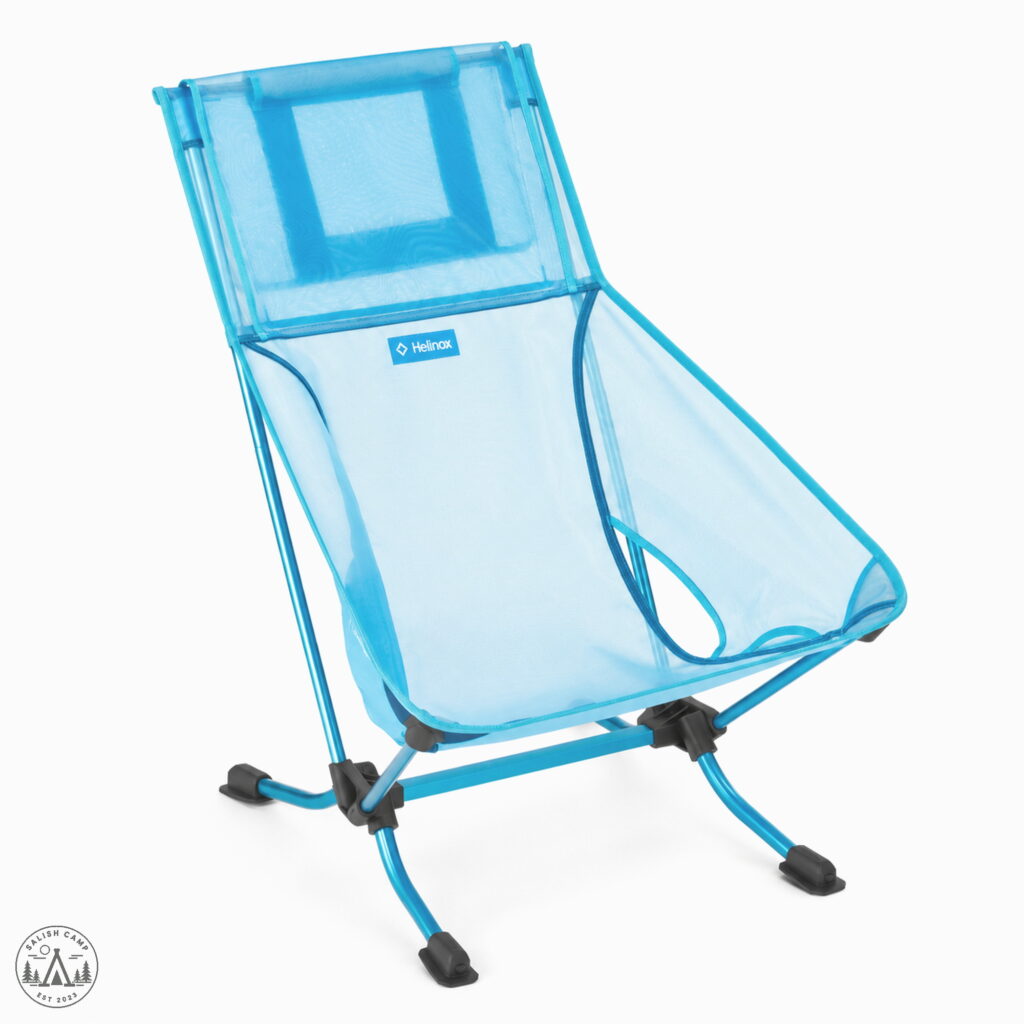
Buy if your camp days regularly end up on Puget Sound beaches, Lake Washington shorelines, coastal sand, soft turf, or other ground where conventional camp-chair feet tend to dig in. The Beach Chair (re) is unusually purpose-specific: the splayed frame and flat feet address soft ground, while the high back gives you somewhere to settle for a long afternoon rather than perching in a minimalist trail chair. The $189.95 Black and Biscay Green versions use solid 300D fabric and pack substantially slimmer; the photographed $209.95 Blue Mesh version trades that compact packed shape for full open-weave ventilation and a mesh tote.
Skip if you mainly need a chair for backpacking, want the smallest possible package in a packed car, or rarely sit on sand or soft ground. At 3 lb 14 oz packed for Blue Mesh—and with the standard build listed at 1704 g—the Beach Chair (re) is portable rather than ultralight. If minimizing carried weight matters more than having this high-back, sand-oriented geometry, our Helinox Chair Zero LT review covers another beach option Helinox itself names because of that chair's built-in ground stabilizer.
What Stands Out
- The frame is genuinely shaped around soft ground. Splayed legs and broad, flat feet distribute the chair's load instead of concentrating it through narrow contact points that can disappear into sand, mud, or soft turf.
- It stays low without giving up a high back. That's the defining combination here: a low beach-chair position with neck and shoulder support rather than the abbreviated back common on smaller packable chairs.
- There are two materially different builds on the same product page. Black and Biscay Green use solid 300D fabric for $189.95; the photographed Blue Mesh version is full open-weave mesh and costs $209.95.
- Blue Mesh is much bulkier when packed. Its mesh tote measures 21.5 x 6.5 x 9 in, versus the standard chair's 21 x 6 x 4.5 in dual-zip case. That's a meaningful difference when loading a vehicle.
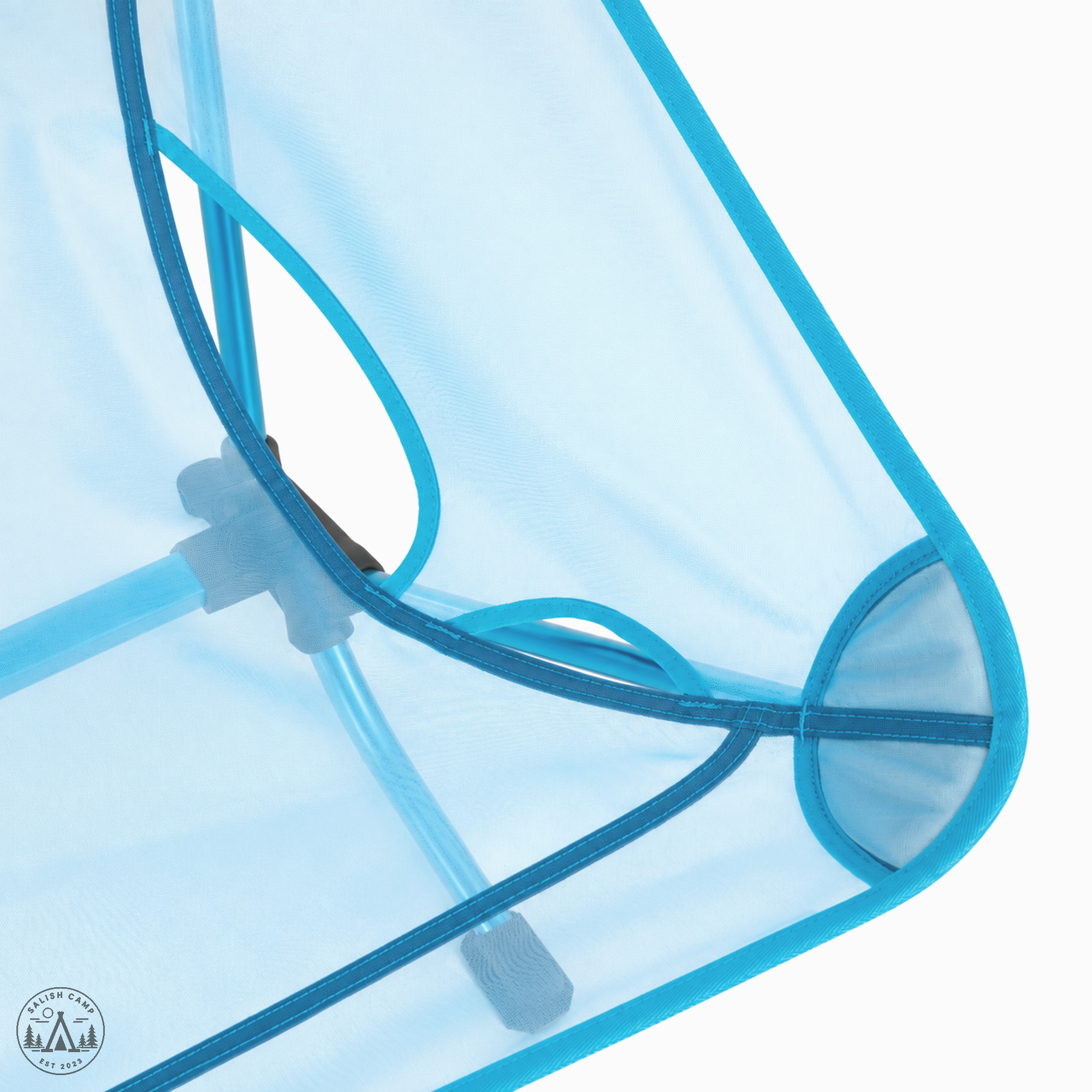
- A second perimeter tension line is part of the redesign. Helinox says it distributes weight more evenly and addresses sag compared with the original Beach Chair.
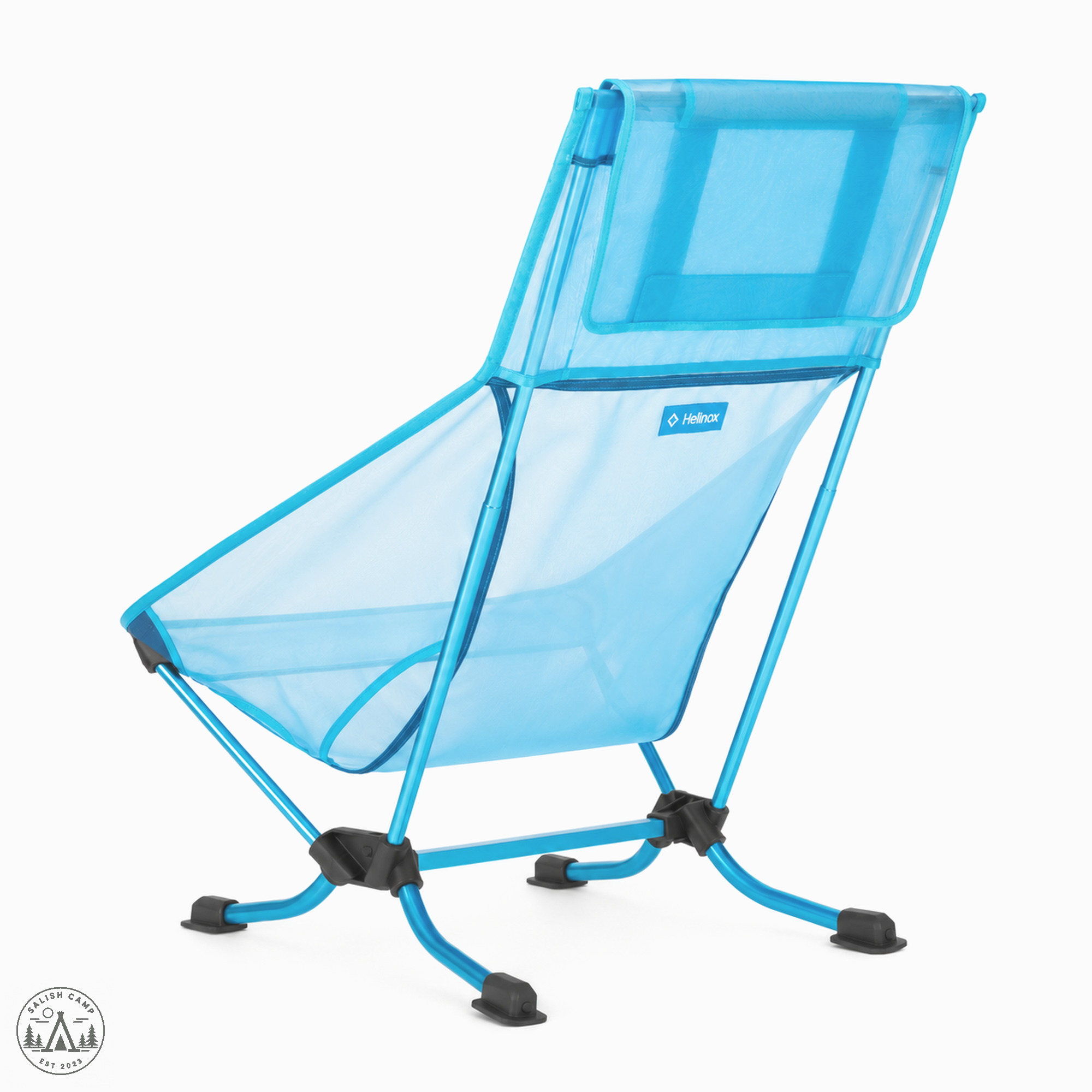
- The headrest flap has a practical job. It can retain a rolled towel, soft pillow, puffy jacket, or the chair's own carrying bag behind your head.
- The 320 lb capacity doesn't change between builds. Blue Mesh and the solid-fabric versions share the same published 320 lb / 145 kg capacity.
In The Field
The reason I'd choose the Beach Chair (re) over a more general camp chair becomes obvious on an actual beach. Around Puget Sound, I can go from packed gravel to coarse sand to softer patches near the water in a few steps. On the coast, the surface can be looser still. A chair that works perfectly well on a campground pad can become irritating once narrow feet start drilling downward every time I shift my weight.
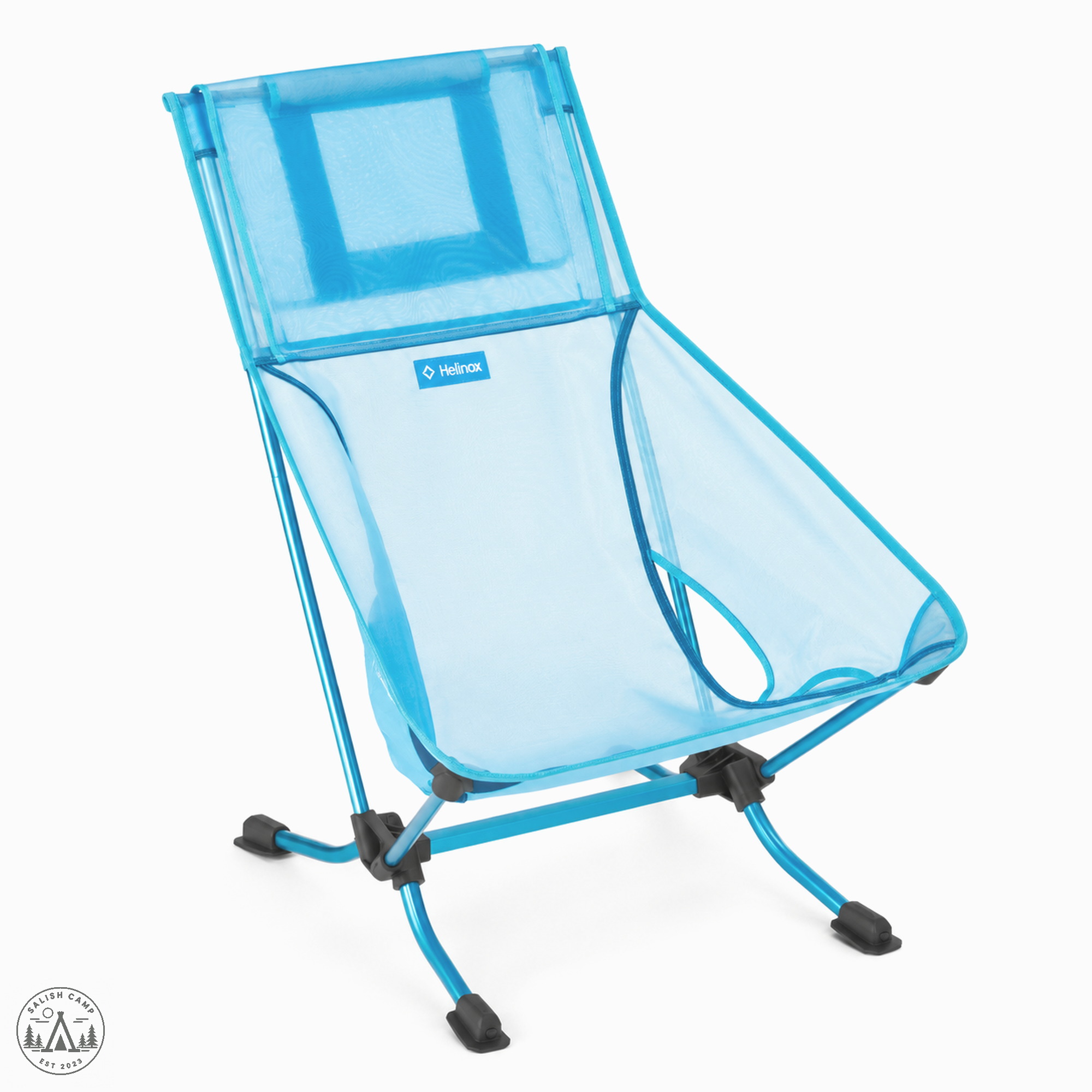
The Beach Chair (re) approaches that problem through geometry rather than an accessory. Its legs splay outward and terminate in flat feet, giving the chair a broader footprint against soft ground. Helinox specifically says that arrangement resists sinking in sand, mud, and turf. That is the feature I would put ahead of almost everything else on the spec sheet because it explains why this chair exists.
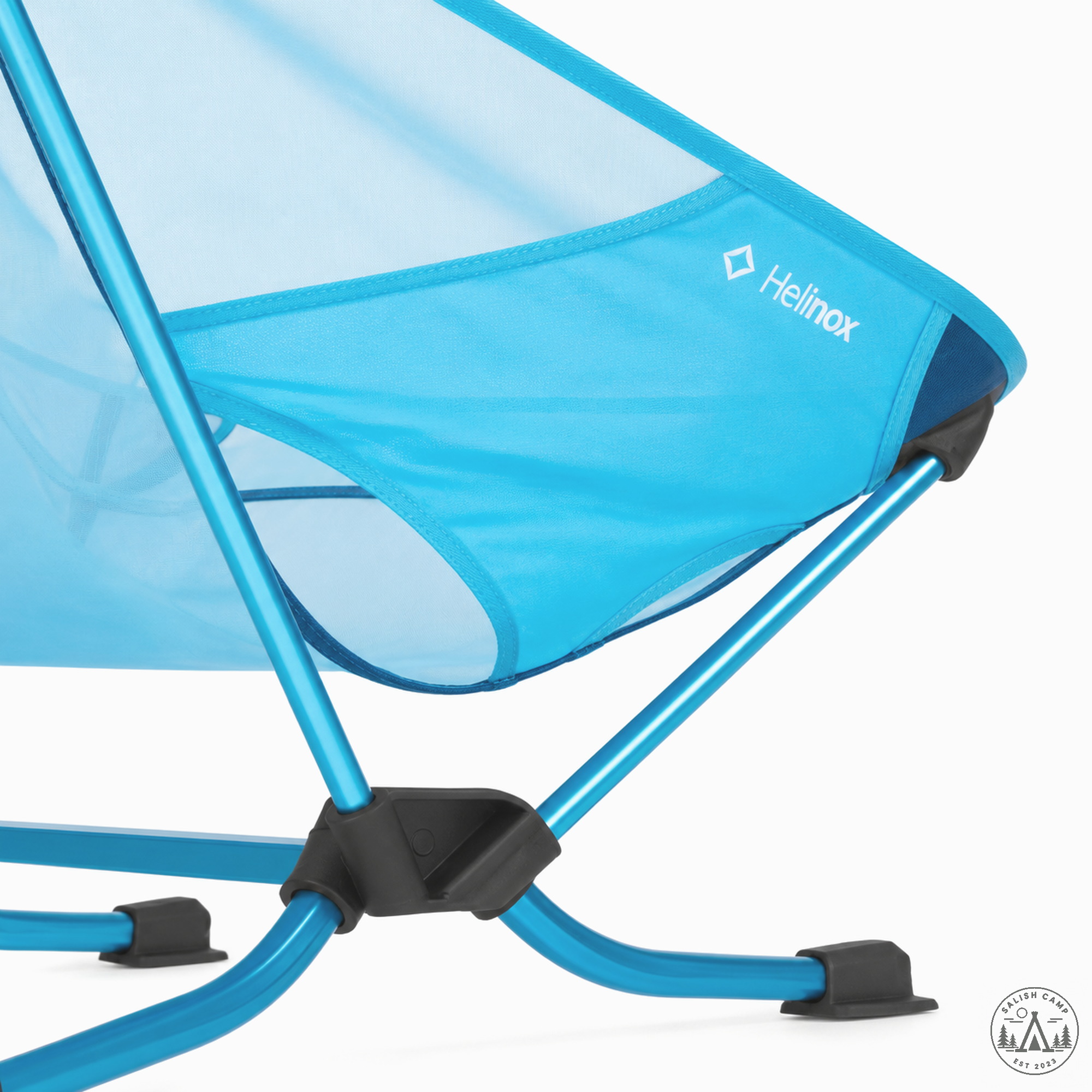
It's also a deliberately low chair. I like that position at a beach because I'm not trying to sit at dining-table height. I'm closer to a blanket, cooler, or gear on the ground, and the lower profile feels natural when I'm settling in for a few hours rather than constantly standing up around camp.
The unusual part is that Helinox combines that low stance with a high back. That makes the Beach Chair (re) feel conceptually different from a compact low chair whose main objective is simply reducing packed mass. The back is there to support the neck and shoulders, and Helinox says the fit is intended for adults up to 6 ft 4 in / 193 cm who want a high headrest with a low seat.
The main specification table gives an overall assembled height of 31.5 in / 80 cm, and Helinox describes the seat itself as low to the ground.
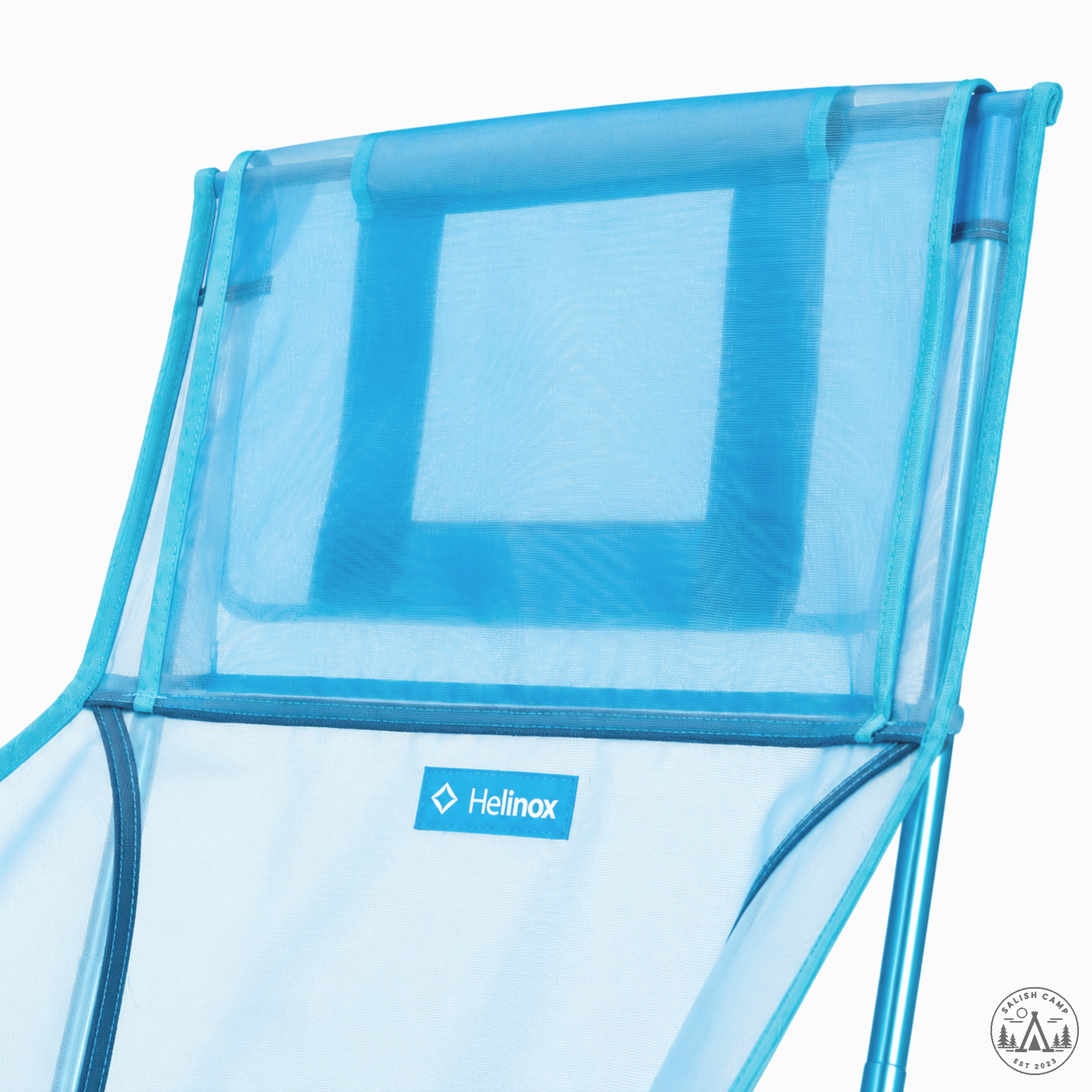
The headrest flap is a small detail I appreciate more in practice than on a feature list. You can put a rolled towel, puffy jacket, soft pillow, or the carrying bag behind it so that whatever you're using for head cushioning doesn't immediately slide away. Nothing extra has to be included for that feature to work.
Below that, the seat has another meaningful change from the original Beach Chair: a second perimeter tension line. Helinox says it was added to prevent sag and distribute weight more evenly. For a chair designed around long, relaxed sits, that's the kind of structural revision that matters more to me than cosmetic updates.
The Blue Mesh chair in these photos pushes the warm-weather idea further. This is the full open-weave version rather than the standard solid-fabric build. Air can move through essentially the entire seating surface, which makes sense for warm Lake Washington afternoons or sunny coastal days when I don't want a solid panel pressed against my back.
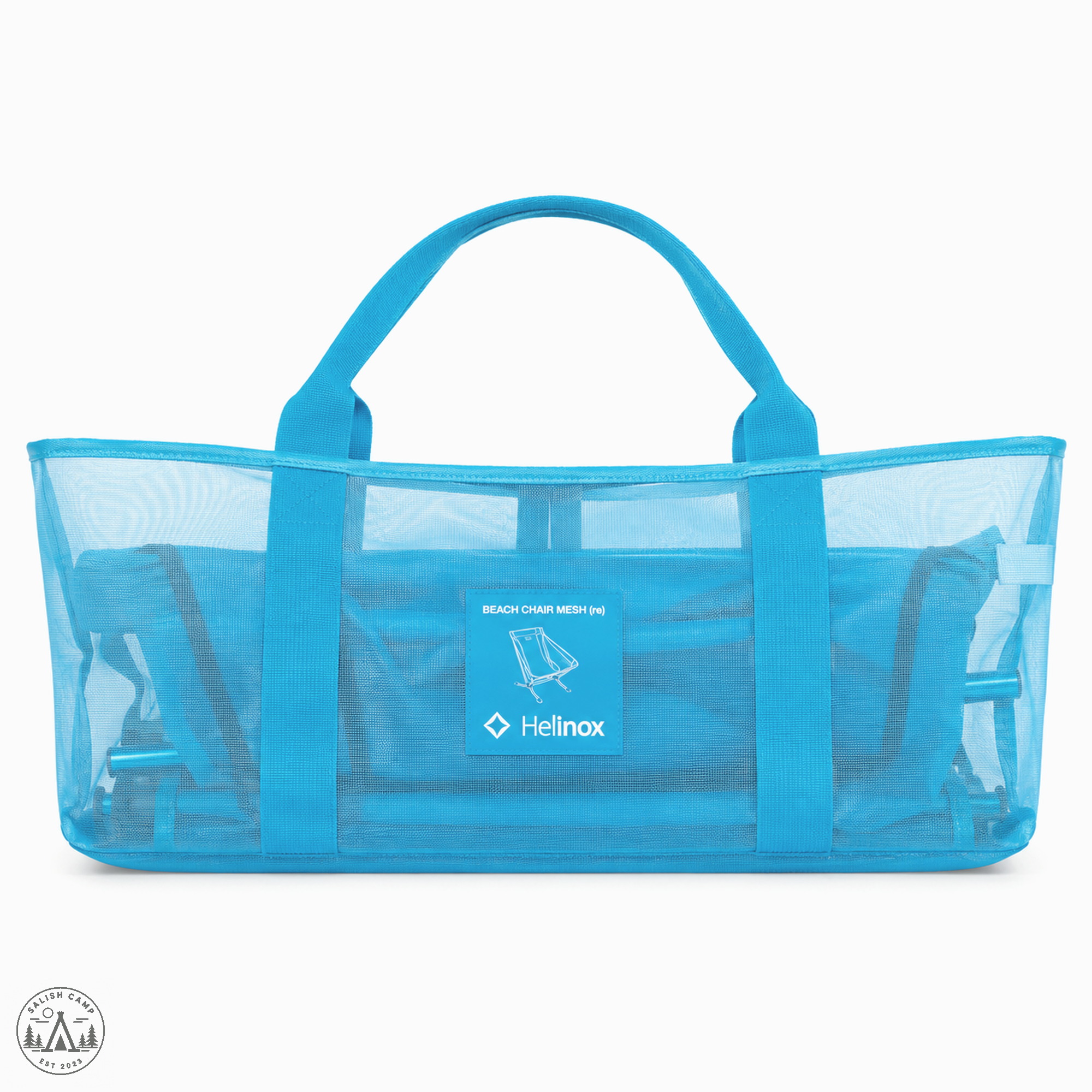
The tradeoff is packed volume. Blue Mesh comes with a mesh tote and packs to 21.5 x 6.5 x 9 in / 55 x 16 x 23 cm. The standard Black and Biscay Green chairs use solid 300D fabric and pack into a 21 x 6 x 4.5 in / 53 x 15 x 11 cm dual-zip case.
That difference is larger than the small changes in length and width might initially suggest because the Mesh package is listed at twice the packed thickness: 9 inches versus 4.5 inches. If I'm loading a crowded hatchback with a tent, cooler, sleeping gear, and several chairs, I would absolutely factor that into the decision. Blue Mesh isn't simply the same chair with a more breathable textile.
The mesh tote does have a beach-specific advantage. Helinox says it can shake out sand and air-dry. After carrying sandy equipment back from the coast, I can see the appeal of not sealing the chair immediately inside a more enclosed case.
Price follows that build distinction. Blue Mesh is $209.95. Black and Biscay Green are $189.95 each. All three were listed in stock on October 4, 2026. I wouldn't describe the extra $20 as buying a universally "better" chair. You're paying for the full-mesh configuration and its different tote. Someone who prioritizes smaller packed volume may reasonably prefer the less expensive standard version.
There is one integrated side pocket for small essentials. That's useful for the usual beach-chair clutter that I don't want disappearing into sand, but it shouldn't be confused with the molded corner pockets. Those corners are structural pole supports. Helinox redesigned them to improve pole support and smooth out assembly; they're not storage compartments.
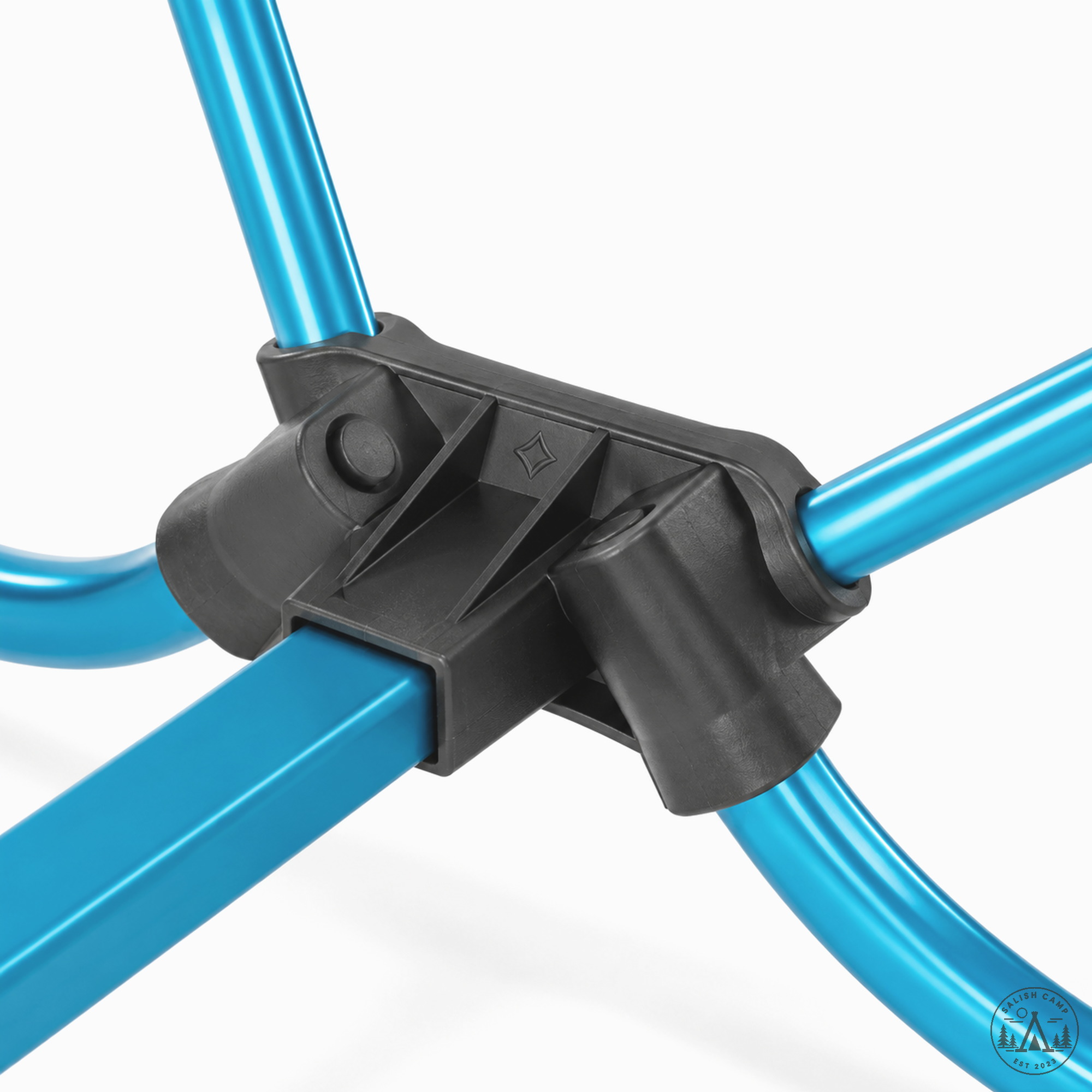
Setup follows the familiar shock-corded-frame approach. The poles naturally organize themselves into the frame, the redesigned nylon resin hubs establish the structure, and the seat's reinforced molded corners locate onto their supports. There are no tools involved. If you've never used this type of chair, the important point isn't speed so much as letting the shock cord guide the frame instead of fighting it.
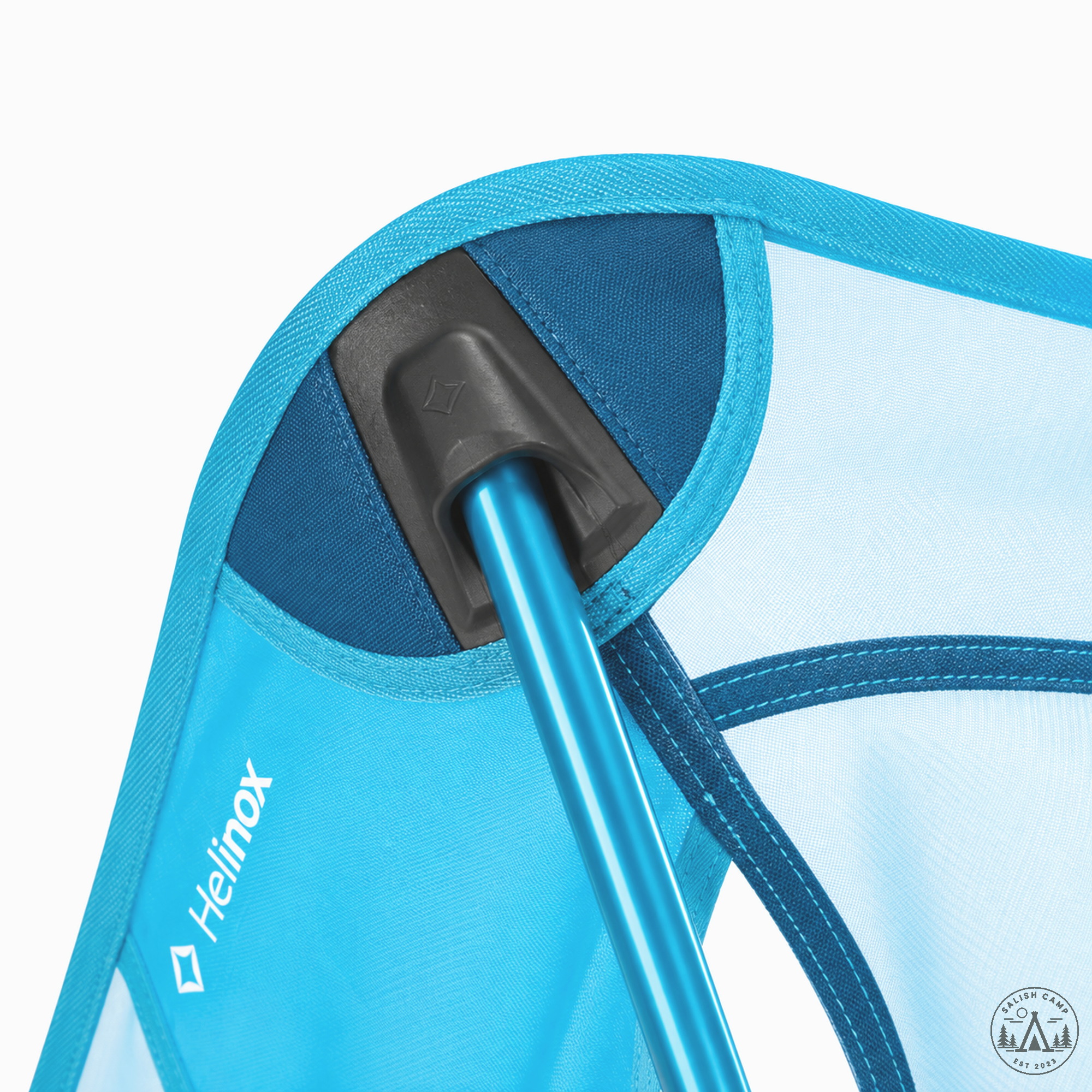
The frame uses DAC TH72M aluminum alloy, with Helinox specifically describing it for use in sun and saltwater conditions. For my purposes, that doesn't mean I would put it away wet and salty. Helinox's own care guidance says to brush or rinse away sand, rinse the frame with fresh water after saltwater exposure, spot-clean the seat with warm water, and let everything dry fully before packing it.
That routine is especially relevant around Puget Sound and the coast. Salt and sand get into joints and onto poles whether I'm careful or not. A quick freshwater rinse when I get home is easier than discovering gritty connections the next time I unfold the chair.
The Beach Chair (re) carries a published capacity of 320 lb / 145 kg. Its fit guidance goes up to 6 ft 4 in / 193 cm. A separate 5 ft 9 in / 176 cm number appearing with the photography refers only to the model shown in Helinox's imagery; it isn't a user-height restriction.
Assembled weight is 3 lb 7.5 oz / 1580 g. Packed, Blue Mesh is 3 lb 14 oz / 1756 g and the standard build is 1704 g. The page also prints a 30.5 in / 78 cm Seat Height, a 66.5 cm width, and a 1571 g assembled figure in other spots; I use the main table's figures.
One other novice question is worth answering: no, the Beach Chair (re) doesn't become a complete wind solution just because its feet work well in sand. Helinox points customers toward the separate Chair Anchor when wind is a concern. Likewise, no shade is included; the chair is compatible with the separately sold Personal Shade. Neither should be treated as part of the chair you're buying here.
For me, that leaves a fairly clear use case. This is a chair I'd bring when the destination itself justifies it: a long Puget Sound beach afternoon, a Lake Washington shoreline stop, a coastal weekend, or a low camp setup where I know I'll spend a lot of time sitting. The 320 lb capacity, high back, low position, and soft-ground stance all reinforce that role.
What it isn't is a chair I'd buy because I want one seat to cover every outdoor situation. It's too specialized—and too expensive—for that argument to be convincing. But specialization works in its favor if sand is precisely the problem you're trying to solve.
Pros
- Splayed frame and flat feet are purpose-built for sand and other soft ground.
- High back provides neck and shoulder support despite the low seating position.
- Choice of compact-packing solid 300D fabric or highly ventilated full-mesh construction.
- 320 lb / 145 kg capacity with a five-year manufacturing-defect warranty.
Cons
- $189.95 for the standard build and $209.95 for Blue Mesh is expensive for a specialized camp chair.
- Blue Mesh's 21.5 x 6.5 x 9 in tote takes considerably more packed space than the standard build's 21 x 6 x 4.5 in case.
- Shade canopy and Chair Anchor are sold separately.
Technical Specifications
| Product | Helinox Beach Chair (re) |
|---|---|
| Color in photos | Blue Mesh (all-mesh build), 10003709, $209.95 |
| Standard build, not photographed | Black 10003707 and Biscay Green 10003708, $189.95 each, solid 300D fabric |
| Price | $209.95 Blue Mesh; $189.95 Black and Biscay Green (helinox.com, 2026-10-04, all in stock) |
| Assembled weight | 3 lb 7.5 oz. The spec table pairs it with 1580 g; the page's standard-build data pairs it with 1571 g |
| Packed weight | Mesh: 3 lb 14 oz (1756 g). Standard: 1704 g, printed as 3 lbs 11.5 oz in the feature line and 3 lb 12 oz in a later Packed Weight row |
| Assembled size | Height 31.5 in (80 cm) in the spec table; a later Seat Height row and photo callout print 30.5 in (78 cm). Width 26 in (66 cm); a later row prints 26 in (66.5 cm). Depth 29 in (74 cm) |
| Packed size | Mesh: 21.5 x 6.5 x 9 in (55 x 16 x 23 cm), mesh tote. Standard: 21 x 6 x 4.5 in (53 x 15 x 11 cm), dual-zip case |
| Capacity | 320 lb (145 kg) |
| Frame | DAC TH72M aluminum alloy, redesigned nylon resin hubs, shock-corded poles, splayed legs, flat feet |
| Seat | Standard: bluesign-certified recycled 300D ripstop. Mesh: full open-weave mesh |
| Included | Chair, plus the dual-zip case (standard) or mesh tote (Mesh). Canopy and Chair Anchor are sold separately |
| Fit | FAQ: adults up to 6 ft 4 in (193 cm). The 5 ft 9 in line is the photo model, not the limit |
| Warranty | 5 years, manufacturing defects |
Final Thoughts
The Beach Chair (re) makes the most sense when I stop judging it as a generic portable chair and judge it as beach equipment. Splayed legs and flat feet address the soft-ground problem directly, while the high back makes it comfortable enough in concept for the long, stationary sits that make up most of my beach days.
The two-build setup deserves equal attention. At $189.95, Black and Biscay Green give you the solid 300D seat and substantially slimmer dual-zip packed case. At $209.95, the photographed Blue Mesh chair replaces that seating surface with full open-weave mesh and uses the much bulkier mesh tote. I'd choose Blue Mesh for ventilation and easy sand shakeout; I'd choose the standard build if vehicle space and the lower price matter more.
My bigger reservation is cost and bulk: $189.95 to $209.95 for a specialized chair, and a Blue Mesh tote that packs twice as thick as the standard case.
For the right shoreline-heavy camp kit, though, the Beach Chair (re) solves a real problem rather than merely adding another variation of a general camp chair. If I knew most of my summer sitting would happen on sand, soft turf, or lakeshore ground—and I wanted a low seat without giving up a high back—this is exactly the kind of specialized design I'd consider paying for.