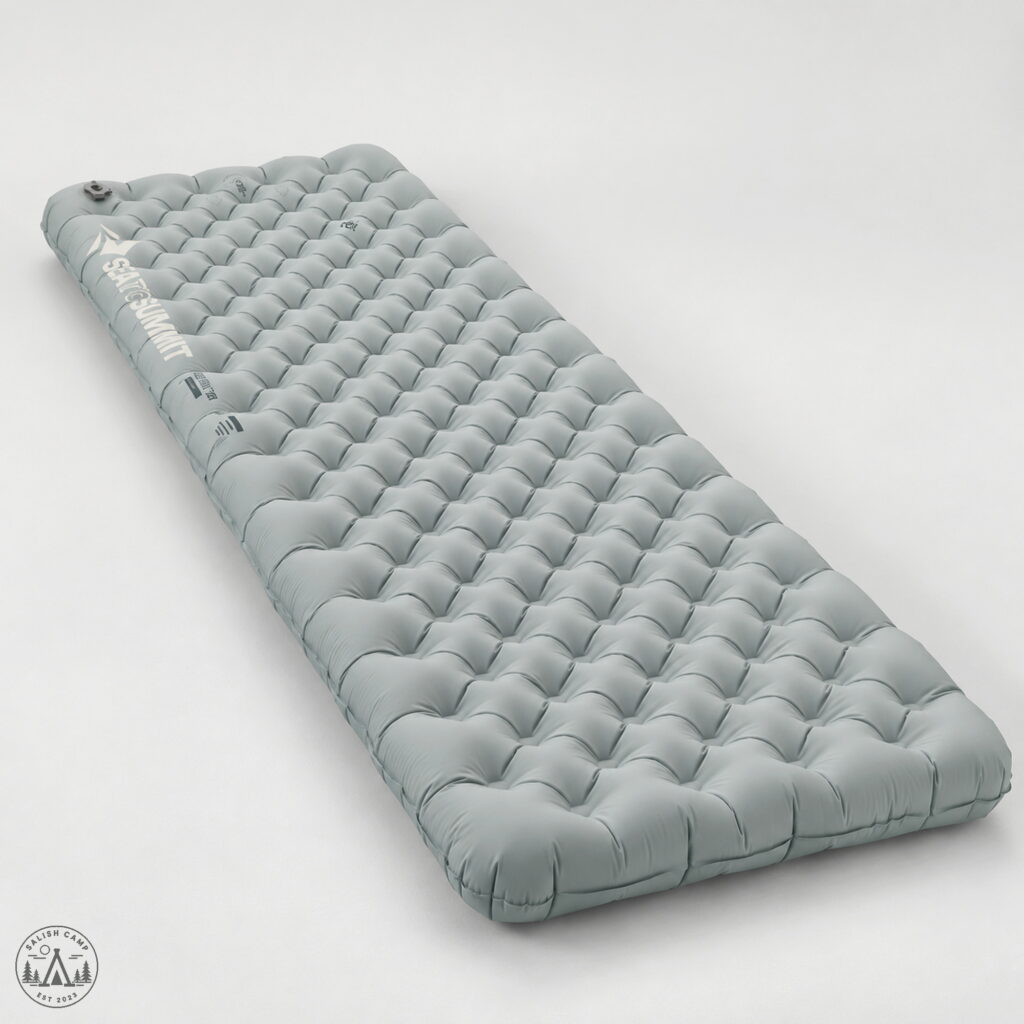
Buy if you want the Ether Light XR Insulated in Regular Rectangular Wide (SKU A3404, $239.00, 605 g / 21.3 oz), a full-length 183 × 64 cm rectangular pad with 10 cm of Air Sprung Cell loft and an ASTM-tested R-value of 4.1. It weighs 665 g / 23.5 oz packed, which still fits a backpacking load. For side sleeping in the Cascades, damp camps in the Olympics, and frosty shoulder-season trips, the wide, straight-sided shape gives hips, knees, and elbows room to settle, and the integrated Airstream pumpsack makes setting up camp noticeably less tedious.
Skip if you count every ounce or need the smallest packed size, since the wide rectangle carries more weight and bulk (9 × 5 × 5 in packed) than a narrow tapered pad. Skip it too if you’re taller than its recommended 183 cm / 72.05 in user height, or if you expect a $239.00 pad to deliver the durability of a closed-cell foam mat. This is still an inflatable pad that needs sensible campsite preparation and puncture care.
What Stands Out
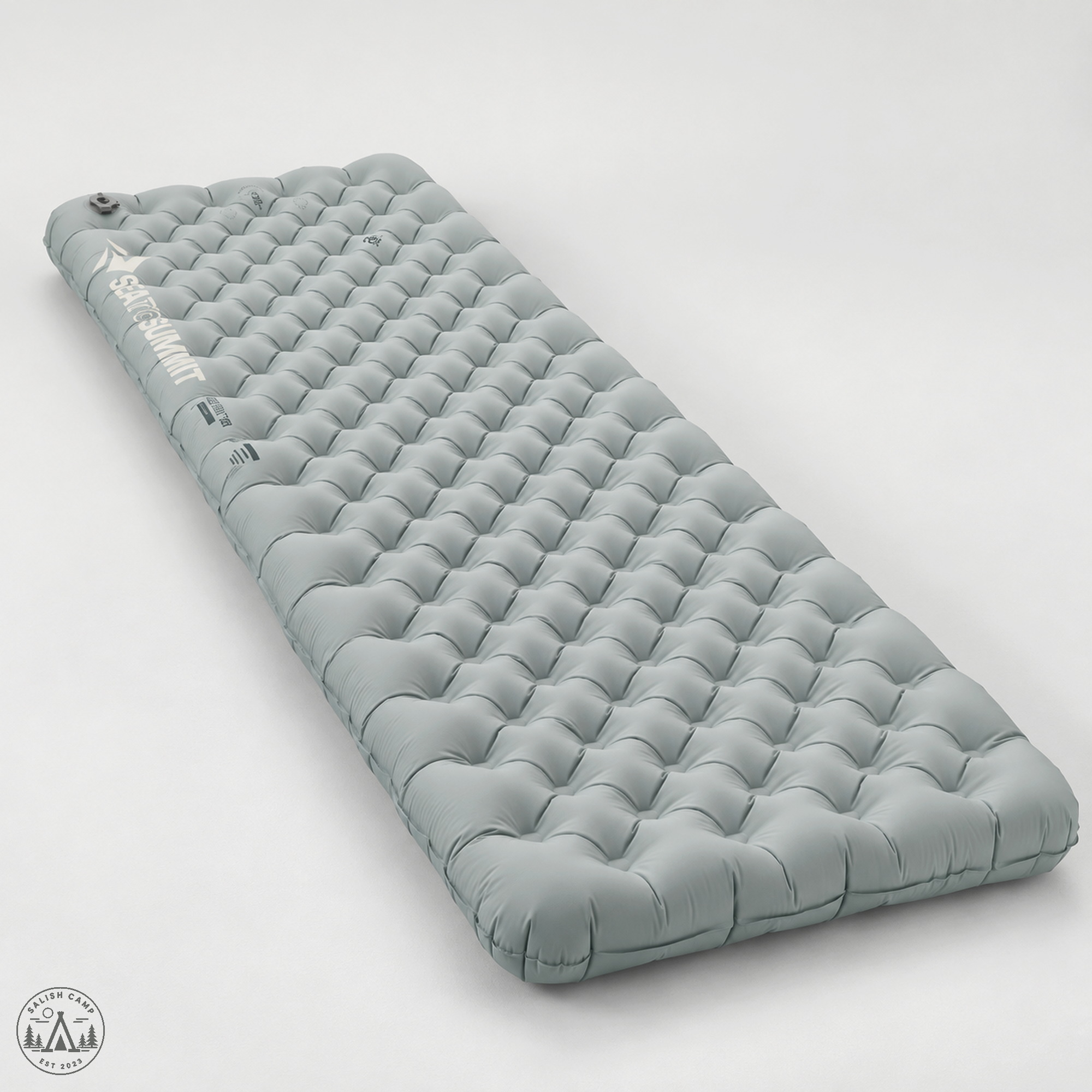
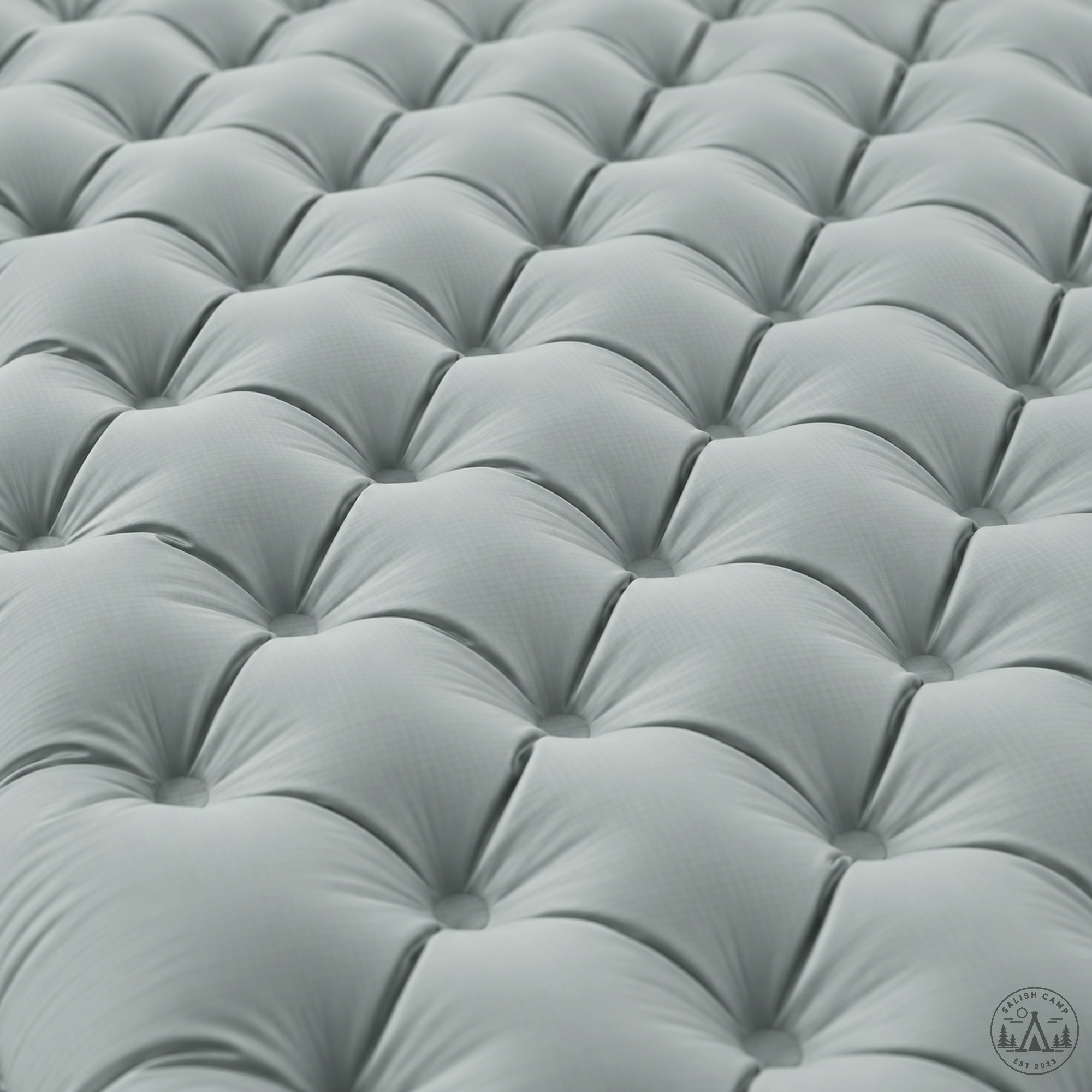
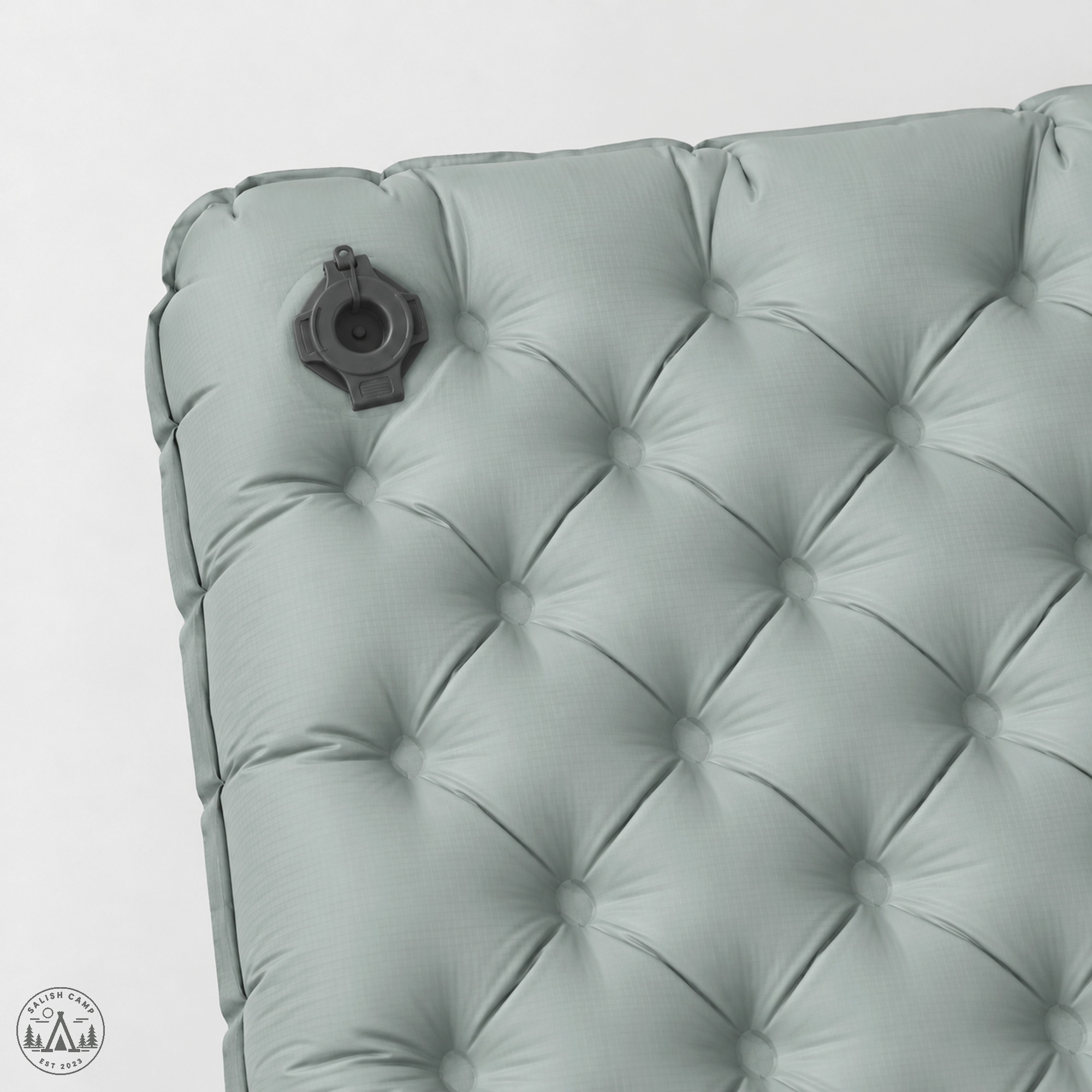
- 10 cm of Air Sprung Cell cushioning. The individually formed air cells create a supportive surface that feels less like balancing on a conventional air mattress, particularly when lying on your side.
- ASTM-tested R-value of 4.1. ThermalCore insulation uses a suspended TRM layer to reflect warmth back toward the sleeper, and Sea to Summit rates the pad extended three-season capable.
- 605 g / 21.3 oz in Regular Rectangular Wide. The full-length, 64 cm-wide rectangular shape keeps weight reasonable for its size without giving up the substantial cushioning that makes this pad attractive for comfort-focused backpackers.
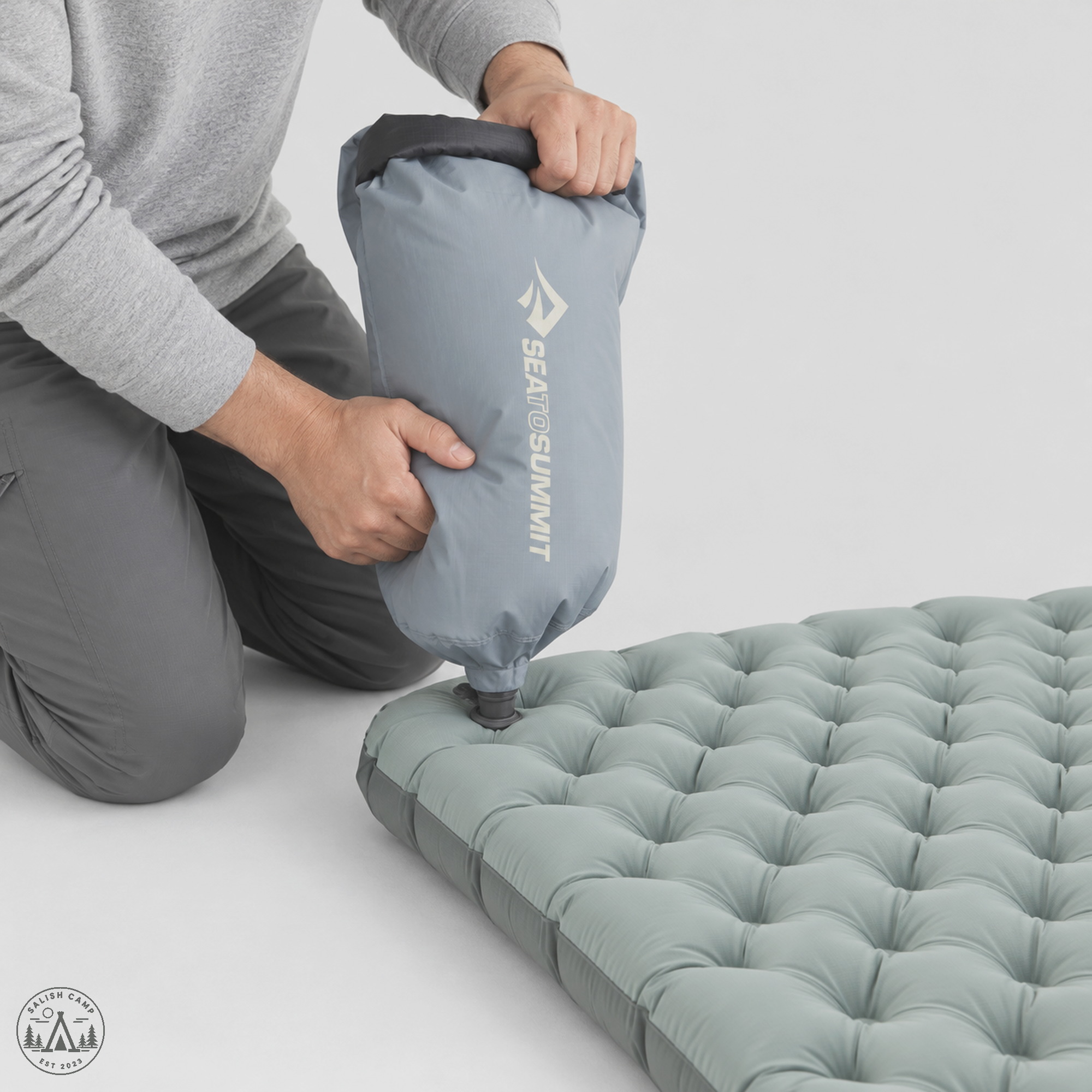
- Integrated Airstream pumpsack. The nylon stuff sack doubles as an inflation pump. Sea to Summit says it fills the pad in two or three pump cycles, so there’s no separate pump to carry.
- Three-function XPRESS valve. A one-way inflation port, a rapid-deflation port, and a fine-tune button make it straightforward to inflate, adjust firmness, and pack the pad away.
- Manageable 9 × 5 × 5 in packed size. Despite its thick, wide sleeping surface, the Regular Rectangular Wide packs into a cylinder that still fits a backpacking sleep system.
- PillowLock patches and stronger welds. The included patches help secure an Aeros pillow, and Sea to Summit cites increased weld strength for greater durability.
In The Field
When I’m choosing a sleeping pad for the Cascades or Olympic Peninsula, comfort matters more than it did when I started backpacking. I can tolerate a little extra pack weight if it means waking up without sore hips or shoulders after a long day of climbing and descending. That’s where the Ether Light XR Insulated makes sense to me.
At 605 g / 21.3 oz for the Regular Rectangular Wide, it asks for more weight than a narrow tapered pad, yet the 10 cm / 3.94 in sleeping surface is a substantial amount of cushioning for a backpacking pad. (Sea to Summit also rounds that thickness to 3.9 or 4 inches in places.) The Air Sprung Cell construction divides the surface into individual cells, so the pad conforms around pressure points rather than behaving like one large, tightly inflated chamber. As a side sleeper, I find that appealing: my hips and shoulders carry most of my weight, and a pad that lets them settle without bottoming out makes a real difference over consecutive nights.
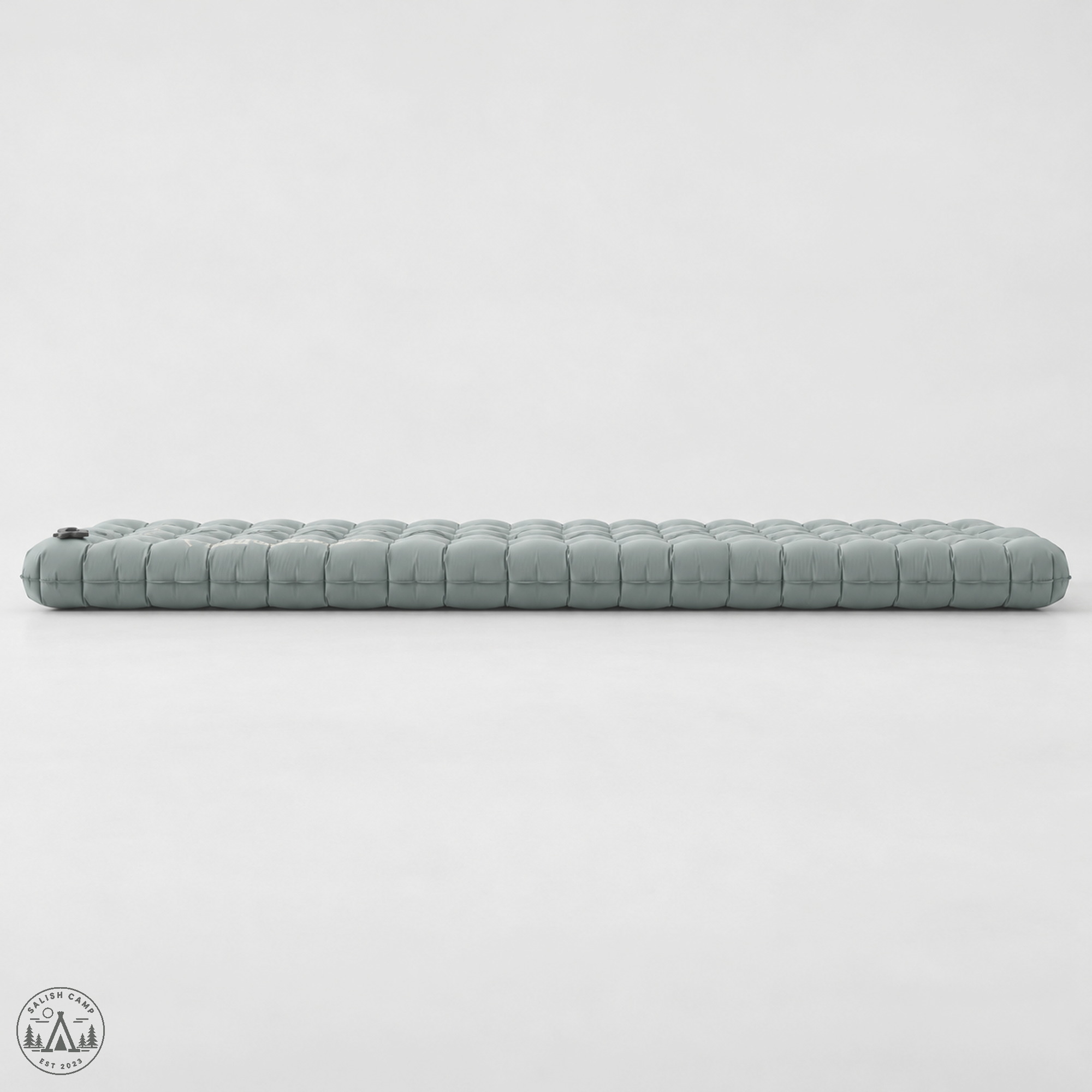
Getting the firmness right matters with any thick air pad. I’d start with a firm inflation and then use the XPRESS valve’s fine-tune button to release small amounts of air while lying on the pad. A pad can feel supportive when you press it with your hands, then feel stiff once your full body weight is on it. I want enough give for my hip and shoulder to settle in, but not so much that I feel the ground when I roll over, and the 10 cm profile leaves useful room for that adjustment. Back sleepers should find the cell layout stable too. A thick air pad isn’t automatically comfortable if it’s inflated like a drum.
Warmth is the other reason I’d carry it beyond the warmest part of summer. The pad carries an ASTM-tested R-value of 4.1, using ThermalCore insulation with a suspended TRM layer designed to reflect warmth back toward the sleeper. In the Olympics, ground moisture can be persistent even when the weather isn’t especially cold. In the Cascades, exposed camps and alpine basins can make the ground feel colder than expected after sunset. A warm sleeping bag can’t make up for poor insulation underneath you, because the insulation compressed beneath your body does little. Sea to Summit says the 4.1 R-value is suitable down to conditions where a hard frost might occur, which is a useful way to think about its range. I’d choose it for an extended three-season setup, as long as the rest of my sleep system matched the conditions; sleeping bag, shelter placement, clothing, and individual cold tolerance still matter.
After a long day on the trail, I don’t want a complicated inflation routine. The Airstream pumpsack is built into the stuff sack, so the bag already assigned to the pad does the work: connect it to the inflation port, capture air in the sack, and press that air into the pad. Sea to Summit lists two or three pump cycles on the product page and three to four in its FAQ, and the actual effort depends on how well you capture air. Because the XPRESS inflation port is one-way, air already in the pad stays put while I set up the next cycle. Mouth inflation remains an option, though Sea to Summit’s FAQ puts it at more than 20 breaths. I’d use the pumpsack whenever practical, since it keeps breath moisture out of the pad, and if I do inflate by mouth, I’d dry the pad thoroughly before long-term storage.
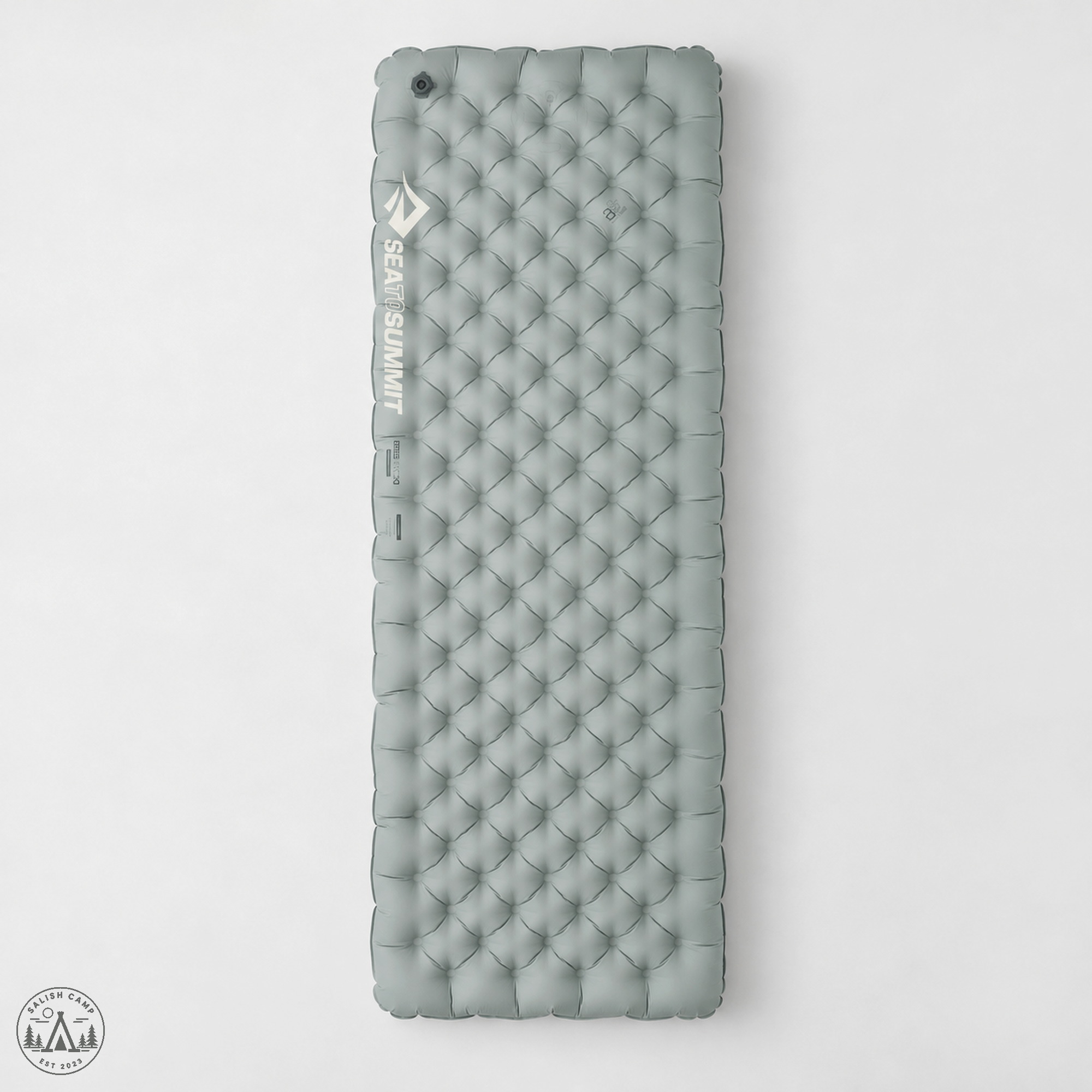
The Regular Rectangular Wide is the version I’d choose, but understand the dimensions before ordering. At 183 × 64 cm (72 × 25 in), it’s a full-length pad that holds its width from head to foot instead of tapering at the legs, and Sea to Summit recommends it for users up to 183 cm / 72.05 in tall. That width is the point for me: when I roll from side to side or draw a knee up, my knees and elbows stay on the insulated surface instead of drifting onto a cold tent floor. The rectangle also costs weight and packed volume, and in a narrow ultralight shelter a 64 cm pad leaves less floor beside it. For context, the tapered Small (A3401) is $189.00 and 445 g / 15.7 oz, but only 66 in long.
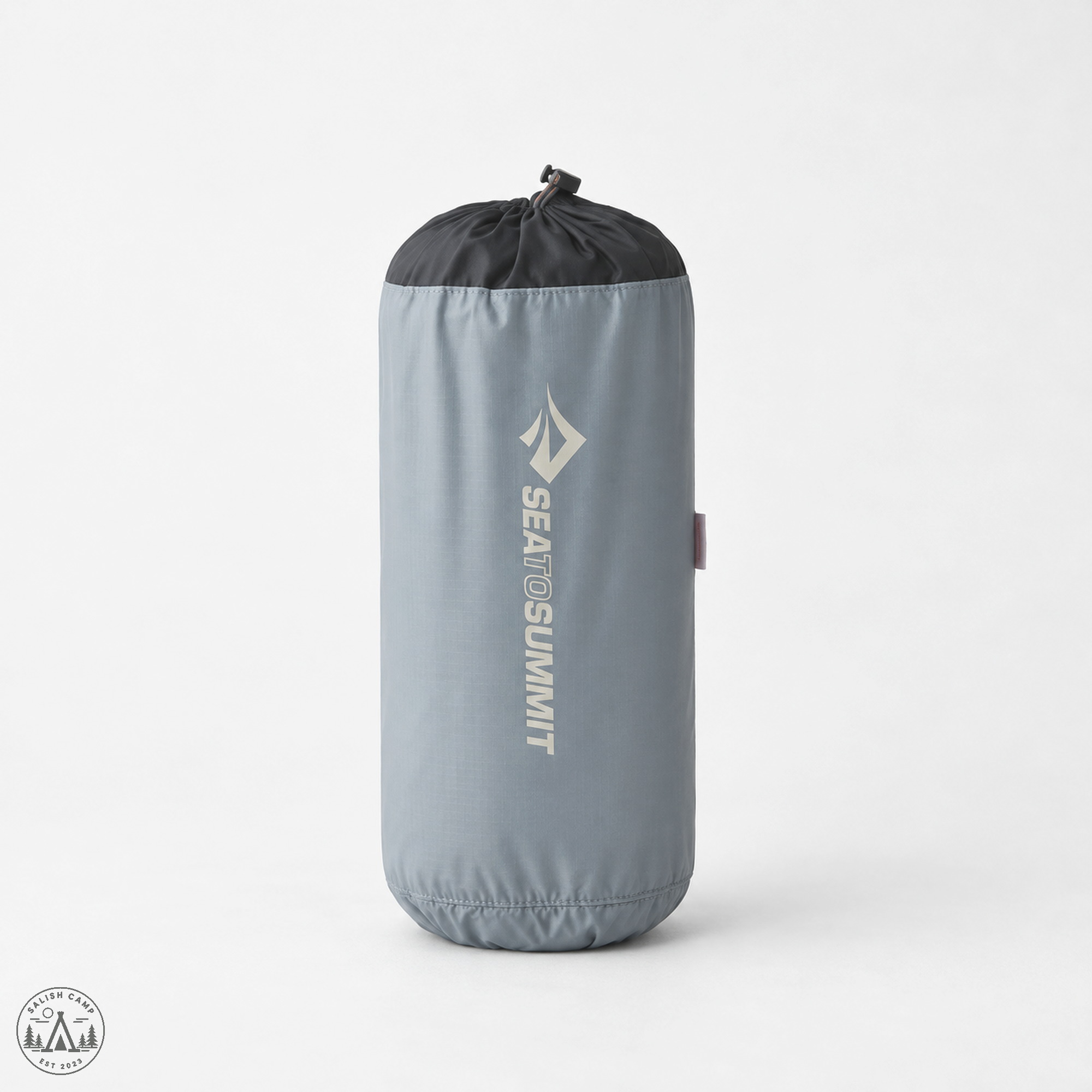
The packed size is the trade-off for that room. At 9 × 5 × 5 inches, the Regular Rectangular Wide takes more pack space than a narrow tapered pad. The pad itself weighs 605 g / 21.3 oz, and the listed packed weight is 665 g / 23.5 oz. For someone counting every ounce, that difference belongs in the gear spreadsheet.
Durability is where I stay realistic about inflatable pads. Sea to Summit highlights increased weld strength, which is encouraging because the welds hold the pad’s structure and air, but a stronger weld doesn’t make the surface puncture-proof. Before laying out the pad, I clear the tent floor of small stones and twigs, and I avoid dragging the inflated pad across rough ground. The included repair kit is worth carrying. When deflating, I use the rapid-dump port and roll the pad deliberately rather than forcing it into a tight bundle with air trapped inside.
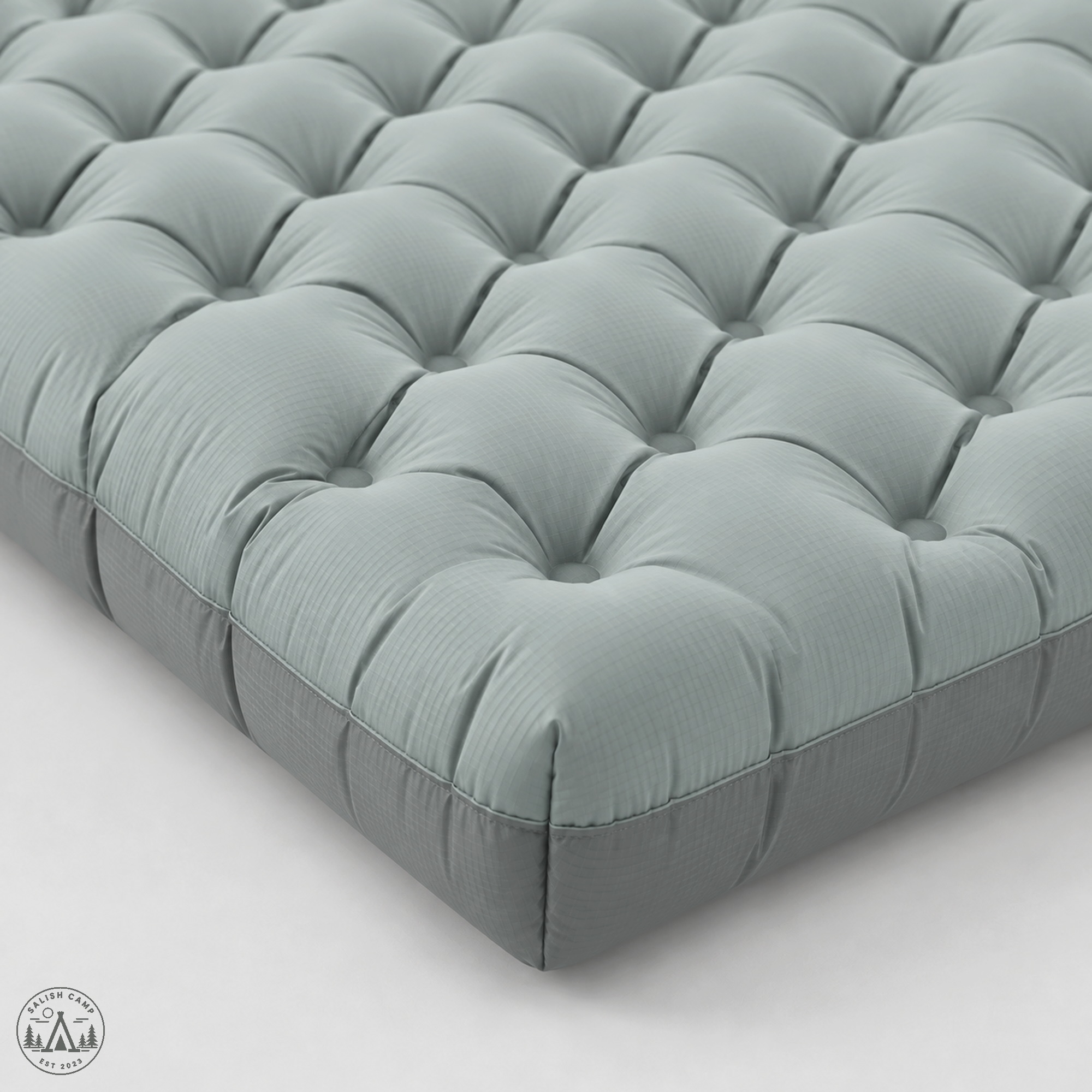
The PillowLock patches are a modest feature I appreciate in principle. They’re designed to secure an Aeros pillow to the pad, and anyone who has spent a night retrieving a pillow from the side of a tent knows why that’s useful. They don’t change how the mattress performs, but along with the fine-tune valve, they make the pad easier to live with.
For a weekend in the Olympics, a multi-night Cascade trip, or a shoulder-season outing with frosty mornings, I’d appreciate this combination of cushioning and insulation without carrying a bulky self-inflating mattress. The trade-off is cost, a few extra ounces, and the inherent vulnerability of inflatable construction. At $239.00, it’s a significant investment, and a closed-cell foam pad removes the risk of losing air overnight, though it won’t give the same plush night. For a side sleeper who wants full-length, wide coverage and extended three-season insulation, the Ether Light XR strikes a sensible balance.
Pros
- Excellent cushioning for side sleepers: The 10 cm Air Sprung Cell construction provides substantial loft and adjustable support for hips and shoulders.
- Strong extended three-season insulation: The ASTM-tested R-value of 4.1 and ThermalCore design make it a compelling choice for damp and frosty Pacific Northwest conditions.
- Convenient integrated inflation system: The Airstream pumpsack and XPRESS valve simplify setup, firmness adjustment, and deflation.
- Roomy full-length package: The Regular Rectangular Wide pairs a 183 × 64 cm rectangular surface with a 605 g / 21.3 oz pad weight and useful comfort features.
Cons
- Heavier and bulkier than narrow tapered pads: The wide rectangle’s 605 g / 21.3 oz and 9 × 5 × 5 in packed size cost real ounces and pack space for weight-focused hikers.
- Premium price: At $239.00, the Regular Rectangular Wide is a considerable investment for an inflatable pad.
- Requires inflatable-pad care: Stronger welds improve construction, but punctures remain a practical concern and careful site preparation is still necessary.
Technical Specifications
| Specification | Details |
|---|---|
| Product | Sea to Summit Ether Light XR Insulated Air Sleeping Pad |
| Config in photos / primary | Regular Rectangular Wide (rectangular), SKU A3404 |
| Price (primary) | $239.00 USD (seatosummit.com, 2026-10-08, in stock) |
| Weight (primary) | 605 g / 21.3 oz |
| Packed weight | 665 g / 23.5 oz |
| Dimensions (Regular Rectangular Wide) | 183 × 64 × 10 cm / 72 × 25 × 4 in |
| Recommended user height (Regular Rectangular Wide) | 183 cm / 72.05 in |
| Packed size (Regular Rectangular Wide) | 24 × 12 × 12 cm / 9 × 5 × 5 in |
| Thickness | 10 cm / 3.94 in |
| R-value | 4.1 (ASTM-tested) |
| Construction | Air Sprung Cell; ThermalCore insulation with suspended TRM layer |
| Valve | XPRESS valve (inflate, deflate, fine-tune) |
| Materials | Mat 100% nylon; valve 100% TPU; stuff sack 100% nylon |
| Includes | Stuff sack with integrated Airstream pumpsack, PillowLock patches, repair kit |
| Best use (rectangular) | Comfort backpacking, hunting |
| Other sizes / prices | Small $189.00; Regular $199.00 (sold out); Large $219.00 (sold out); Large Rectangular $259.00 |
Final Thoughts
The Sea to Summit Ether Light XR Insulated in Regular Rectangular Wide is the kind of sleeping pad I’d choose when I want a genuinely comfortable night in the mountains without moving to bulky car-camping gear.
Its strongest combination is straightforward: a full-length 183 × 64 cm rectangular surface, 10 cm of Air Sprung Cell cushioning, and an ASTM-tested R-value of 4.1 at 605 g / 21.3 oz. Those details make it particularly appealing for backpackers who sleep on their sides, shift around at night, and regularly deal with damp ground or frosty mornings.
The integrated Airstream pumpsack and XPRESS valve are more than conveniences. They make setting up, adjusting, and packing away a pad less frustrating, which matters over consecutive days on the trail.
The limitation is weight, bulk, and price: the wide rectangle carries more ounces and pack volume than a narrow tapered pad, and $239.00 is not inexpensive for an inflatable. It also needs the same puncture awareness as other lightweight air mattresses.
Still, for comfort-focused Pacific Northwest backpacking, the Ether Light XR Insulated delivers a persuasive mix of insulation, cushioning, and portability. I’d choose it for the nights when sleeping well matters as much as hiking efficiently the next morning.