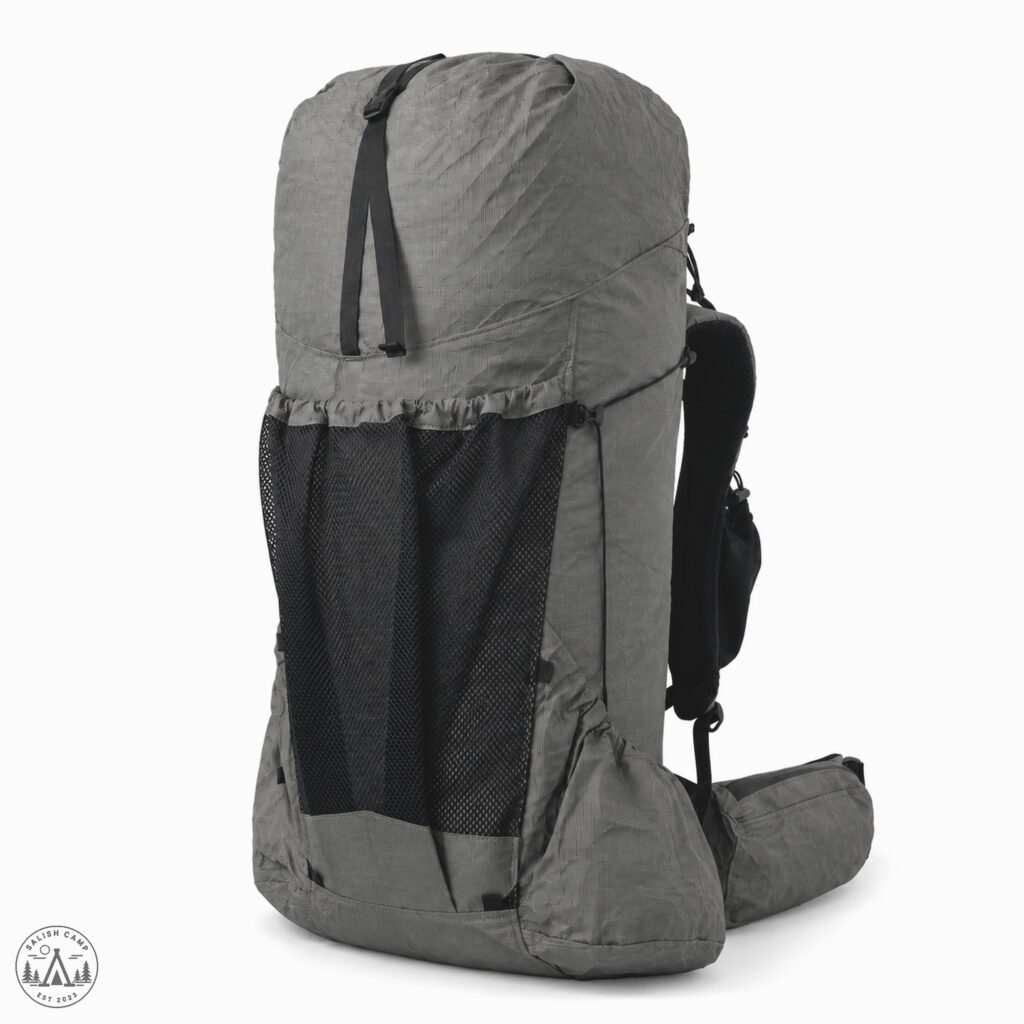
Buy if you want an ultralight multi-day pack that stays under two pounds in this Ultra 200X Small configuration without giving up a structured frame, load lifters, a substantial hipbelt, or useful pockets. The Kakwa 55 makes particular sense to me for Cascades and Olympics trips where food, water, damp gear, and shoulder-season insulation can push a supposedly ultralight load beyond the point where a frameless pack is enjoyable.
Skip if your normal load is already very light and you do not need a 45-pound-capable frame, or if $279 for Ultra 200X is difficult to justify when the UltraGrid Small is $199. Fit also deserves more attention than the low weight suggests: I would measure torso and hip circumference rather than simply ordering my usual clothing size. And if you need the pack immediately, the captured listing showed every variant sold out, with the stated restock timing extending into October.
What Stands Out
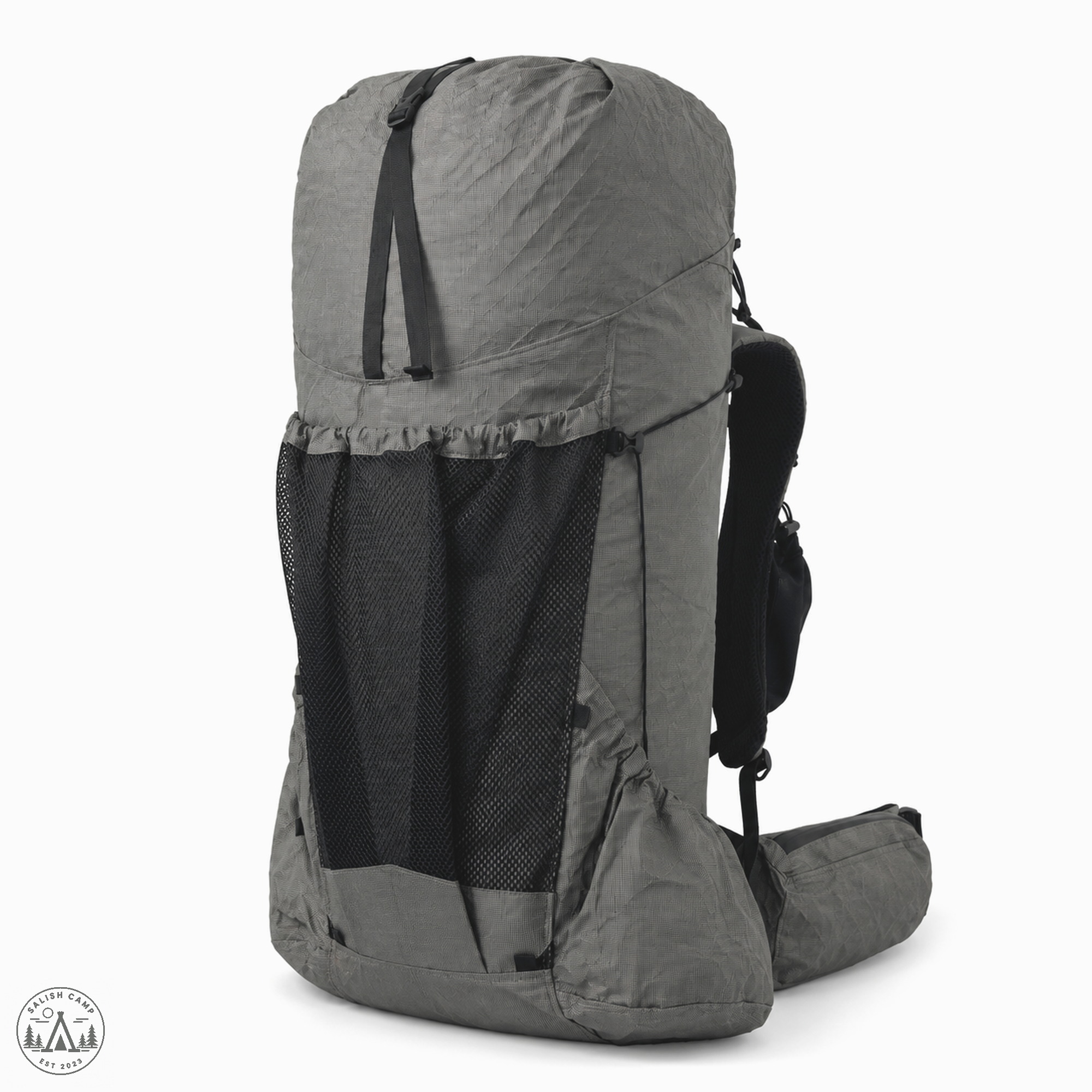
- A real inverted-U aluminum frame at UL weight. The hollow aluminum frame provides both vertical and horizontal structure, with Durston rating the pack for loads up to 45 lb / 20 kg.
- 30.1 oz / 855 g for the locked Ultra 200X Small. That is Complete Pack weight, including the removable frame and backpad, rather than a stripped configuration.
- The hipbelt is built to transfer load. A dual-strap reverse-pull design provides 2:1 leverage, while the redesigned belt incorporates a lumbar pad and comes in two size ranges.
- Pocket access is unusually complete. Two hipbelt pockets, two shoulder-strap pockets, a zippered QuickPocket in the left side pocket, and the large knit-mesh front pocket reduce how often I have to stop and open the main pack.
- Ultra 200X is the premium fabric option. It uses a dominantly woven UHMWPE/Dyneema® construction laminated to film, with the newer “X” version using a tougher inner film.
- The front pocket is knit mesh rather than conventional stretch mesh. It uses pleats to provide capacity, with protected elastics and a construction that feels aimed at actual trail abuse rather than maximizing stretch.
- The exterior still leaves room for unconventional loads. A Y-shaped top strap and twelve attachment points give me options for securing wet gear, bulky food, or other awkward items outside the main compartment.
In The Field
The first thing I want from a pack like the Kakwa 55 is not the lowest possible number on a scale. I want to know what happens after I put four days of food, a shelter, sleep system, stove, water, rain gear, and an extra insulation layer inside it.
That distinction matters in the Pacific Northwest. A carefully planned summer load can look impressively small on the living-room floor, then grow once the forecast turns damp and cold. I might leave the trailhead with wet-weather layers accessible, carry more food than expected, or end up packing a shelter that is already wet on the second morning. The Kakwa 55 appeals to me because its weight savings do not come from abandoning the basic load-transfer structure I want when that happens.
The locked Small Ultra 200X pack weighs 30.1 oz / 855 g as a complete pack. Durston's general marketing copy also says “1.9 lbs (31 oz / 890 g),” but for this configuration I use the size-specific Complete Pack figure.
That complete-pack distinction is important. The hollow aluminum inverted-U frame is already included. It weighs 3 oz / 90 g and can be removed, but I would start by using it rather than treating removal as a prerequisite for going ultralight.
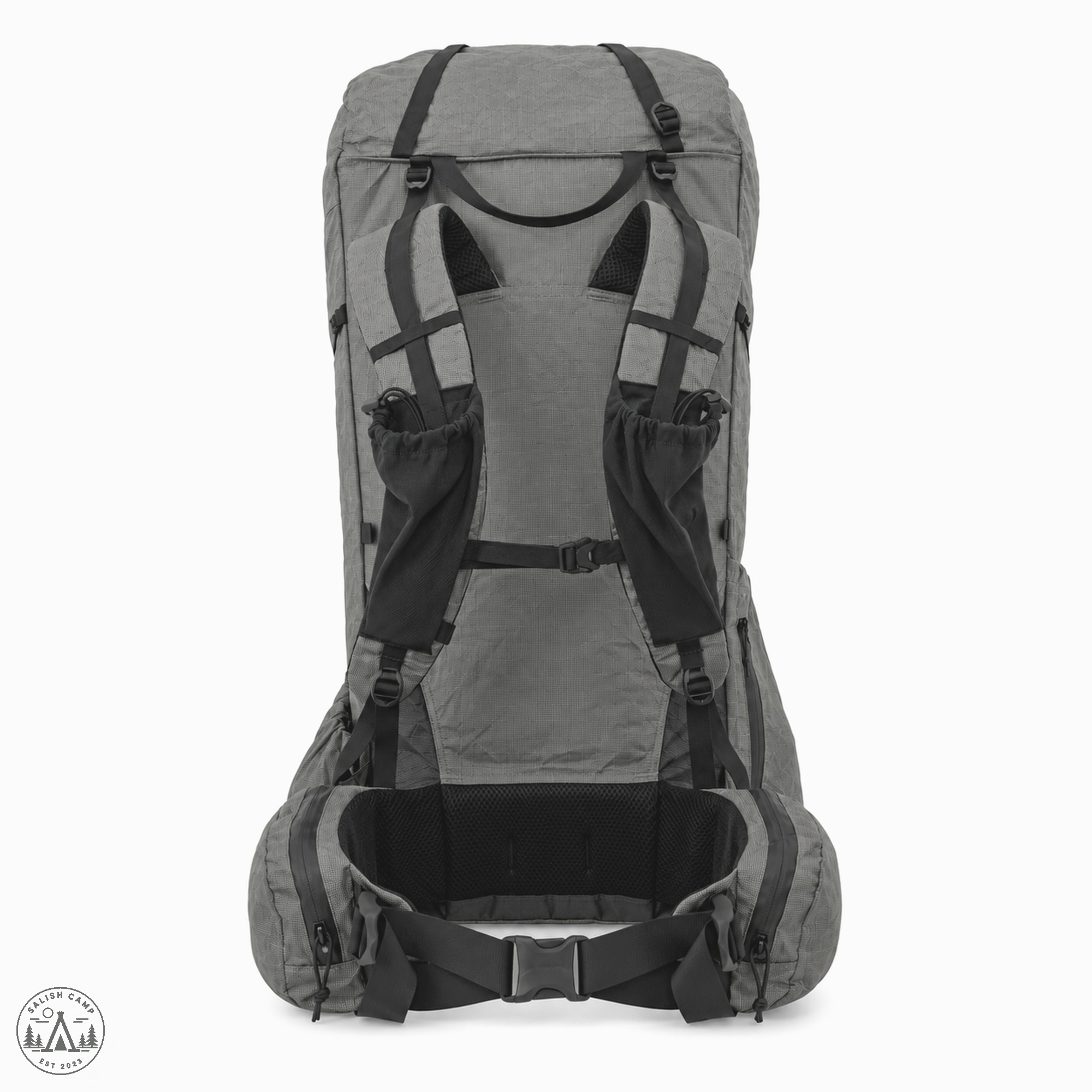
The frame gives the Kakwa both vertical and horizontal structure, and Durston rates the pack for loads up to 45 lb / 20 kg. I would read that as useful headroom rather than a suggestion that carrying 45 pounds is the sweet spot. The more interesting question is what the frame does at the weights I actually expect on a multi-day backpacking trip.
When food and water make the first day the heaviest, I want the load directed into the hipbelt instead of hanging entirely from my shoulders. The Kakwa combines that frame with load lifters, S-shaped shoulder straps, a lumbar pad, and a dual-strap reverse-pull hipbelt. The two hipbelt straps also provide 2:1 tightening leverage.
That is a much more serious carrying system than I expect from packs that chase minimum weight by stripping away structure. It is why the Kakwa makes sense to me as a crossover between traditional framed packs and minimalist UL designs.
But none of that works properly if I buy the wrong size.
For this Small, Durston specifies a 15–18 inch / 38–46 cm torso. I would actually measure my torso before ordering. I would not choose Small because I am short, because I wear a small jacket, or because another company's Small happened to fit.
The same applies to the S/M hipbelt. Its recommended circumference is 29–38 inches / 76–96 cm, while its absolute adjustment range extends from 28–45 inches / 71–115 cm. I would pay more attention to the recommended range than use the extreme min–max figures as evidence that virtually anyone can make the belt work.
That matters even more after weight loss, seasonal clothing changes, or when buying close to one end of the adjustment range. Having enough webbing to buckle a belt is not the same thing as having the padding and lumbar area positioned correctly.
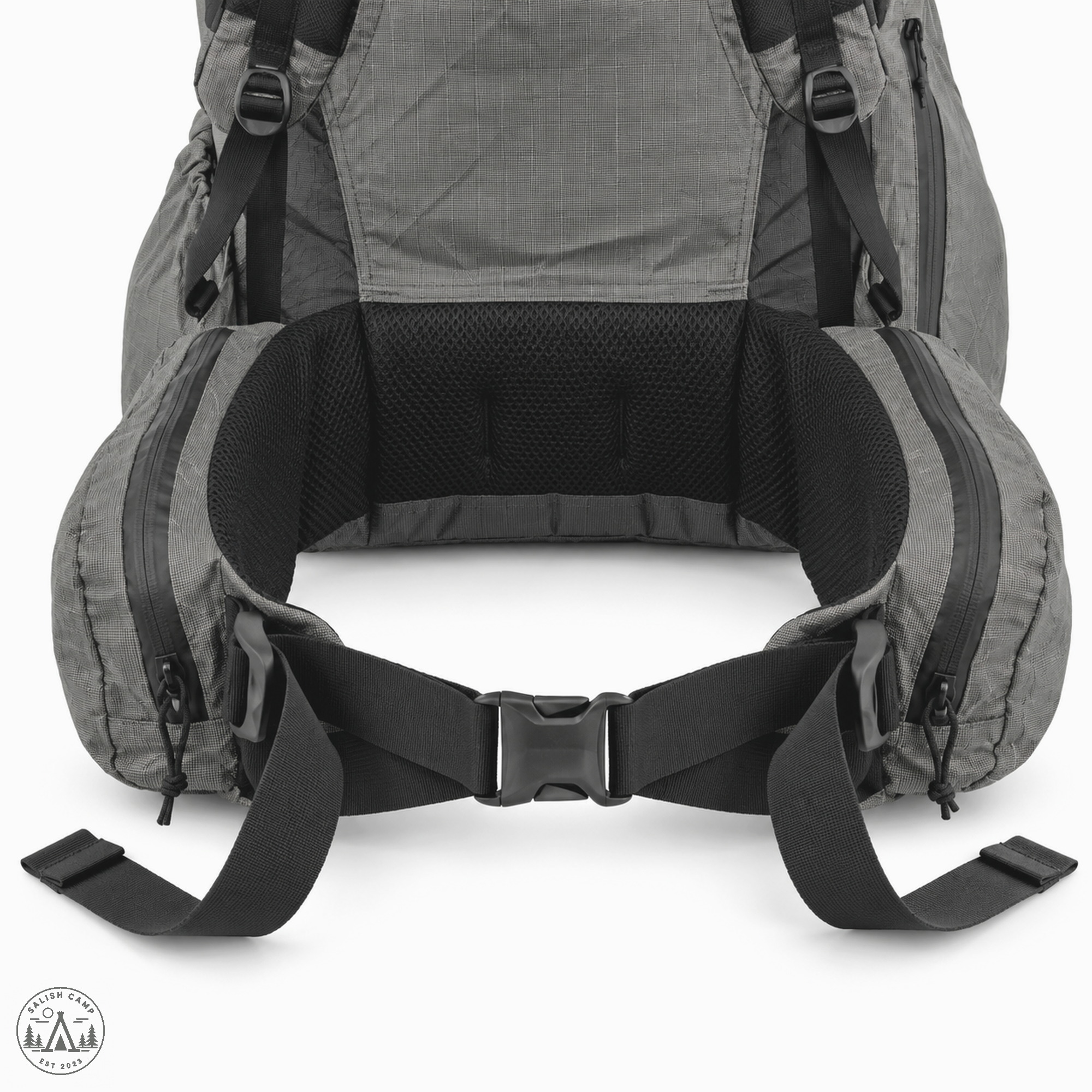
Once the fit is sorted, the pocket layout is probably the part of the Kakwa 55 I would appreciate most hour after hour.
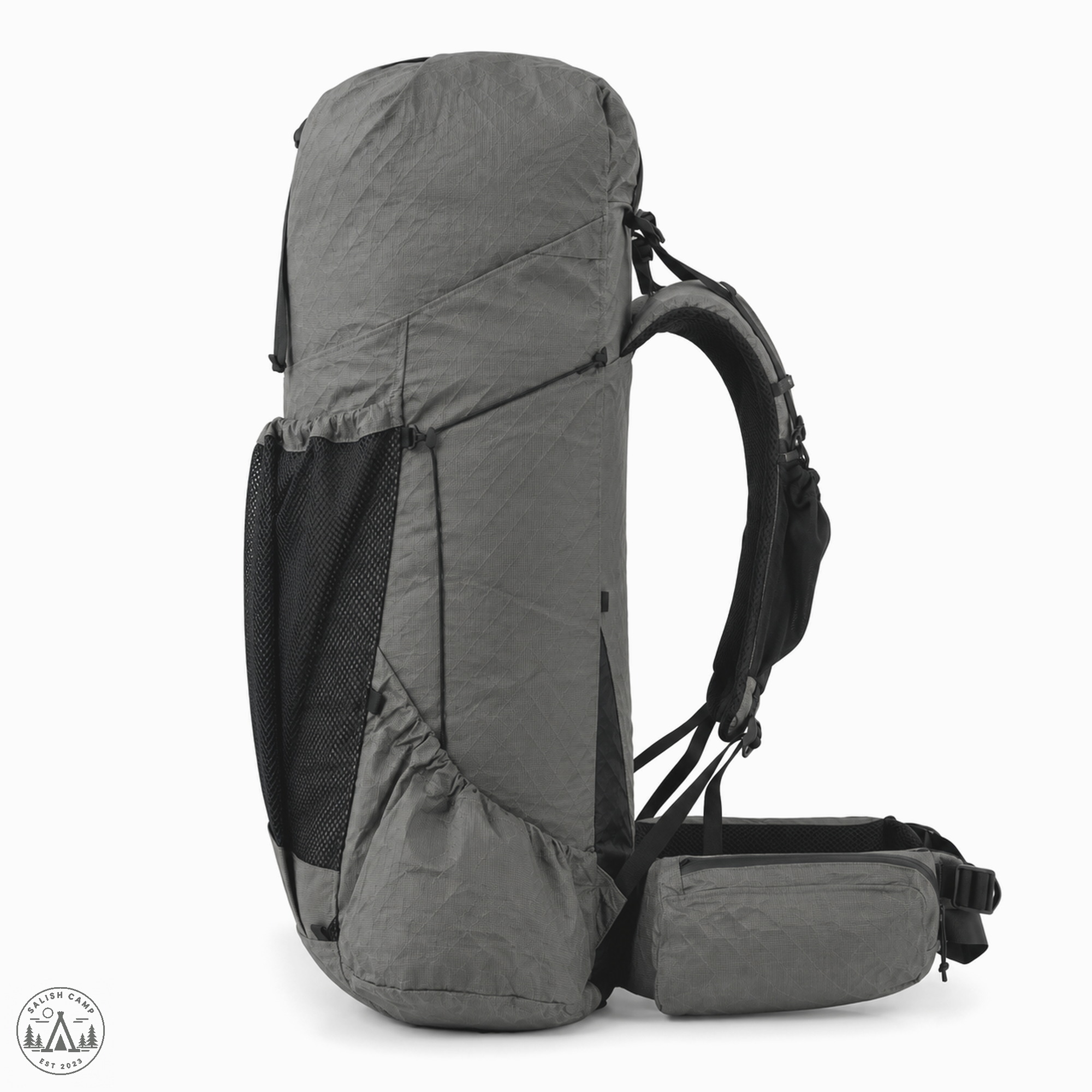
There are two hipbelt pockets and two shoulder-strap pockets. That immediately gives me four small storage locations I can reach without removing the pack. On a wet Cascades climb, that means I can organize snacks, sunscreen, navigation items, small electronics, or other frequently used gear without stuffing everything into one belt pocket.
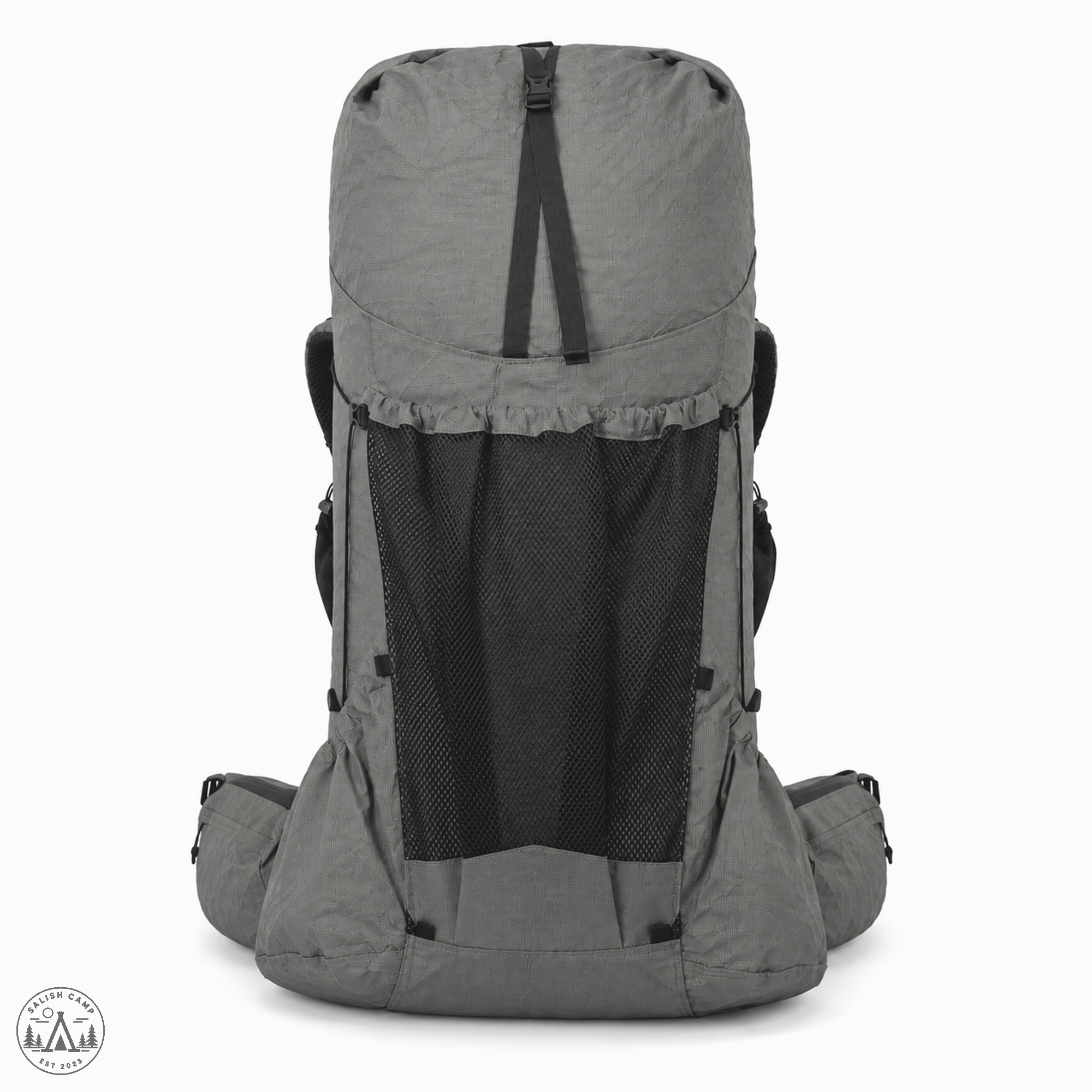
Shoulder pockets are particularly useful to me because they move small essentials into my field of view. Whether I use them for a bottle or other trail items depends on the day, but having the storage built into the pack means I do not immediately need aftermarket pockets dangling from the harness.
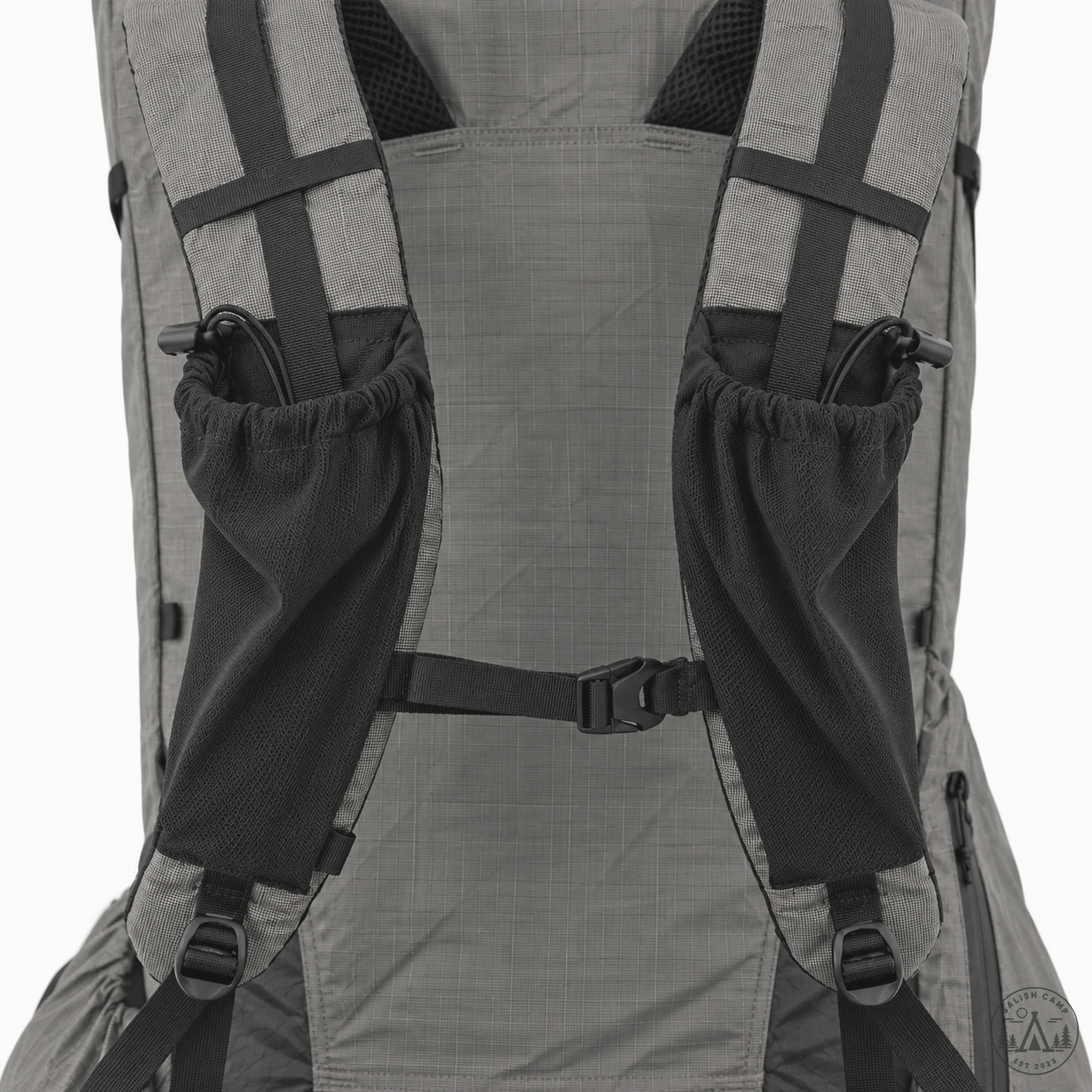
The side storage adds another useful detail: the QuickPocket, a zippered compartment integrated into the left side pocket. That gives me a more secure place for something I want accessible without treating an open bottle pocket as secure storage.
The large front pocket is also worth understanding before buying. It is described as heavy-duty polyester knit mesh, with pleats providing volume rather than relying on a highly elastic stretch panel. I like that approach for the way I use a front pocket: rain shell, water filter, stakes, camp sandals, or a damp shelter component that I do not want sealed inside the main compartment.
It is not an infinite elastic catch-all. I see that as a positive. Stretch mesh is convenient, but on brushy Northwest trails it is also one of the areas I watch most closely for abrasion and snagging.
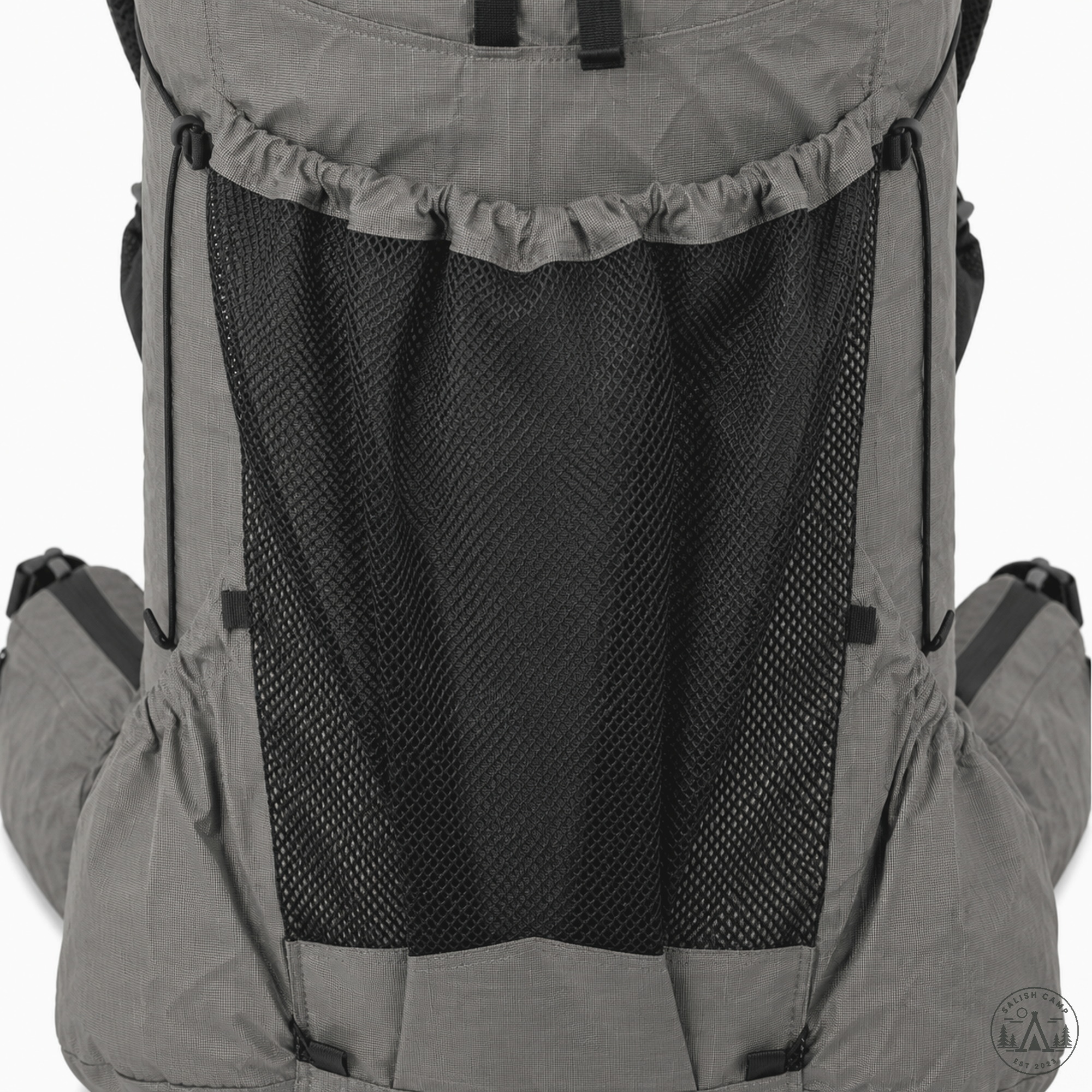
The main pack itself gives the Small 53 L of internal volume and 68 L total volume. I would not translate that automatically into a certain number of trail days because food bulk, shelter choice, sleep system, and season change that calculation dramatically. What matters is that this is clearly intended as a multi-day pack rather than a tiny UL bag that demands an extremely compact kit.
The Small is 34 inches / 85 cm tall when unrolled. Top and bottom circumferences are 42 inches / 107 cm and 35 inches / 89 cm respectively. Up top, the Y-shaped strap is useful when I have something that does not belong inside the pack. Combined with twelve attachment points, it gives the Kakwa flexibility without turning the exterior into a maze of permanent straps.

Then there is the $80 fabric question.
The Ultra 200X Small costs $279, while the UltraGrid Small is $199. Interestingly, the cheaper UltraGrid Small is also slightly lighter in the Complete Pack table at 29.2 oz / 830 g versus 30.1 oz / 855 g for Ultra 200X. So I would not pay the premium because I assume the most expensive fabric must also produce the lightest configuration.
Ultra 200X is the choice I would make because I specifically want its dominantly woven UHMWPE/Dyneema® laminated construction and tougher “X” inner film. UltraGrid is the value decision: a nylon fabric with UHMWPE ripstop and PU coating. Durston's page describes UltraGrid as both 200D and 210D in different places, so I would not pretend there is one unambiguous denier specification beyond what the listing itself provides.
For a buyer building a complete UL kit on a fixed budget, that $80 difference is significant. It could be spent on another part of the system that removes more weight or improves sleep, shelter, or rain performance. Ultra 200X is therefore not automatically the better purchase simply because it is the premium Kakwa 55.
For me, the justification comes down to intended use. If this is going to be my primary multi-day pack, see regular damp Northwest trips, get set against rough ground, and spend years being loaded and unloaded, I can see paying $279 for the Ultra 200X version. If I mainly want the Kakwa suspension and pocket architecture at the best price, the $199 UltraGrid version is hard to ignore.
The other issue right now is availability. On the October 6 capture, all ten variants were sold out. The page indicated an early-October USA restock and late-October restock for the rest of the world. That makes the purchasing decision unusually simple if I have a trip next week: a theoretical advantage does not help if I cannot obtain the pack in time.
If I can wait, though, I would rather wait for the correct torso and hipbelt combination than compromise on fit because another size appears first. A 30-ounce pack with the wrong torso length is still the wrong pack.
That is ultimately what I find compelling about the Kakwa 55. It does not ask me to pretend that ultralight backpacking means every load will always be ultralight. It gives me a legitimately light starting point, but backs that up with a frame, lumbar support, load lifters, an effective hipbelt, accessible storage, and enough capacity for a real multi-day kit.
For damp shoulder-season miles in the Cascades or Olympics, that is the version of ultralight packing I find much easier to live with.
Pros
- Excellent complete-pack weight: 30.1 oz / 855 g for the Ultra 200X Small while retaining a framed carrying system.
- Serious load-transfer hardware: Inverted-U aluminum frame, load lifters, lumbar pad, and dual-strap reverse-pull hipbelt.
- Excellent trail-access storage: Dual hipbelt and shoulder pockets, QuickPocket, and a large pleated knit-mesh front pocket.
- Useful multi-day versatility: 53 L internal volume in Small plus a Y-strap and twelve external attachment points.
Cons
- Ultra 200X carries a substantial premium: $279 versus $199 for the UltraGrid version.
- Fit requires careful sizing: Torso and hipbelt choices should be based on measurements, particularly when you fall near the edge of a recommended range.
- Availability is currently the biggest practical problem: All ten variants were sold out on the captured listing, with restock timing extending through October depending on region.
Technical Specifications
| Specification | Details |
|---|---|
| Product | Durston Kakwa 55 |
| Config in photos / primary | Ultra 200X / Small / S/M, SKU DPK-1002-S-W-S/M |
| Price (primary) | $279.00 USD (durstongear.com, 2026-10-06) |
| Weight Complete Pack (primary) | 30.1 oz / 855 g (Ultra 200X Small) |
| Stock (capture) | Sold out all 10 variants; restock note early Oct USA / late Oct ROW |
| Other Ultra 200X Complete Pack | Medium 31.5 oz / 895 g; Large 32.4 oz / 920 g (all $279.00) |
| UltraGrid context | Small 29.2 oz / 830 g; Medium 30.6 oz / 870 g; Large 31.3 oz / 890 g (all $199.00) |
| Removable items | Frame 3 oz / 90 g; backpad 0.5 oz / 15 g (included, removable) |
| Main fabric (primary) | Ultra 200X (UHMWPE / Dyneema® laminated to film) |
| Front pocket mesh | Heavy duty polyester knit mesh |
| Frame | Hollow aluminum inverted U; load capacity up to 45 lbs / 20 kg |
| Torso (primary) | Small 15–18" (38–46 cm) |
| Hipbelt (primary) | S/M; recommended 29"–38" (76–96 cm); min–max 28"–45" (71–115 cm) |
| Circumference Top / Bottom | 42" (107 cm) / 35" (89 cm) |
| Unrolled height (S) | 34" (85 cm) |
| Internal volume (S) | 53 L |
| Total volume (S) | 68 L |
| Hipbelt / shoulder pockets | Dual hipbelt pockets; dual shoulder-strap pockets; QuickPocket; large front mesh pocket |
| Warranty | 1 year against defects |
| Marketing weight line (once only if used) | Body copy “1.9 lbs (31 oz / 890 g)” vs Complete Pack Ultra 200X Small 30.1 oz / 855 g — primary is the table |
Final Thoughts
The Kakwa 55 hits a combination I care about more than simply chasing the lightest backpack available: low base weight without throwing away the features that make a multi-day load comfortable and convenient.
At 30.1 oz / 855 g complete in the Ultra 200X Small, I get an aluminum frame, load lifters, a lumbar-supported hipbelt, four harness-mounted pockets, the QuickPocket, a substantial front pocket, and enough internal capacity for a genuine multi-day setup. That is a strong package for the kind of Cascades and Olympics trips where my starting load and my third-day load can feel like two different packs.
The decision gets less obvious at checkout. UltraGrid is $80 cheaper, and the Small is actually 0.9 oz / 25 g lighter according to the Complete Pack figures. I would spend $279 on Ultra 200X because I specifically wanted that fabric construction, not because the premium version automatically wins every specification.
Most importantly, I would buy the Kakwa according to my measured torso and hip circumference rather than chasing whichever configuration comes back into stock first. The suspension is one of the main reasons to choose this pack; compromising its fit defeats the point.