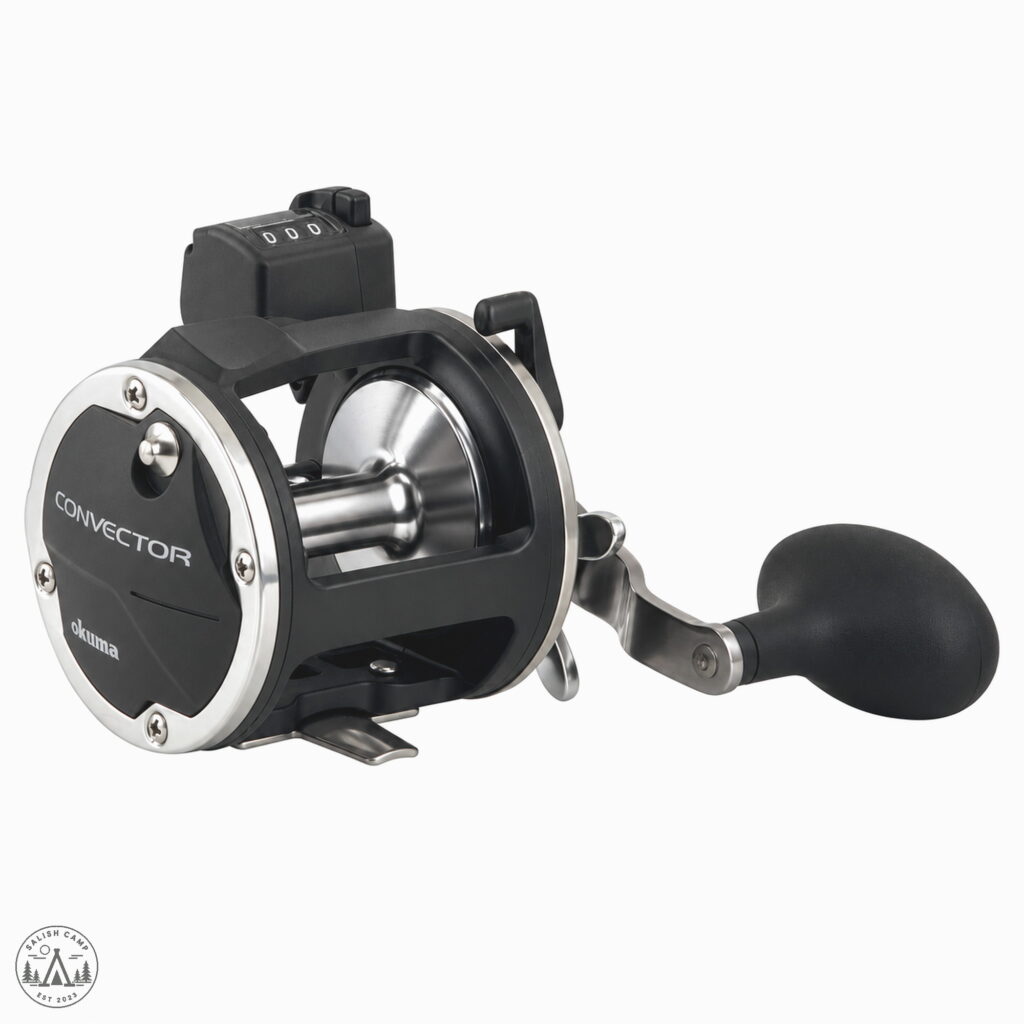
Buy if you want a straightforward right-hand line counter for Puget Sound salmon, especially if you split your time between downrigger trolling and mooching. The CV-30D gives you a mechanical counter reading in feet, a 4.0:1 brass gear train, a ratcheting Carbonite star drag and a levelwind that manages line during repeated drops and retrieves. It is a sensible value choice for a dedicated salmon rod.
Skip if you want a lighter reel for holding a rod through an entire tide, prefer left-hand retrieve, or expect a saltwater reel that needs almost no maintenance. The Convector is a traditional, substantial levelwind. It prioritizes controlled line handling and practical fishing features over compact dimensions, fast retrieves or premium refinement.
What Stands Out
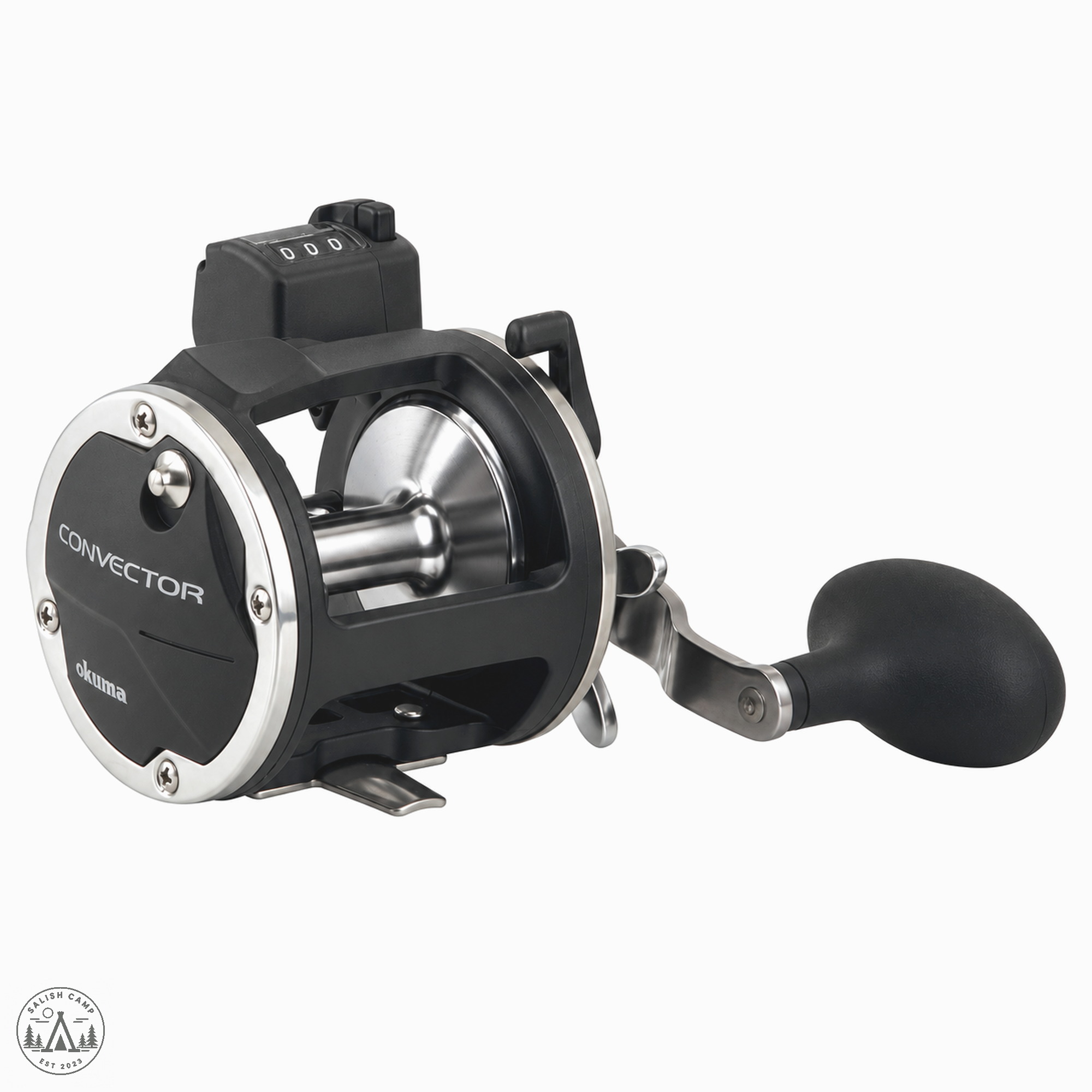
- Mechanical counter in feet: The top-mounted counter tracks line leaving the spool, making it easier to repeat trolling setbacks and mooching presentations without guessing how much line has been deployed.
- 4.0:1 gearing with 61 cm per turn: The moderate retrieve favors deliberate line management rather than high-speed cranking, with a brass main and pinion gear system built around a drop-down gearbox.
- Multi-disc Carbonite drag: A ratcheting star provides tactile adjustments, while the Carbonite drag system is designed to manage steady pressure when a salmon runs.
- Wide Mouth levelwind: Okuma specifies “clearance for copper line,” giving the guide additional room for bulkier trolling line while distributing line across the spool during retrieval.
- Machined aluminum spool: The gunsmoke anodized spool sits inside a corrosion-resistant frame with stainless steel reinforcing sideplate rings, providing a practical combination of materials for marine use.
- Dual anti-reverse arrangement: A roller bearing works alongside mechanical anti-reverse, helping keep the handle from moving backward when pressure comes onto the reel.
- Mechanical Stabilizing System: Okuma says its patented system “stabilizes the spool shaft at 3 key stress points,” supporting alignment in the reel’s gear and spool assembly.
In The Field
A foggy August morning off Point No Point is a good place to appreciate why a line counter belongs on a salmon rod. I might have the downrigger ball running at 85 feet, with the boat moving slowly across a stretch of bait and current. Visibility is short, the electronics are showing fish around a depth band, and I want to put the same presentation back in the water after every check or strike. This is where the Convector’s counter becomes useful. Instead of estimating line behind the boat, I have a number I can repeat.
There is an important distinction for anyone buying a first line counter: the counter measures line leaving the reel, not the actual depth of the lure. With a downrigger, the downrigger controls the ball’s depth. The reel counter helps measure the line deployed behind the boat before clipping into the release. If I get a strike with a particular setback, I can reproduce that arrangement rather than relying on memory.
That same counted-line approach becomes useful on the Possession Bar when I switch to mooching cut-plug herring. I like being able to drop a bait into a productive part of the water column, check its presentation and return to approximately the same amount of line. Current makes the distinction between line out and actual depth even more important. When the line runs at an angle, the bait is shallower than the counter’s reading might suggest. A mechanical counter cannot correct for that angle, but it gives me one consistent reference point while I adjust to the tide.
The levelwind is another feature I would emphasize to someone getting started with salmon fishing. Without one, line management requires more attention to how the spool fills as you retrieve. The Convector’s moving guide distributes line across the spool as the handle turns. That is particularly helpful when repeatedly sending gear down, bringing it back, checking bait and resetting a presentation. It removes one routine job from a busy cockpit.
The 4.0:1 gear ratio means the spool turns four times for each complete handle rotation. Okuma specifies 61 cm of line retrieved per turn. That is a moderate retrieve, which I prefer to understand before buying rather than assuming every line counter will bring gear up quickly. When raising a downrigger rig, I am retrieving fishing line with the reel, not lifting the downrigger weight. It offers controlled winding, though there are faster reels for rapid pickups.
The anti-reverse system is especially useful to understand as a beginner. When the reel is engaged, it prevents the handle from turning backward under line tension. Okuma pairs its Quick-Set roller bearing with a mechanical backup. Anti-reverse is not the drag, though. A salmon still needs to pull line against controlled drag pressure, and that pressure comes from the Carbonite drag system.
I would set that pressure using a scale rather than guessing from how difficult the line feels to pull by hand. I run the fishing line through the rod guides, attach a suitable scale to the terminal end and apply steady pressure at a realistic fishing angle while watching the reading. Small changes to the star let me establish a starting setting appropriate to my leader and tackle. The ratcheting adjustment helps with deliberate changes, but the clicks are not calibrated drag measurements.
There is a specification issue worth knowing before treating the advertised maximum as a target. Okuma’s own spec sheets don’t agree on max drag; the global spec table says 7 kg, so I would set drag with a scale and never lean on the top number for a hot king. On the water, controlled, reasonably smooth pressure matters more to me than a maximum figure printed in a specification sheet. I want a fish to take line without an abrupt change in resistance, particularly when it turns near the boat.
The Wide Mouth levelwind deserves a little explanation as well. Copper trolling line can be bulkier and less forgiving around guides than conventional line. The wider guide opening gives that material more physical room to pass through the levelwind. It doesn’t make copper handling effortless.
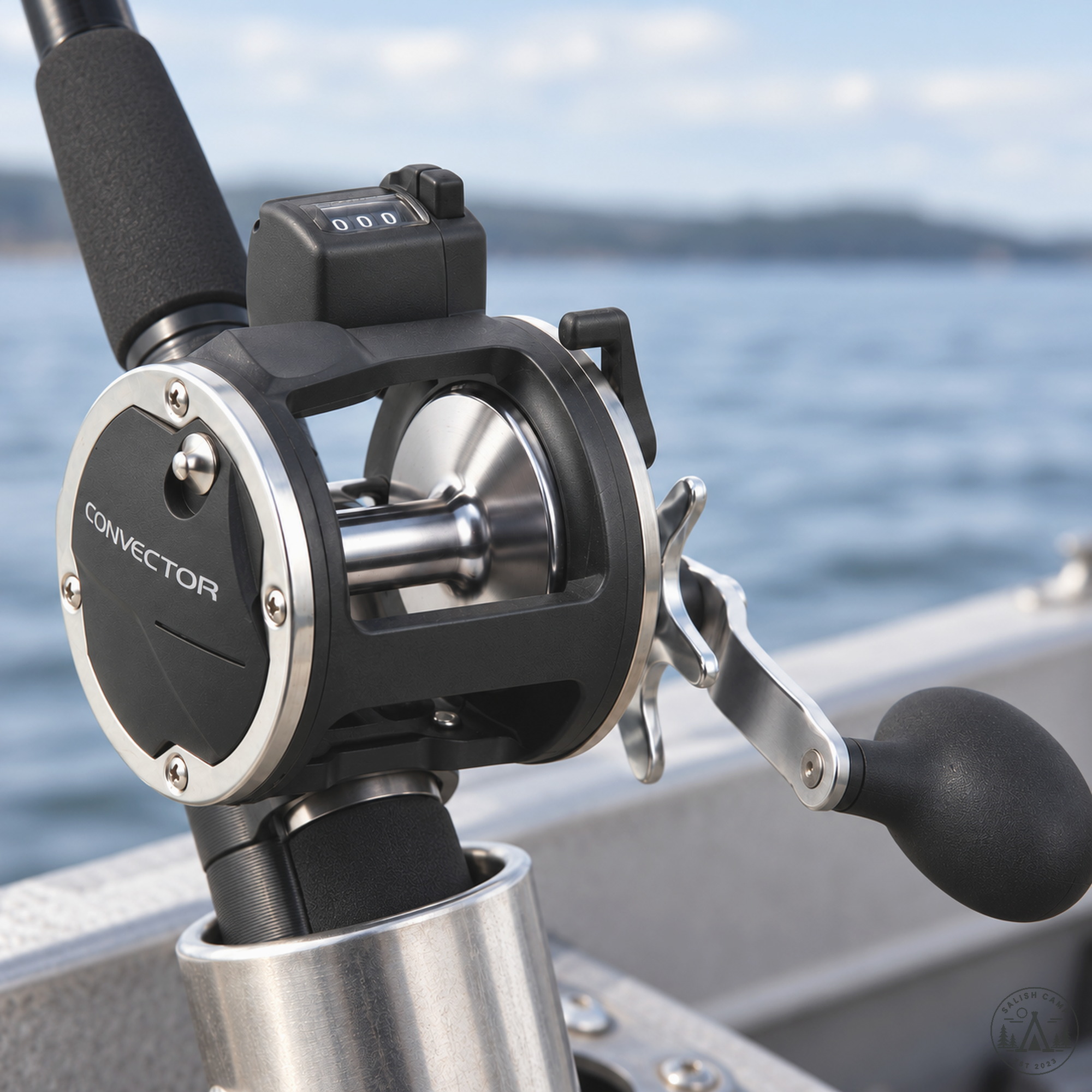
21.5 oz (610 g) is a meaningful amount of reel to mount on a rod. Sitting in a downrigger rod holder, that mass is relatively easy to accept. The reel stays put while the boat fishes, and I only handle it when checking gear, clearing a line or fighting a fish. Holding the rod through a full mooching tide is different. The combined rod-and-reel weight becomes noticeable as I repeatedly lift, lower and work the bait. Balance matters, but this would not be my first choice if minimizing hand fatigue were the main priority.
On a September coho tide off Sekiu, the practical appeal of a conventional levelwind becomes clear. There may be a series of short resets, a moving current seam and a narrow period when the fish are willing to bite. I want the reel to handle those repeated cycles without needing much attention. The brass gearing, supported spool assembly and straightforward counter layout are all relevant to that job.
The tradeoff is that this is still a corrosion-resistant reel, not one I would treat as protected from saltwater intrusion. At the boat ramp, I give the exterior a gentle freshwater rinse rather than blasting water into the sideplates, counter or handle assembly. I wipe it down, allow it to dry, and inspect the levelwind and exposed hardware for salt or debris. Periodic lubrication and servicing should follow the manufacturer’s guidance.
Long-term ownership is the area where I would stay realistic about the value proposition. Owner reports are mixed on drag reliability and long-term durability. That does not mean the reel is automatically unsuitable for regular salmon fishing, but it makes inspection and preventative maintenance worthwhile. Before a trip, I want the drag to start releasing line predictably, the handle to engage properly and the counter to operate without sticking. I would rather identify a problem at home than discover it while a fish is running away from the boat.
Pros
- Practical mechanical line counter: Reads in feet and makes it easier to reproduce trolling setbacks and mooching presentations.
- Solid conventional gearing: Brass main and pinion gears with a moderate retrieve suited to controlled salmon fishing.
- Beginner-friendly line handling: The levelwind, anti-reverse arrangement and ergonomic handle simplify repetitive deployments and retrieves.
- Useful drag adjustment: Multi-disc Carbonite construction with a ratcheting star provides accessible, incremental control.
Cons
- Substantial for active mooching: More comfortable in a rod holder than when repeatedly working a rod by hand through a long tide.
- Moderate retrieve speed: The gearing is practical for controlled fishing but less appealing when fast line recovery is the priority.
- Requires consistent saltwater care: The corrosion-resistant construction still needs careful rinsing, drying and periodic mechanical maintenance.
Technical Specifications
| Specification | Detail |
|---|---|
| Product | Okuma Convector Line Counter CV-30D |
| Config | Right-hand retrieve |
| Type | Levelwind line counter reel |
| Weight | 21.5 oz (610 g) |
| Gear ratio | 4.0:1 |
| Line retrieve | 61 cm per turn |
| Bearings | 2BB + 1RB |
| Max drag | 7 kg (Okuma spec) |
| Mono capacity | 0.40 mm/420 m, 0.45 mm/320 m, 0.50 mm/260 m |
| Line counter | Mechanical, reads in feet |
| Drag | Multi-disc Carbonite, ratcheting star |
| Spool | Machined aluminum, gunsmoke anodized |
| Gears | Brass main and pinion, drop-down gearbox |
| Anti-reverse | Quick-Set roller plus mechanical |
Final Thoughts
The Okuma Convector CV-30D is an appealing reel because it focuses on what I actually need during a typical Puget Sound salmon day: repeatable line deployment, straightforward retrieval and enough mechanical simplicity to keep fishing rather than thinking about the equipment.
When I am running a downrigger, the counter takes the guesswork out of measuring line behind the boat. When I switch to mooching, it gives me a repeatable reference as I follow bait and salmon through changing currents. Neither application requires an especially sophisticated interface. I need a number I can read, line that lays properly on the spool and a drag I can set and check before fishing.
The reel’s compromises are equally clear. It is substantial in the hand, its gearing favors controlled winding over speed, and saltwater maintenance cannot be ignored. I would approach it as a working reel rather than a premium mechanical instrument. Regular inspection, careful drag adjustment and sensible rinsing are part of the ownership equation.
For someone outfitting a dedicated trolling rod or adding a counted-depth setup for occasional mooching, I think the Convector offers the right basic feature set. It is also a reasonable step up from estimating line by eye, particularly when fishing multiple rods or trying to recreate a productive presentation.
I would choose it for measured, repeatable salmon fishing rather than for exceptional lightness or mechanical refinement. In that role, it remains a practical value-oriented option for a Puget Sound boat.